
What Does an IT Consultant Do? Roles and Business Benefits (2026)
Most organisations do not hire an IT consultant because they lack technology. They hire one because they lack a specific answer, and that gap tends to surface at the worst possible moment: mid-migration, days before an audit, or right after a breach nobody saw coming.
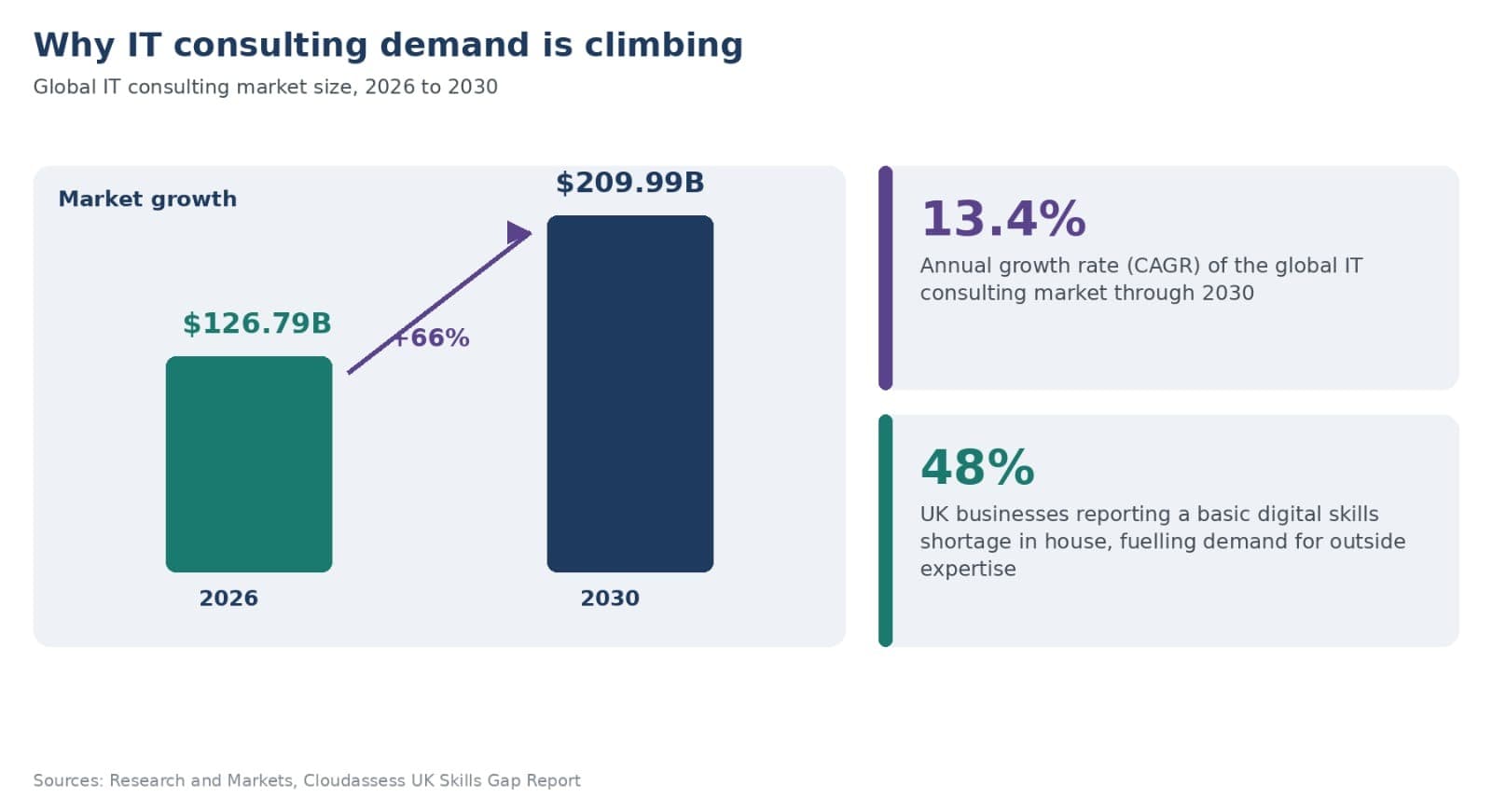
Here is the number that explains why this is happening more often. The global IT consulting market is projected to grow from 126.79 billion US dollars in 2026 to 209.99 billion US dollars by 2030, a jump of roughly two-thirds in under four years, as cloud migration, AI adoption and regulatory pressure outrun what most internal teams can absorb alone.
That is not a market inflating on hype. It is thousands of organisations reaching the same conclusion at once: some problems need an outside expert, not another internal hire. So what does an IT consultant actually do, and when does hiring one make business sense? Here is a clear breakdown.
Key takeaway
An IT consultant is not an extra headcount. They are a specialist brought in to answer a specific question, close a skills gap or provide an independent view before a major decision. Organisations that treat consulting engagements as targeted and time-bound get the most value from them.
What Does an IT Consultant Do
An IT consultant is an independent specialist who advises organisations on how to use technology to meet business goals. Unlike an internal hire, a consultant is not there to run day-to-day operations. They are there to assess a specific problem, recommend a solution and, in many cases, help implement it.
The work varies widely by engagement. One project might involve reviewing an organisation's cyber security posture ahead of an audit. Another might involve designing the architecture for a cloud migration, or advising on which software vendor best fits a specific set of requirements. What stays consistent is the independence: a good consultant has no incentive to recommend anything other than what actually fits the client's situation.
Most engagements are structured around a defined scope, a timeline and a set of deliverables, rather than an open-ended relationship. That structure is what separates consulting from ongoing managed support.
Core Roles and Responsibilities of an IT Consultant
The day-to-day responsibilities of an IT consultant usually fall into a handful of consistent categories, regardless of sector. What changes from engagement to engagement is the depth of each stage, not the sequence: an assessment always comes before a recommendation, and a recommendation always comes before implementation.
Assessment and Technical Audit
Every engagement starts with finding out what is actually true, rather than what the organisation assumes is true. That means auditing infrastructure, network configuration, software licensing, data flows and security controls against a defined benchmark, whether that is a compliance standard, an industry framework or simply the client's own stated goals.
This stage typically produces a gap analysis: a plain list of what is working, what is at risk and what is missing entirely. A consultant who skips straight to recommendations without this step is guessing, however confident the guess sounds.
Strategy, Architecture and Roadmapping
Once the current state is clear, a consultant translates it into a plan. That can mean designing a target architecture for a cloud migration, setting out a phased roadmap for modernising legacy systems, or mapping which technology investments should happen this year versus next. Each option usually comes with its trade-offs made explicit, so leadership is choosing between defined paths rather than a single unexamined recommendation.
A business case typically accompanies the roadmap, translating technical choices into cost, risk and timeline terms that a non-technical board can actually weigh against other priorities.
Cyber Security and Risk Management
Security threads through most engagements rather than sitting apart from them. A consultant reviews access controls, data protection practices and incident response readiness, and flags where a proposed change (a new vendor, a migration, a piece of shadow IT) introduces risk that was not there before.
Where compliance is in scope, this extends to mapping current practice against the relevant standard, such as ISO 27001, Cyber Essentials or a sector-specific regulation, and producing the evidence an auditor will actually ask for.
Vendor and Project Management
Many engagements involve choosing between competing software or service providers. A consultant runs that comparison against the organisation's specific requirements rather than a generic checklist, negotiates on the client's behalf and keeps the resulting project on schedule and within scope once a vendor is selected.
This role can extend to managing the project itself: coordinating internal stakeholders, external suppliers and any specialist contractors involved, so the client has a single point of accountability for the outcome rather than several disconnected workstreams.
Implementation and Technical Delivery
Implementation support is common, though not universal; some engagements end at the recommendation stage. Where it is included, a consultant may configure systems directly, oversee a migration cutover, integrate new software with existing infrastructure, or manage the rollout schedule so that business operations are disrupted as little as possible.
This is also where a consultant's independence is tested most directly: a good one flags problems that surface mid-implementation honestly, rather than quietly working around them to protect the original plan.
Training, Documentation and Knowledge Transfer
Documentation and knowledge transfer close out most engagements. A consultant who leaves without a clear handover, including the reasoning behind key decisions, has not finished the job. That handover usually includes written documentation of the new system or process, training sessions for the internal staff who will own it going forward, and a record of why alternatives were rejected, so the decision does not need to be re-litigated a year later.
Why Demand for IT Consultants Is Growing
The growth in this market is not abstract. A recent UK skills gap analysis found that 48 percent of UK businesses report a basic digital skills shortage, with 68 percent lacking advanced digital skills altogether. That gap does not close on its own, and it rarely closes quickly through hiring alone.
Consultants fill that gap without requiring a permanent headcount increase. For a one-off migration, a compliance deadline or a specialist security review, bringing in outside expertise is often faster and cheaper than building the capability in-house from scratch.
Business Benefits of Hiring an IT Consultant
The clearest benefit is access to expertise an organisation does not need permanently. Few businesses need a full-time cloud architect or compliance specialist on staff, but almost every business needs that expertise occasionally.
A second benefit is objectivity. Internal teams can be too close to a system to see its weaknesses clearly, or too invested in a prior decision to recommend changing it. An outside consultant has no such attachment.
Speed is a third factor. A consultant who has run the same type of project many times before will usually move faster than a team encountering it for the first time, simply through pattern recognition and prior experience.
Cost predictability rounds it out. A well-scoped consulting engagement has a defined price and timeline, which is easier to budget against than the open-ended cost of a delayed internal project or a preventable security incident.
When It Is Time to Bring in an IT Consultant
Not every IT needs calls for a consultant. Routine support, helpdesk work and day-to-day monitoring are usually better handled by an internal team or a managed service provider on an ongoing basis.
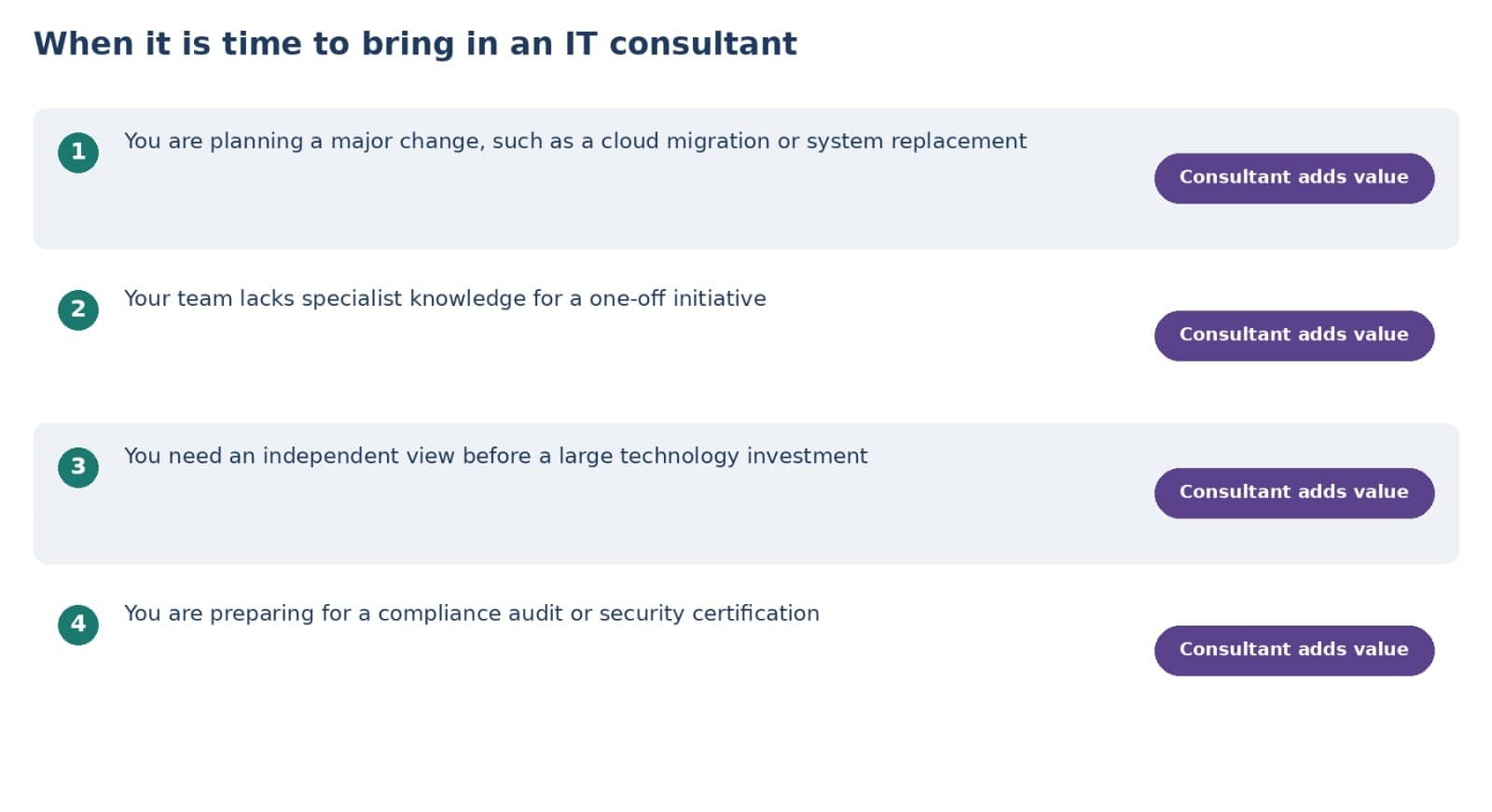
A consultant earns their fee in specific moments: a major technology change, a skills gap on a one-off initiative, a need for an independent view before a large investment, or preparation for a compliance audit. Outside those moments, the cost of a consultant is harder to justify.
Getting the Most from a Consulting Engagement
Define the scope tightly before the engagement starts. Vague briefs produce vague recommendations, and vague recommendations are hard to act on.
Set a clear deliverable and deadline. A consultant should know exactly what they are producing and by when, whether that is an audit report, an architecture diagram or a fully implemented system.
Plan for handover from day one. The value of a consulting engagement outlasts the consultant only if the organisation retains the knowledge, documentation and reasoning behind every recommendation made.
Not Sure Whether You Need a Consultant or an Ongoing Support Partner?
We can help you scope the right engagement, whether that is a focused consulting project or longer-term managed support. Contact DDevices