
Introduction
Digital transformation doesn't begin with technology—it begins with the decisions organisations make before a single solution is purchased.
Strategic IT procurement has evolved far beyond negotiating prices or selecting suppliers. Today, it plays a central role in helping organisations manage risk, optimise technology spending, strengthen supplier relationships, improve governance, and ensure every technology investment contributes to measurable business value.
For CIOs, CTOs, Procurement Directors, and other senior decision-makers, procurement has become a strategic capability that directly influences business resilience, operational performance, and competitive advantage.
The financial impact of delaying technology modernisation is already evident. According to TechUK's 2025 State of Digital Government report, outdated technology costs the UK public sector an estimated £45 billion in lost productivity every year. The report also found that more than one in four government digital systems are outdated, increasing to 70% in some departments, while legacy technology can cost three to four times more to maintain than modern alternatives.
In this guide, we'll explore why Strategic IT Procurement has become a critical component of successful digital transformation, how it differs from traditional purchasing, the principles that underpin an effective procurement strategy, and the practical approaches organisations can adopt to create long-term business value from every technology investment.
What Is Strategic IT Procurement?
Strategic IT procurement is the process of planning, sourcing, acquiring, and managing technology investments in a way that supports an organisation's long-term business objectives. Unlike traditional purchasing, which often focuses on obtaining products at the lowest possible price, strategic IT procurement evaluates the broader business impact of every technology decision.
A strategic approach considers far more than the initial purchase price. Decision-makers assess the Total Cost of Ownership (TCO), supplier capabilities, scalability, integration with existing systems, security requirements, software licensing, ongoing support, sustainability commitments, and the complete technology lifecycle before making an investment.
This enables organisations to minimise risk, maximise return on investment (ROI), and ensure technology remains aligned with future business needs.
| Traditional IT Procurement | Strategic IT Procurement |
|---|---|
| Focuses on purchase price | Focuses on business value |
| Short-term savings | Long-term ROI |
| Transactional supplier relationships | Strategic supplier partnerships |
| Reactive purchasing | Proactive planning |
| Product-focused | Business outcome-focused |
| Limited stakeholder involvement | Cross-functional collaboration |
| One-time purchase | Full technology lifecycle management |
| Measures cost savings | Measures business outcomes, resilience, and innovation |
Why Strategic IT Procurement Is the Foundation of Successful Digital Transformation
As organisations accelerate their digital transformation initiatives, procurement has evolved into a strategic business function that connects technology decisions with commercial outcomes. Rather than measuring success purely through cost savings, modern procurement teams are expected to improve operational resilience, manage supplier risk, support innovation, strengthen governance, and maximise the return on technology investments.
Industry Insight:
"Global organisations have already embraced this mindset. Procter & Gamble (P&G), recognised as one of the world's leading procurement organisations, has long positioned procurement as a strategic capability that creates value beyond purchasing. Instead of focusing solely on negotiating lower prices, P&G's procurement strategy emphasises supplier collaboration, innovation, sustainability, and long-term partnerships. This approach demonstrates how procurement can become a driver of business transformation rather than an administrative function."
Ultimately, digital transformation is not achieved by purchasing the latest technology. It is achieved by making informed, strategic decisions that balance innovation, risk, cost, and long-term business value.
Strategic IT procurement provides the governance, commercial expertise, and supplier relationships that enable organisations to transform with greater confidence while building a resilient technology foundation for future growth.
Why Early Procurement Involvement Leads to Better Technology Decisions
A strategic approach begins much earlier. Procurement should be involved from the initial planning stages of any digital transformation initiative, working alongside executive leadership, IT, finance, cybersecurity, legal, and operational teams to ensure every technology investment aligns with both technical requirements and wider business objectives.
Industry Expert:
This perspective is shared by procurement expert Tom Beaty, who has consistently emphasised that procurement delivers its greatest value when it participates before purchasing decisions are made.
Rather than acting as a transactional function, early procurement involvement enables organisations to assess commercial risks, evaluate supplier capabilities, optimise total cost of ownership (TCO), and negotiate agreements that support long-term strategic outcomes.
Bringing procurement into the decision-making process at an early stage also helps organisations answer critical questions before contracts are signed:
- Does this technology align with our digital transformation strategy?
- Can the solution scale as the organisation grows?
- What is the total cost of ownership over the next three to five years?
- Does the supplier meet our cybersecurity, compliance, and governance requirements?
- Will the technology integrate with existing systems and future platforms?
- Are the proposed service levels, warranties, and support agreements sufficient for business-critical operations?
- What commercial, operational, or supplier risks could affect long-term success?
The DDevices Strategic IT Procurement Framework
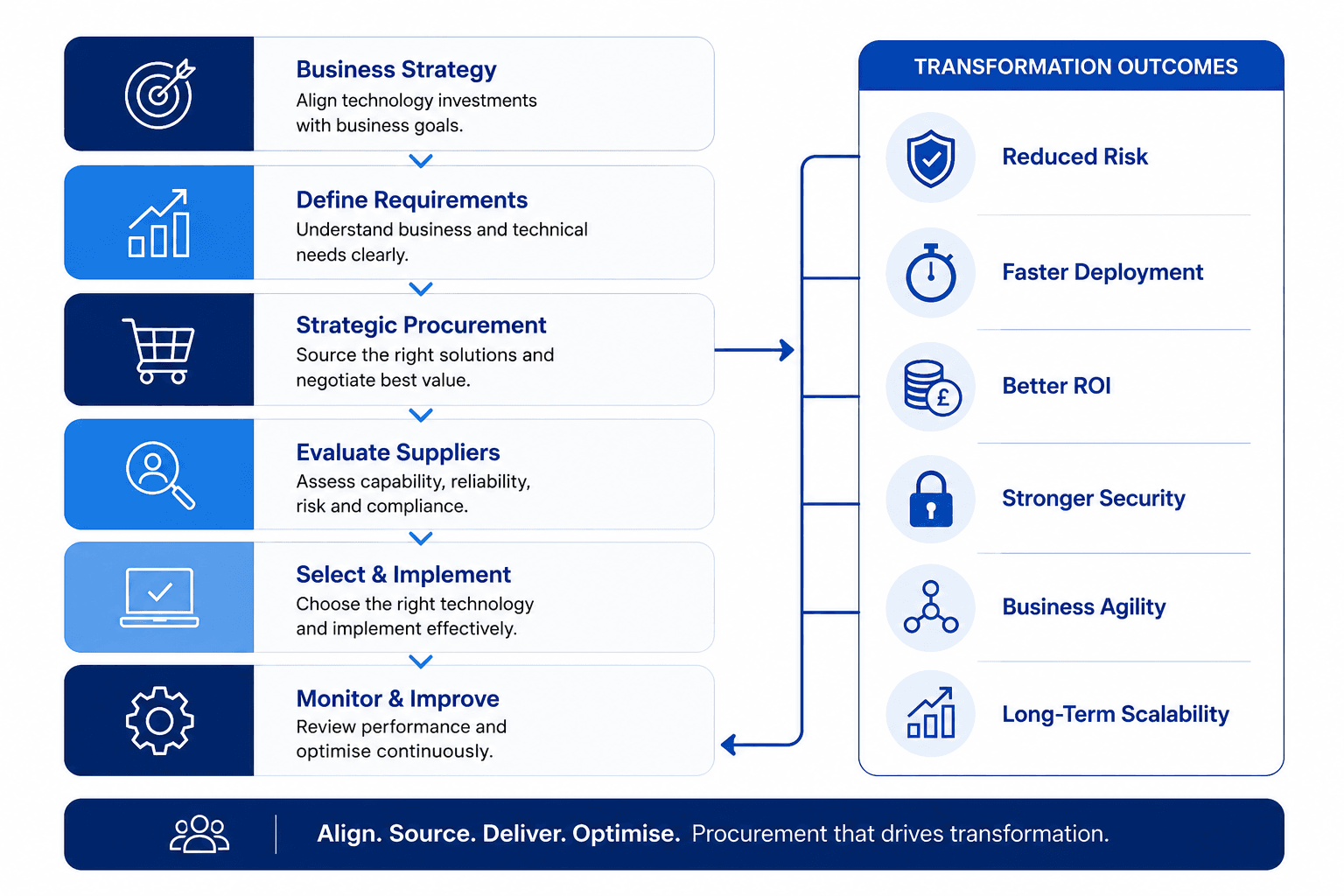
Successful digital transformation requires more than selecting the latest technology. It demands a structured procurement strategy that aligns business priorities, technology investments, supplier capabilities, and governance throughout the entire lifecycle.
Based on enterprise procurement best practices, we've developed the DDevices Strategic IT Procurement Framework to help organisations make informed technology decisions while reducing commercial risk and maximising long-term business value.
1. Align Procurement with Business Strategy
Every procurement initiative should begin with a clear understanding of the organisation's strategic objectives. Whether the goal is improving operational efficiency, enabling hybrid working, strengthening cybersecurity, or accelerating cloud adoption, technology investments should directly support measurable business outcomes.
2. Define Business and Technical Requirements
Successful procurement starts with understanding what the business actually needs—not simply purchasing the latest technology. Organisations should define functional requirements, technical specifications, security expectations, compliance obligations, scalability requirements, and future growth plans before approaching suppliers.
3. Evaluate Suppliers Beyond Price
Selecting the lowest-cost supplier rarely delivers the best long-term value. Supplier evaluations should consider:
- Technical expertise
- Financial stability
- Security certifications
- UK support capability
- Product roadmap
- Service Level Agreements (SLAs)
- Warranty and lifecycle services
- Industry experience and customer references
A strategic supplier should become a long-term technology partner rather than simply a vendor.
4. Consider Total Cost of Ownership (TCO)
Technology costs extend far beyond the initial purchase price. Organisations should evaluate:
- Software licensing
- Cloud consumption costs
- Deployment services
- Training
- Maintenance
- Technical support
- Hardware refresh cycles
- Energy consumption
- End-of-life disposal
Considering the full lifecycle cost helps organisations make commercially sustainable investment decisions while avoiding hidden expenses.
5. Implement Strong Governance and Risk Management
Every procurement decision should include a structured assessment of cybersecurity risks, supplier dependencies, regulatory compliance, contractual obligations, and business continuity requirements. Establishing governance from the outset reduces project risk and creates greater confidence in technology investments.
6. Measure, Optimise, and Continuously Improve
Strategic IT procurement doesn't end when contracts are signed. Organisations should continuously measure supplier performance, technology utilisation, procurement KPIs, contract renewals, software licence optimisation, and business outcomes.
Regular reviews enable organisations to adapt procurement strategies as technology, business priorities, and market conditions evolve.
💡 DDevices Procurement Insight
Digital transformation is not a one-time project—it is an ongoing business strategy. Procurement plays a central role in ensuring technology investments continue supporting organisational growth, resilience, and innovation long after the initial purchase has been made.
Frequently Asked Questions (FAQs)
Traditional IT procurement typically focuses on purchasing technology at the lowest possible cost to meet an immediate business need. Strategic IT procurement takes a broader approach by aligning technology investments with business strategy, evaluating long-term commercial value, managing supplier relationships, reducing procurement risk, and supporting digital transformation initiatives.
Digital transformation requires organisations to invest in technologies that support long-term business growth. Strategic IT procurement helps organisations select the right technology partners, manage commercial and operational risks, optimise technology spending, and ensure every investment contributes to measurable business outcomes rather than short-term objectives.
Some of the most common challenges include managing rising software costs, evaluating multiple suppliers, ensuring cybersecurity and regulatory compliance, controlling software licensing, mitigating supply chain disruptions, reducing procurement risk, and aligning technology purchases with wider business goals.
Total Cost of Ownership (TCO) measures the complete cost of a technology investment throughout its lifecycle. It includes acquisition costs, software licences, implementation, maintenance, technical support, cloud consumption, upgrades, training, energy usage, and end-of-life disposal. Evaluating TCO helps organisations make better long-term investment decisions.
An experienced procurement partner should offer independent technology advice, strong supplier relationships, commercial negotiation expertise, software licensing knowledge, cybersecurity awareness, lifecycle management capabilities, and experience supporting enterprise digital transformation projects. They should also understand your industry's regulatory and operational requirements.
DDevices supports organisations across the UK with strategic IT procurement by helping businesses source enterprise hardware, software, cloud solutions, cybersecurity technologies, networking infrastructure, and managed services from leading global vendors. Our procurement specialists work closely with organisations to reduce commercial risk, optimise technology investments, strengthen supplier relationships, and maximise the long-term value of every IT investment.