
What Is IT Procurement? A Complete Guide for Modern Businesses
For many organisations, technology investments are among the largest and most strategic business decisions they make. Yet poor procurement practices can lead to budget overruns, security vulnerabilities, implementation delays, and solutions that fail to deliver long-term value.
In today's business environment, IT procurement is no longer simply about purchasing hardware or software at the lowest price. It is about making informed technology investments that support business growth, operational resilience, and competitive advantage.
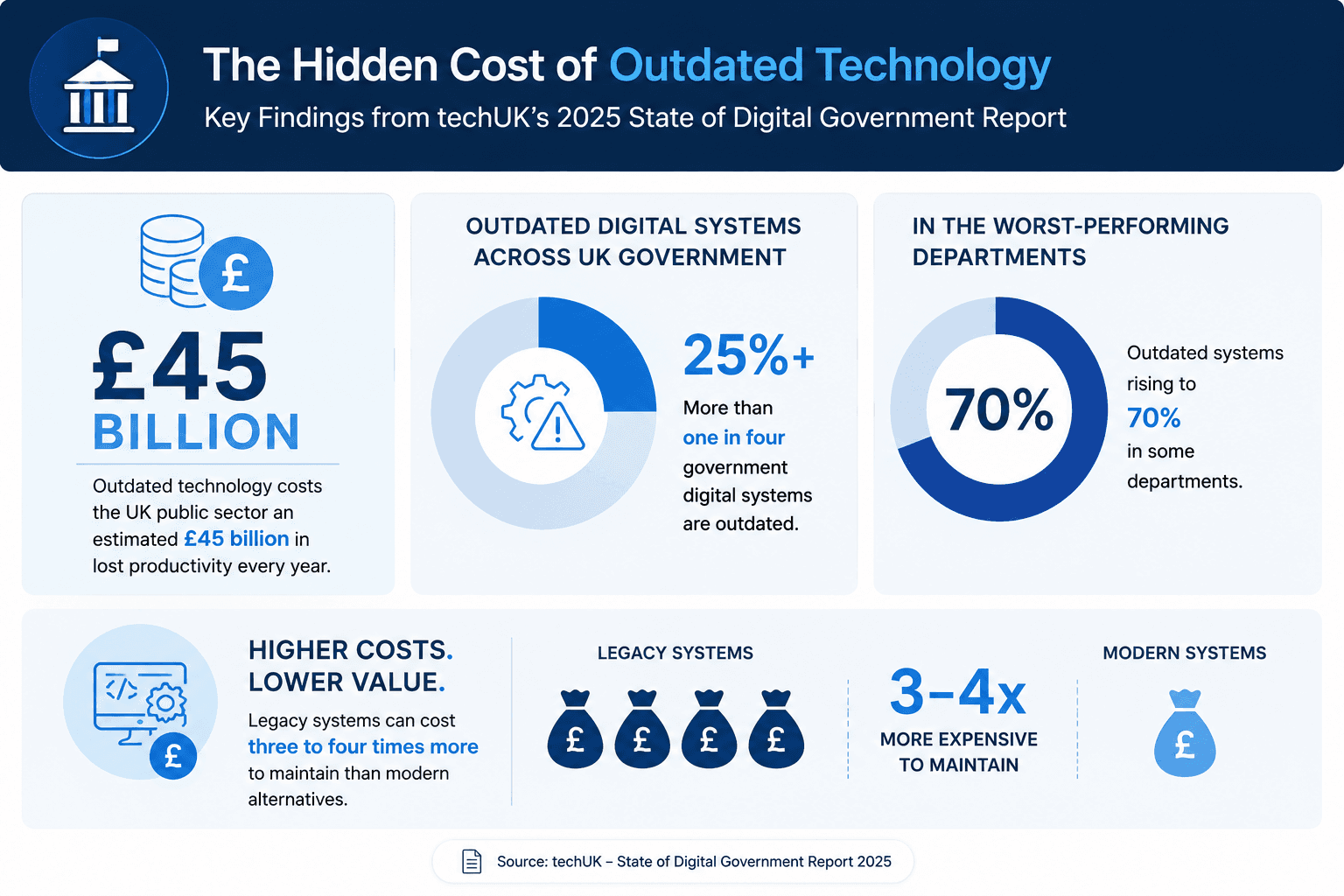
Recent research highlights just how significant these decisions have become. According to TechUK's 2025 State of Digital Government report, outdated technology costs the UK public sector an estimated £45 billion in lost productivity every year.
The report also found that more than one in four government digital systems are outdated, rising to 70% in some departments, while legacy systems can cost three to four times more to maintain than modern alternatives.
This guide explains what IT procurement is, why it has become a strategic business function, how the procurement process works, and the best practices organisations can adopt to maximise the value of every technology investment.
What Is IT Procurement?
IT procurement is the strategic process of identifying, evaluating, purchasing, deploying, and managing technology products and services that support an organisation's operational and business objectives.
A successful procurement strategy ensures organisations acquire technology that not only meets today's operational needs but also remains scalable, secure, and cost-effective as business requirements evolve.
Modern IT procurement typically covers:
- Enterprise laptops, desktops, and mobile devices
- Servers, storage, and networking infrastructure
- Cloud platforms and subscription services
- Enterprise software and SaaS applications
- Cybersecurity solutions
- Managed IT Services
- Professional and consulting services
- Software licensing and renewals
- Warranties and support agreements
- Device lifecycle management
Rather than viewing procurement as an administrative purchasing activity, leading organisations now recognise it as a strategic discipline that directly contributes to business performance and long-term resilience.
Why IT Procurement Matters More Than Ever
Today's procurement teams are expected to evaluate far more than purchase price. They must assess long-term operational costs, supplier reliability, cybersecurity risks, licensing models, regulatory compliance, environmental sustainability, and future scalability before making investment decisions.
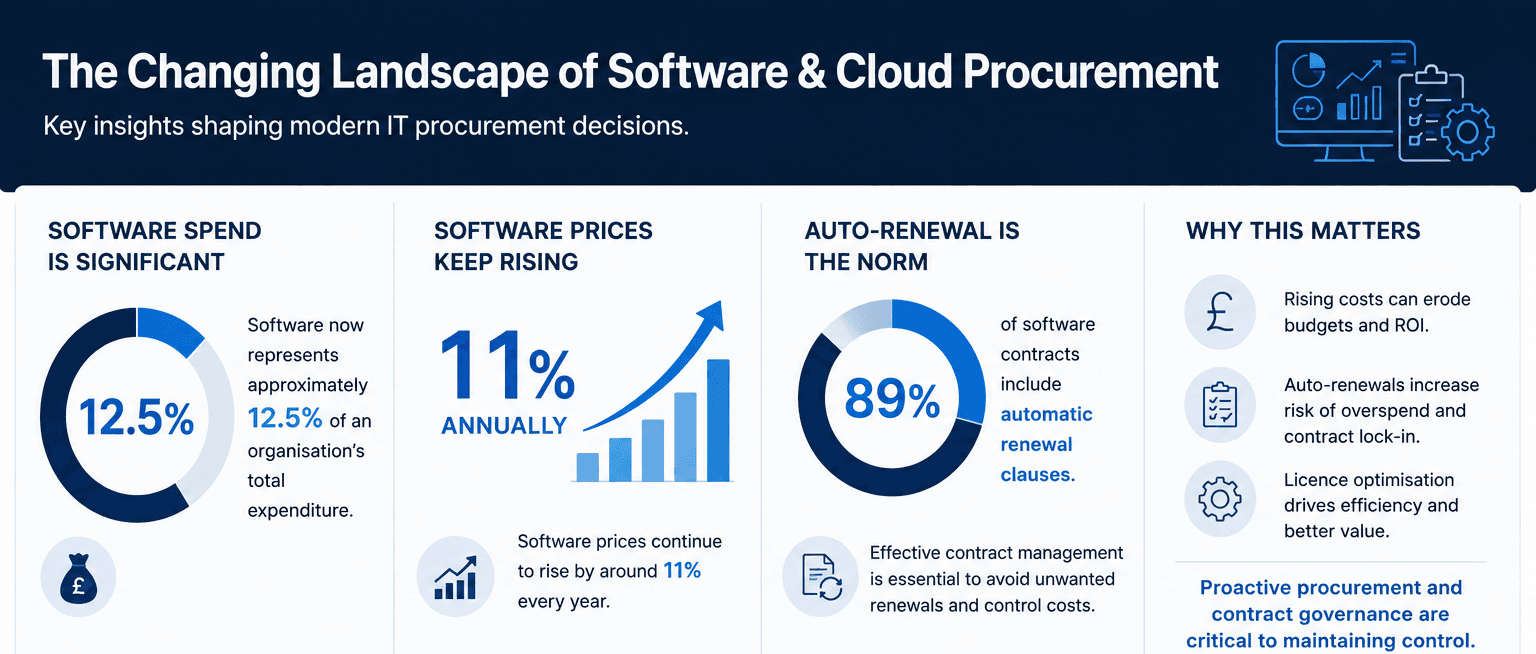
Software procurement alone has become increasingly complex. Research from Vertice estimates that software now represents approximately 12.5% of an organisation's total expenditure, while software prices continue to rise by around 11% annually.
At the same time, 89% of software contracts include automatic renewal clauses, making contract management and licence optimisation essential to controlling technology costs.The rapid adoption of cloud computing has also transformed procurement priorities.
Organisations are no longer purchasing one-off software licences; instead, they are managing recurring subscriptions, consumption-based pricing, hybrid cloud environments, and multiple software vendors. Without effective procurement governance, costs can quickly escalate while duplicate applications, unused licences, and unnecessary renewals reduce return on investment.
What Does IT Procurement Include?
An effective IT procurement strategy covers the entire technology lifecycle, from identifying business requirements through to ongoing management and eventual replacement.
Hardware Procurement
This includes purchasing business-critical infrastructure such as laptops, desktops, servers, storage systems, monitors, networking equipment, printers, and mobile devices. Procurement teams must consider performance, compatibility, warranty options, energy efficiency, and lifecycle costs rather than focusing solely on purchase price.
Software Procurement
Software procurement involves evaluating and acquiring operating systems, productivity suites, collaboration platforms, business applications, cybersecurity software, and enterprise resource planning (ERP) systems. Procurement professionals must also manage licensing terms, renewal dates, user adoption, and vendor negotiations to avoid unnecessary expenditure.
Cloud Services
As organisations continue moving workloads to the cloud, procurement increasingly includes Infrastructure as a Service (IaaS), Platform as a Service (PaaS), Software as a Service (SaaS), cloud storage, backup solutions, and cloud security services. Evaluating scalability, consumption models, and ongoing operational costs is essential for maximising cloud investments.
Managed IT Services
Many organisations partner with external providers for services such as IT support, managed cloud, managed networking, cybersecurity, monitoring, and help desk operations. Procurement teams evaluate service level agreements (SLAs), technical expertise, commercial terms, and long-term partnership value.
Professional Services
Technology consulting, implementation services, project management, migrations, training, and change management all form part of modern procurement activities, ensuring organisations gain maximum value from technology investments.
Lifecycle and Asset Management
Procurement does not end once technology is delivered. Organisations must also manage deployment, software updates, warranties, maintenance, device refresh programmes, secure disposal, and asset recovery throughout the technology lifecycle.
Common IT Procurement Challenges
Although every organisation has unique procurement priorities, several challenges consistently affect businesses across industries. Understanding these issues helps procurement teams make better decisions while reducing unnecessary costs and operational risks.
Managing Rising Technology Costs
Technology budgets continue to face pressure from inflation, subscription-based licensing, cloud consumption models, and increasing software prices. Procurement teams must balance innovation with financial responsibility while ensuring investments continue delivering measurable business value.
Selecting the Right Technology
The technology marketplace has never been more competitive. Organisations often evaluate multiple vendors offering similar capabilities, making it increasingly difficult to determine which solution provides the best long-term value.
Poor technology selection can result in costly migrations, compatibility issues, limited scalability, and low user adoption.
Managing Supplier Risk
Supplier reliability has become a strategic consideration. Procurement professionals must assess financial stability, cybersecurity maturity, delivery capability, support quality, sustainability commitments, and contractual flexibility before selecting a technology partner.
Controlling Software Licensing
Subscription licensing has introduced ongoing procurement responsibilities. Automatic renewals, changing licence requirements, and underutilised software can significantly increase operational costs if contracts are not actively managed.
According to Vertice, 89% of software contracts include automatic renewal clauses, highlighting why contract governance and licence optimisation are now essential procurement activities.
Strengthening Cybersecurity
Every technology purchase introduces potential security risks. Procurement teams must ensure suppliers meet organisational security standards while complying with regulations such as GDPR, Cyber Essentials, and ISO 27001.
Improving Stakeholder Alignment
Successful procurement requires collaboration between IT, procurement, finance, security, legal, and business leaders. Early stakeholder engagement helps reduce delays, improve solution selection, and ensure technology investments align with wider organisational objectives.
The IT Procurement Process
Although procurement processes vary between organisations, most successful businesses follow a structured approach that reduces risk and improves investment outcomes.
1. Identify Business Requirements
Every procurement initiative begins by understanding the business problem. Stakeholders define technical requirements, business objectives, security considerations, user needs, and expected outcomes before evaluating potential solutions.
2. Develop Technical and Commercial Specifications
Procurement and IT teams create detailed specifications covering functionality, compatibility, performance, compliance requirements, budget expectations, and implementation timelines. Clear specifications reduce ambiguity and improve supplier comparisons.
3. Research the Market
Procurement professionals assess available technologies, compare suppliers, review product capabilities, analyse independent research, and identify solutions that best align with organisational objectives.
4. Evaluate Suppliers
Potential suppliers are assessed against criteria such as technical capability, financial stability, cybersecurity credentials, service quality, implementation experience, sustainability commitments, and long-term support capabilities. Commercial value should always be balanced with operational risk.
5. Request Proposals and Negotiate Contracts
Shortlisted suppliers submit proposals outlining pricing, delivery schedules, licensing terms, warranties, support models, and service commitments. Procurement teams negotiate favourable commercial terms while ensuring contractual flexibility and clear performance expectations.
6. Procurement Approval and Purchase
Following stakeholder approval, purchase orders are issued, contracts are finalised, and implementation planning begins.
7. Deployment and Ongoing Vendor Management
The procurement lifecycle continues after delivery. Organisations monitor supplier performance, manage software renewals, track assets, review service levels, and assess whether technology investments continue to deliver the expected business value.
Benefits of Strategic IT Procurement
Organisations that treat IT procurement as a strategic business function rather than a purchasing activity are better positioned to reduce operational costs, minimise risk, and maximise the return on technology investments. Every procurement decision should contribute towards long-term business objectives rather than simply addressing an immediate requirement.
Some of the key benefits include:
Better Cost Control
Strategic procurement considers the Total Cost of Ownership (TCO) rather than the initial purchase price alone. This includes implementation, maintenance, software licensing, training, support, upgrades, energy consumption, and end-of-life disposal.
For example, research from Vertice estimates that software represents approximately 12.5% of an organisation's total expenditure, while software prices continue to increase by around 11% annually. Procurement teams that actively negotiate contracts, optimise licensing, and regularly review software usage are better positioned to control these growing costs.
Reduced Business Risk
Technology procurement directly influences cybersecurity, compliance, supplier resilience, and operational continuity. Selecting suppliers with strong security standards, financial stability, and proven support capabilities significantly reduces business risk.
Improved Supplier Relationships
Long-term supplier partnerships often provide greater commercial flexibility, faster support, preferential pricing, improved service levels, and access to new technologies before they reach the wider market.
Greater Technology Standardisation
Standardising hardware, software, and cloud platforms simplifies IT management, improves compatibility, reduces support complexity, and enhances user productivity across the organisation.
Increased Business Agility
A well-defined procurement strategy enables organisations to respond more quickly to changing business priorities, whether expanding into new markets, supporting hybrid workforces, adopting AI technologies, or scaling cloud infrastructure.
Conclusion
IT procurement has evolved into one of the most important strategic functions within modern organisations. Every technology investment influences operational performance, cybersecurity, financial efficiency, and long-term business growth.
As technology ecosystems become increasingly complex, successful organisations are moving beyond transactional purchasing towards strategic procurement that balances commercial value, technical capability, supplier resilience, and future scalability.
By adopting structured procurement processes, evaluating technology based on long-term business outcomes, and building trusted supplier partnerships, organisations can reduce risk, optimise technology spending, and create a resilient foundation for future innovation.
Why Choose DDevices for Professional IT Procurement Services?
At DDevices UK, we work closely with organisations across the UK to simplify complex technology procurement. Our team helps businesses source enterprise IT hardware, software, cloud solutions, cybersecurity technologies, and managed services from leading global vendors.
Professional IT Procurement Services help organisations:
- Identify the most suitable technology solutions for their operational requirements.
- Access competitive commercial pricing through established supplier networks.
- Evaluate vendors objectively based on technical capability, commercial value, and long-term support.
- Strengthen cybersecurity and regulatory compliance throughout the procurement process.
- Optimise software licensing, renewals, and contract management.
- Reduce procurement cycle times and improve purchasing efficiency.
- Manage the complete technology lifecycle, from procurement and deployment to refresh and secure disposal.
- Build strategic supplier relationships that support future growth and innovation.