
Proactive vs Reactive IT Support: UK Cost & ROI Guide 2026
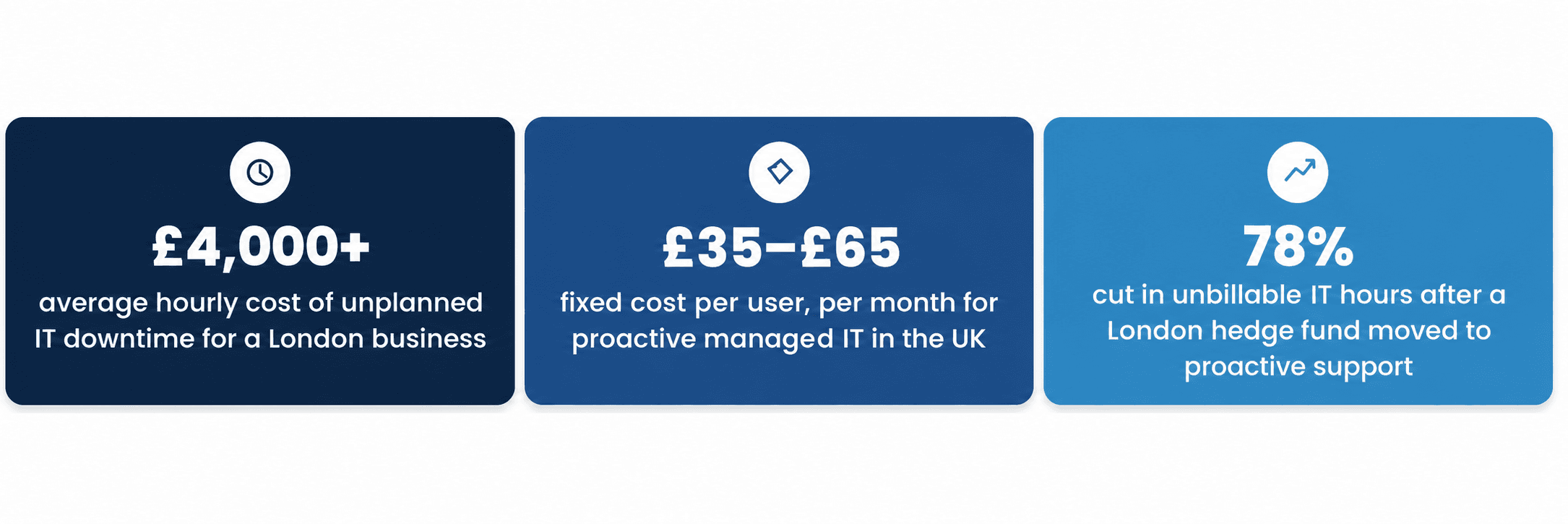
Quick answer: Reactive IT support fixes problems after they happen and is billed hourly, typically £90 to £150 per hour in London, plus the cost of the downtime itself. Proactive IT monitoring catches and resolves issues before they cause damage, for a fixed £35 to £65 per user, per month. Most UK firms actually run a hybrid of the two: heavily automated proactive monitoring, backed by fast reactive support for the hardware faults and user errors that automation cannot prevent.
What is proactive IT monitoring?
Proactive IT monitoring is the continuous observation of a business's systems, networks and devices, built to catch early warning signs, such as rising server load, a failing drive, or unusual sign-in activity, and act on them before they cause an outage or a breach.
Modern proactive IT has moved well past the disk defrags and scheduled antivirus scans of a decade ago. Today it typically includes AIOps anomaly detection, endpoint detection and response (EDR/XDR), automated patch management with rollback, and conditional access governance through platforms such as Microsoft Entra ID.
This is the opposite of reactive IT support, sometimes called break-fix support, where a provider only steps in once something has already gone wrong and someone has noticed and reported it.
Proactive vs reactive IT support: The honest picture
Most comparisons present this as a straight choice: proactive good, reactive bad. In practice, that is not how UK businesses actually run their IT. Tier 1 reactive support will always exist, hardware fails, laptops get lost, people forget passwords, and no amount of monitoring prevents that.
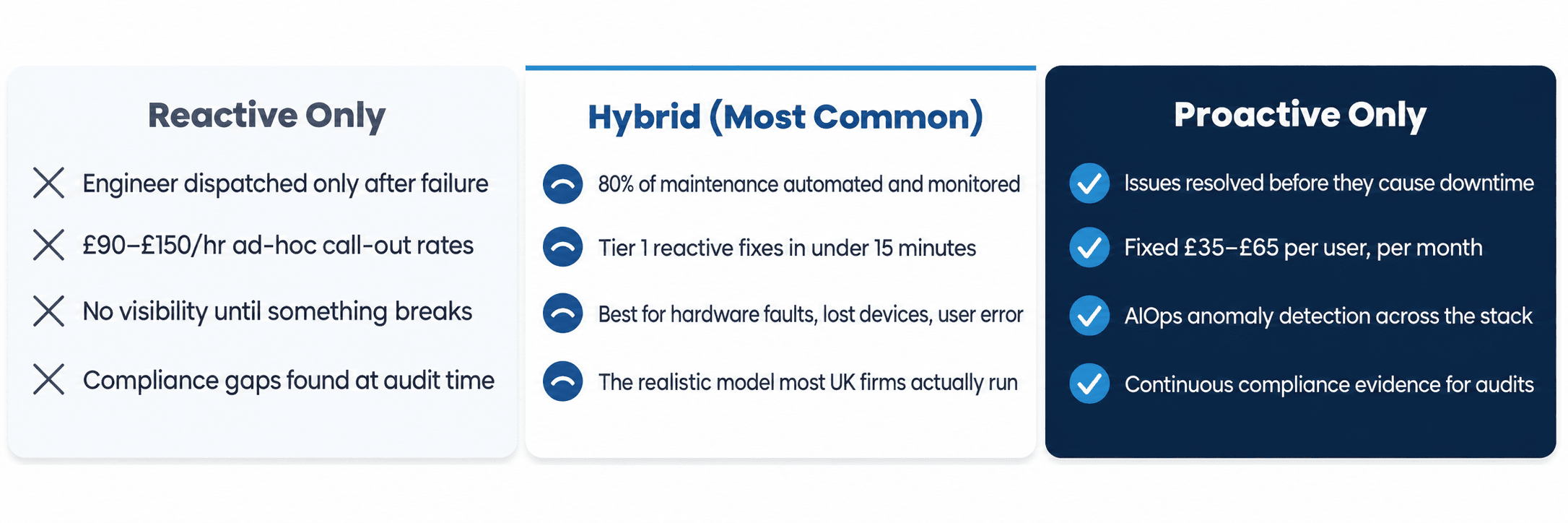
The real value of proactive monitoring is that it automates roughly 80% of routine maintenance and threat detection, which frees engineers to deliver genuinely fast reactive support, often under 15 minutes, for the issues that do still need a human. A hybrid model, heavily proactive with fast-reactive backup, is what most well-run UK businesses actually use.
Comparison matrix: 8 Vectors that actually matter
Rather than a generic pros and cons list, this is how the two models compare across the factors that affect cost, risk and day-to-day operations for a UK business.
| Vector | Reactive (Break-Fix) | Proactive Managed IT |
|---|---|---|
| Billing model | Hourly, ad-hoc: £90–£150/hr | Fixed: £35–£65 per user/month |
| Cyber security | Reviewed after an incident is reported | 24/7 monitoring, EDR/XDR, AIOps detection |
| SLA guarantees | Best-effort, traffic and availability dependent | Guaranteed response and resolution times |
| Compliance | Gaps surface only at audit time | Continuous evidence for Cyber Essentials, GDPR, FCA |
| Employee productivity | Staff wait on a fix mid-incident | Most issues resolved before staff notice |
| Downtime risk | High and unpredictable | Minimised through early detection |
| Scalability | Re-negotiated as headcount grows | Scales with per-user pricing |
| On-site London support | Subject to commute and traffic delays | Hybrid dispatch SLA, remote-first triage |
The real cost: Total cost of ownership for a London business
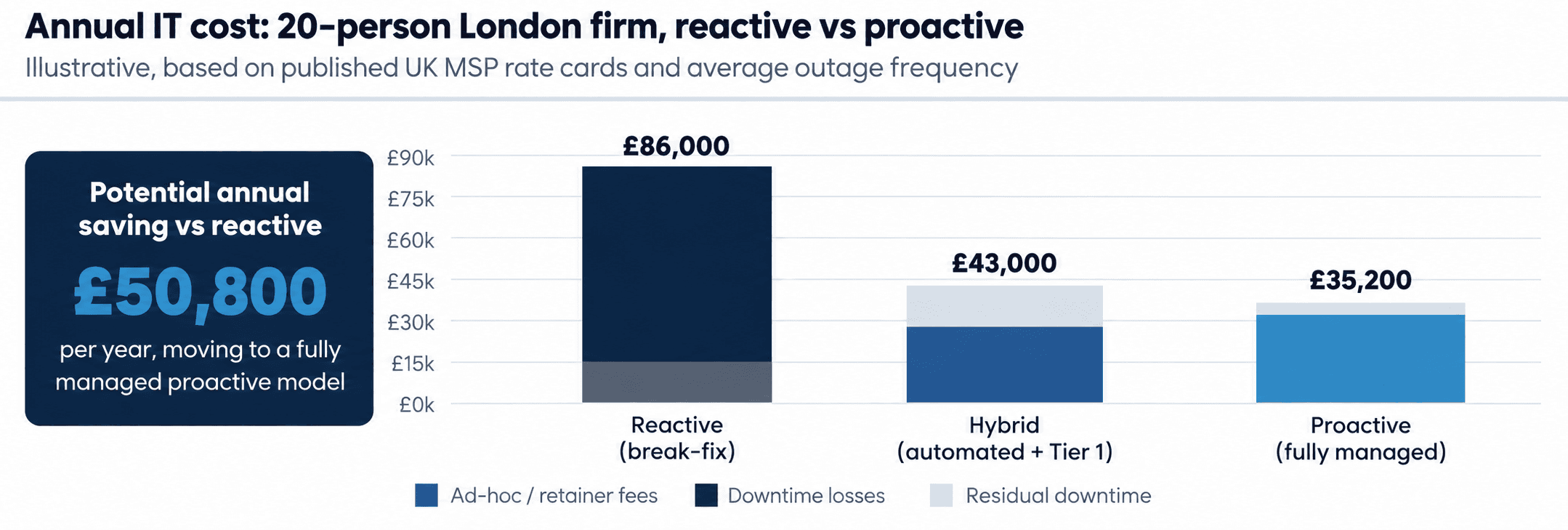
Hourly reactive rates in London typically run from £90 to £150 per hour for an ad-hoc engineer visit, and that figure does not include the cost of the downtime itself. For a business that depends on its systems to trade, bill, or serve clients, unplanned downtime in London is estimated to cost in excess of £4,000 per hour.
Proactive managed IT, by contrast, is typically priced at a fixed £35 to £65 per user, per month, with the cost known in advance regardless of how many issues are prevented behind the scenes.
The chart below models this for a representative 20-person London professional services firm across a full year, including a hybrid model as the realistic middle ground.
London-specific realities most guides ignore
Commute and on-site SLA delays
A reactive, hourly retainer rarely accounts for London's geography. An engineer dispatched from Shoreditch to a client in Mayfair or Canary Wharf during peak hours can lose an hour or more simply in transit, time billed at the hourly rate while the client's systems remain down. Proactive providers structure this differently, with hybrid dispatch SLAs that combine remote-first triage with guaranteed on-site response windows, rather than a best-effort attendance time dependent on traffic.
Sector-specific compliance
London's economy is dominated by financial services, legal firms and creative agencies, each with its own regulatory exposure. Financial firms answer to the FCA's operational resilience rules, law firms to SRA requirements around client data, and most UK businesses now need evidence of Cyber Essentials Plus or ISO 27001 certification to win enterprise contracts or renew cyber insurance. Proactive monitoring generates the continuous audit trail these frameworks require as a by-product of normal operation; reactive support generates it only when someone remembers to document an incident after the fact.
London case study: a Mayfair hedge fund
A 45-person boutique hedge fund in Mayfair was running a reactive, retainer-based IT arrangement. Engineers were billed hourly and dispatched only once a fault had already affected trading desks or compliance systems. After moving to a fully managed, proactive model with 24/7 monitoring and automated patching, the firm cut unbillable IT hours by 78% within the first year, while also closing the compliance documentation gaps that had previously been flagged in an FCA operational resilience review.
Making the move from reactive to proactive
Switching does not require replacing everything at once. Most London businesses make the shift by:
- Deploying centralised, AIOps-driven monitoring across servers, network, cloud platforms and endpoints
- Moving patch management onto a fixed, automated schedule with rollback built in
- Implementing EDR/XDR and conditional access governance rather than legacy antivirus alone
- Verifying backups on a tested recovery schedule, not just confirming they ran
- Keeping a fast-response reactive tier for hardware faults, lost devices and user error
- Mapping monitoring and patch evidence directly to Cyber Essentials, GDPR and FCA requirements
Most businesses complete the transition within a few weeks, with no sudden cut-over and no extended downtime.
Why UK and London businesses choose DDevices
At DDevices, proactive monitoring is built into how we support clients, not offered as a separate add-on. Our team runs AIOps-driven monitoring across servers, networks, cloud platforms and endpoints, with real engineers reviewing genuine alerts and a hybrid dispatch model built for London's geography, rather than a best-effort attendance time.
Our managed IT support includes:
- 24/7 AIOps monitoring with anomaly detection across your full stack
- EDR/XDR threat response and automated patch management with rollback
- Entra ID conditional access governance for hybrid and remote teams
- Fixed, per-user monthly pricing with no surprise call-out fees
- Continuous compliance evidence for Cyber Essentials, GDPR and FCA resilience requirements
- Hybrid dispatch SLAs built around London's commute realities, not against them
Still paying London call-out rates to fix things after they break?
Talk to a DDevices specialist about moving to fixed-cost, proactive IT support across London.
Frequently asked questions
Reactive IT support fixes problems after they have already caused an issue, typically billed by the hour. Proactive IT monitoring continuously watches for early warning signs and resolves them before they escalate, for a fixed monthly fee, reducing both downtime and unplanned costs.
Not in total cost of ownership. Break-fix looks cheaper per hour, but London call-out rates of £90 to £150 per hour, combined with downtime costing over £4,000 an hour, typically make reactive support far more expensive annually than a fixed £35 to £65 per user, per month proactive contract.
No. Hardware failures, lost devices and forgotten credentials still need a human response. What changes is speed: with 80% of routine maintenance automated, engineers have the bandwidth to resolve genuine Tier 1 issues in under 15 minutes rather than queuing behind other reactive work.
AIOps applies machine learning to operational data to detect anomalies, such as a failing SSD or unusual login pattern, before they cause an outage or breach. It is a core part of modern proactive monitoring and goes well beyond older approaches like scheduled antivirus scans.
Continuous monitoring and automated patching generate an ongoing evidence trail that maps directly to frameworks such as Cyber Essentials Plus, ISO 27001 and FCA operational resilience requirements, so compliance documentation exists as a by-product of normal operations rather than being assembled after the fact.