
Proactive IT Support: Reduce Downtime & Improve Productivity
Technology should help a business move forward, not slow it down. Yet when systems fail, applications become unavailable or employees cannot access the tools they need, even a small IT issue can quickly become a business disruption.
For IT leaders, the challenge is therefore not only how quickly an issue can be fixed, but whether it can be identified and addressed before it affects the business.
This is where proactive IT support takes a different approach. Instead of waiting for users to report problems, proactive support continuously monitors systems, identifies potential risks and addresses issues before they become larger incidents.
For industry leaders, the result can be fewer disruptions, more productive employees, stronger IT resilience and better control over technology operations.
Downtime is not only an IT problem. It is a productivity, revenue and customer experience problem.
Why Is Proactive IT Support Becoming More Important?
Modern IT environments are becoming increasingly complex. Businesses may depend on cloud applications, networks, endpoints, cybersecurity tools, business applications and connected devices at the same time.
A problem with one part of this environment can affect several business functions.
Cybersecurity is another growing concern. The UK Government's Cyber Security Breaches Survey 2025/2026 found that 43% of UK businesses had experienced a cyber breach or attack during the previous 12 months. The figure was significantly higher among large businesses, at 69%.
This makes continuous monitoring and early detection increasingly important. IT teams need visibility into what is happening across their environments rather than relying entirely on employees to report problems after they occur.
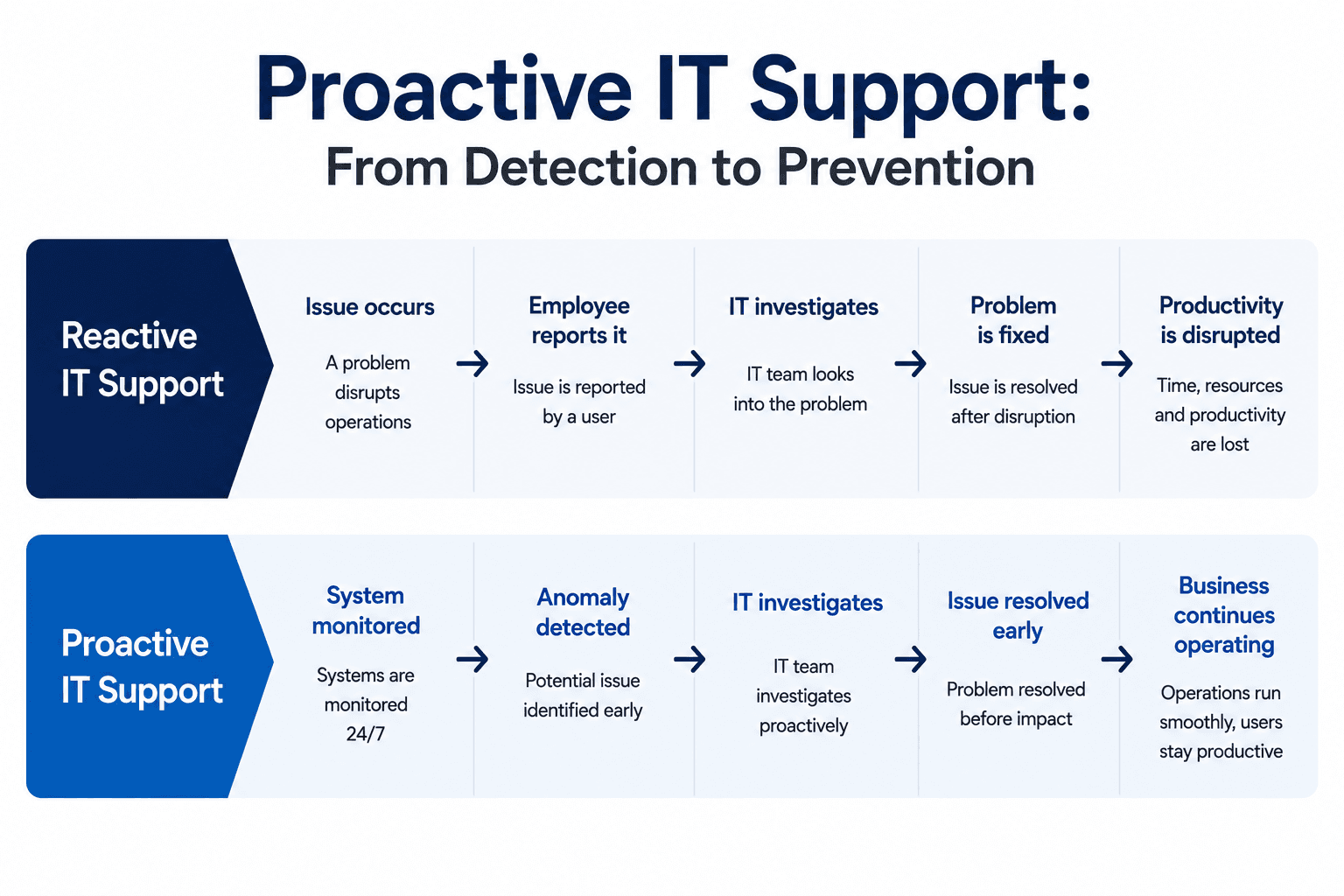
Key message:
The goal is not simply to fix IT problems faster. It is to prevent those problems from becoming business disruptions.
What Are IT Leaders Prioritising?
Proactive IT support also aligns with the priorities currently influencing IT leadership decisions.
According to BCS's Tech Priorities, Skills and the AI Outlook for 2025, cybersecurity was the top technology priority among IT leaders, at 33%, followed by AI at 24%. Business process automation and the as-a-service model each accounted for 11%.
The same research found that only 5% of IT leaders and professionals believed their organisations had enough resources to achieve their technology priorities, while 63% said their organisations needed enhanced IT capabilities and skills within their existing workforce.
| IT Leadership Priority | Percentage |
|---|---|
| Cybersecurity | 33% |
| Artificial Intelligence | 24% |
| Business Process Automation | 11% |
| As-a-Service Models | 11% |
| Organisations needing enhanced IT capability and skills | 63% |
These priorities show why businesses are looking beyond traditional break-fix support. IT teams need to spend less time responding to preventable issues and more time supporting security, automation, AI and wider business initiatives.
What Is Proactive IT Support?
Proactive IT support is an approach to IT management that focuses on preventing problems rather than simply responding to them.
Instead of waiting for a server to fail, a user to report a slow application or a security issue to become an incident, proactive support uses continuous monitoring, maintenance, alerts and preventative measures to identify potential problems earlier.
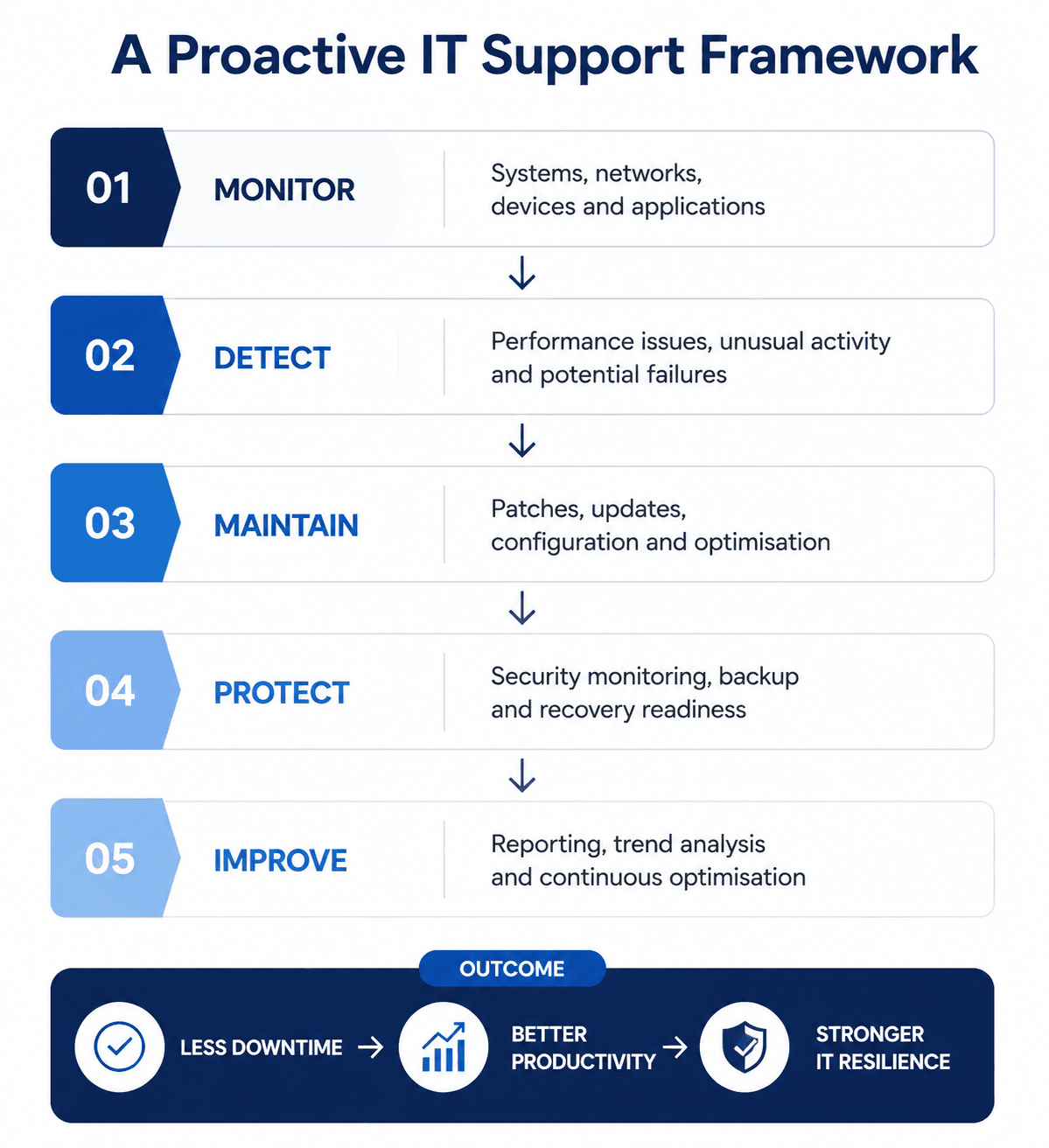
Depending on the IT environment, proactive support may include system monitoring, patch management, endpoint management, network monitoring, security monitoring, performance optimisation and backup checks.
The goal is straightforward:
Identify the problem before the problem affects the business.
Proactive vs Reactive IT Support: What Is the Difference?
The difference is mainly about timing and approach.
Reactive IT support begins after something has gone wrong. An employee reports an issue, a service desk creates a ticket and the IT team investigates and resolves it.
Proactive IT support works earlier in the process. Systems are monitored continuously, potential failures are identified and maintenance or corrective action can take place before users experience the impact.
| Reactive IT Support | Proactive IT Support |
|---|---|
| Responds after an issue occurs | Identifies potential issues early |
| Relies heavily on user reports | Uses monitoring and alerts |
| Focuses on incident resolution | Focuses on prevention and resolution |
| Can result in unexpected downtime | Helps reduce avoidable downtime |
| Often consumes IT resources reactively | Helps IT teams plan and prioritise |
Neither approach completely eliminates incidents. Even well-managed environments can experience unexpected failures. The difference is that proactive support aims to reduce the number and impact of preventable incidents.
How Does Proactive IT Support Reduce Downtime?
1. Continuous Monitoring Identifies Problems Earlier
Continuous monitoring gives IT teams greater visibility into system health and performance.
Instead of discovering a problem when users start experiencing slow applications or network interruptions, monitoring tools can identify unusual activity, performance degradation or potential failures.
This creates an opportunity to investigate the issue before it becomes a major disruption.
2. Preventative Maintenance Reduces Avoidable Issues
Technology requires ongoing maintenance.
Outdated software, missed patches, capacity problems and configuration issues can create unnecessary risks. Proactive IT support addresses these areas as part of an ongoing maintenance programme.
This can include:
- Patch management
- Software updates
- Device maintenance
- Capacity monitoring
- Network optimisation
- Backup checks
The objective is to keep the IT environment healthy rather than waiting for a failure to reveal that something was wrong.
3. Early Security Detection Can Limit Business Disruption
Cybersecurity and IT support are increasingly connected.
A suspicious login, unusual network activity or compromised endpoint can become a serious business problem if it is not identified quickly.
The UK's latest Cyber Security Breaches Survey shows why this matters. 43% of UK businesses reported a cyber breach or attack in the previous 12 months, while only 25% had a formal incident response plan.
Proactive IT support can complement cybersecurity operations by monitoring systems, identifying unusual behaviour and escalating potential security incidents before they develop into larger operational problems.
How Does Proactive IT Support Improve Productivity?
Downtime is only one part of the problem.
Employees can also lose time because of slow systems, recurring technical problems, application issues or unreliable connectivity.
When these problems happen repeatedly, the cumulative effect can be significant.
Proactive IT support helps by addressing the underlying cause rather than repeatedly resolving the same symptom.
For example, if employees regularly experience slow access to a business application, reactive support may resolve individual tickets. A proactive approach would look for the underlying performance issue and address it at the system or infrastructure level.
This allows employees to spend more time on their actual responsibilities rather than troubleshooting technology.
Proactive IT Support Can Also Help IT Teams Work More Strategically
There is another benefit that is often overlooked.
Proactive support can reduce the amount of IT capacity consumed by preventable incidents.
This matters because IT teams are already under pressure to support new technology initiatives.
BCS found that 63% of respondents believe their organisations need enhanced IT capability and skills within their existing workforce, while cybersecurity/resilience was the leading concern among IT leaders.
When IT teams spend less time dealing with recurring and preventable issues, they have more capacity to focus on:
- Cybersecurity
- Cloud optimisation
- AI initiatives
- Automation
- Digital transformation
- Technology planning
In this way, proactive IT support is not only about keeping systems running. It can help shift IT from a predominantly reactive function towards a more strategic role.
What Role Does Proactive IT Support Play in Business Continuity?
A resilient IT environment needs more than backups.
Businesses also need to understand whether their systems are healthy, whether critical services are available and whether recovery processes will work when they are needed.
Veeam's 2024 Data Protection Trends Report, based on research involving 1,200 IT leaders and implementers, found that 92% of organisations planned to increase their data protection spending. The research also identified cyberattacks as the leading cause of business outages.
This reinforces an important principle:
Prevention and recovery should work together.
Proactive IT support can help maintain system health and identify potential problems, while backup and disaster recovery capabilities provide a path to restore operations if an incident does occur.
What Should Businesses Look for in a Proactive IT Support Provider?
Not every IT support provider operates proactively.
When evaluating a provider, business leaders should look beyond basic help desk response times.
A proactive IT support partner should be able to provide continuous monitoring and alerting, preventative maintenance, clear reporting and defined escalation processes. Cybersecurity should also be integrated into the broader support model rather than treated as an entirely separate concern.
For larger organisations, scalability is equally important. The provider should be able to support changes in users, locations, applications and infrastructure without creating unnecessary complexity.
Most importantly, the provider should understand the business impact of IT problems, not just the technical problem itself.
Is Proactive IT Support Worth the Investment?
For business leaders, the value of proactive IT support should not be measured only by the number of support tickets resolved.
The more useful question is:
How much business disruption can we prevent?
If an organisation repeatedly experiences downtime, recurring technical issues, security incidents or performance problems, reactive support can become expensive over time.
A proactive approach aims to move the organisation from:
Fixing problems → Preventing problems
and from:
IT as a cost centre → IT as an enabler of productivity and resilience
The exact business case will depend on the organisation's environment, but the principle remains the same: preventing avoidable disruption is generally more valuable than repeatedly responding to it.
Conclusion
IT problems rarely remain isolated for long. A failing device can interrupt an employee's work. A network problem can affect an entire department. A security incident can disrupt critical operations.
Proactive IT support takes a different approach by looking for problems before they become business problems.
Through continuous monitoring, preventative maintenance, security awareness and ongoing optimisation, businesses can reduce avoidable downtime while giving employees a more reliable technology environment.
For leaders, the real value is not simply having faster IT support. It is having an IT environment that is more predictable, resilient and capable of supporting the business as it grows.
Frequently Asked Questions
Proactive IT support is an approach to IT management that identifies and addresses potential technology problems before they cause significant disruption. It commonly involves continuous monitoring, preventative maintenance, security monitoring and performance management.
Proactive IT support reduces downtime by monitoring systems for potential issues, identifying problems early and carrying out preventative maintenance before failures affect users or business operations.
Reactive IT support responds after a problem occurs, while proactive IT support looks for potential problems before they affect the business. Proactive support uses monitoring, maintenance and preventative measures to reduce avoidable incidents.
Yes. By reducing recurring technical issues, downtime and performance problems, proactive IT support can help employees spend less time dealing with technology disruptions and more time on their core responsibilities.
It can. Proactive IT support may include security monitoring, patch management, endpoint protection and escalation of suspicious activity. However, organisations with more complex security requirements may also need dedicated cybersecurity services or a managed security provider.
Yes. Small businesses can benefit from proactive support because they may have limited internal IT resources. Outsourcing monitoring and preventative maintenance can provide access to specialist capabilities without requiring a large internal IT team.