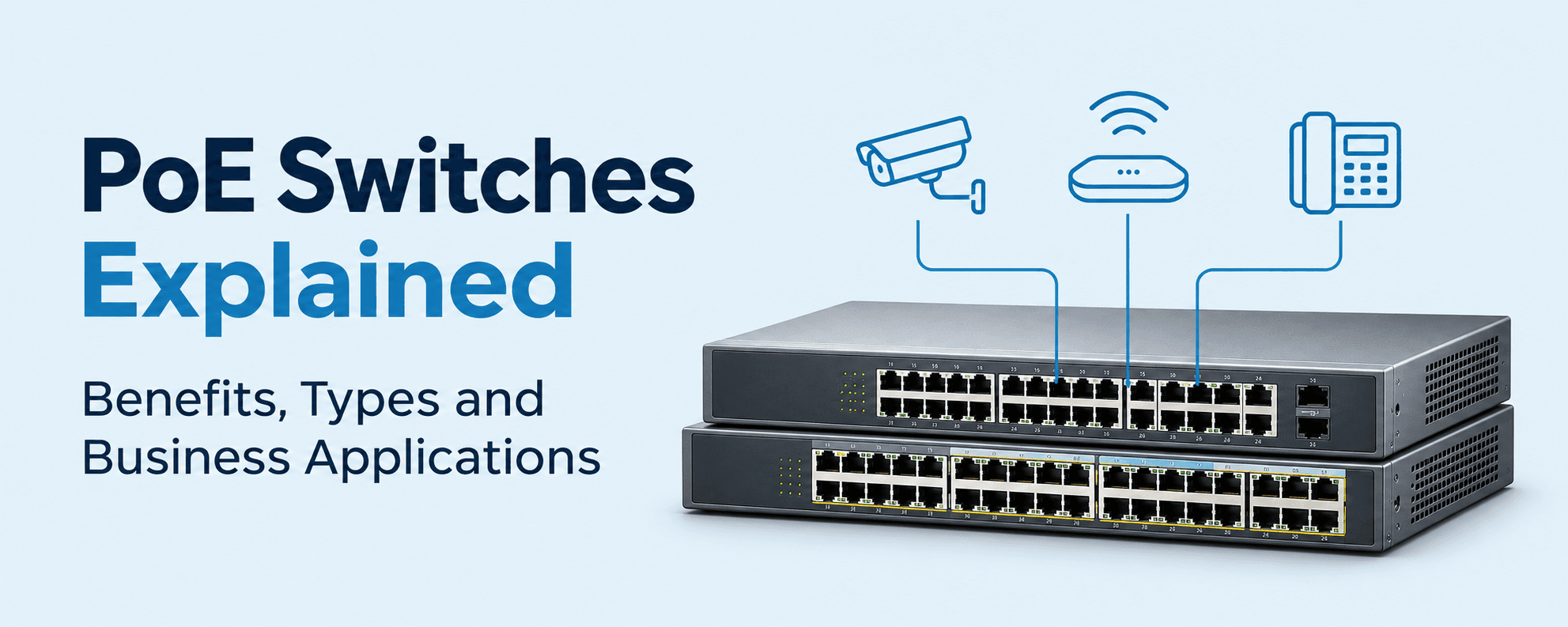
PoE Switches Explained: Benefits, Types and Business Applications
Power over Ethernet (PoE) switches help businesses simplify network installations by delivering data and electrical power through a single Ethernet cable. They are commonly used to connect IP security cameras, wireless access points and VoIP phones without requiring separate power connections for every device. Businesses exploring suitable networking devices from DDevices can consider PoE-enabled solutions for their infrastructure requirements.
However, choosing the right PoE switch involves more than checking the number of ports. Businesses must consider power requirements, PoE standards, network management capabilities and compatibility with connected equipment. This guide explains how PoE switches work, their business applications and what to consider when selecting suitable networking equipment.
What Is a PoE Switch and How Does It Work?
A Power over Ethernet (PoE) switch is a network switch that delivers electrical power and data connectivity to compatible devices through a single Ethernet cable. It eliminates the need for separate power adapters and nearby electrical outlets, making network installations simpler and more flexible.
PoE technology is particularly useful for businesses deploying IP security cameras, wireless access points and VoIP phones across offices, warehouses and commercial buildings.
How Does a PoE Switch Work?
A PoE switch acts as the Power Sourcing Equipment (PSE), supplying electrical power through its Ethernet ports to compatible devices, known as Powered Devices (PDs).
The process involves three main steps:
- Device connection: A compatible device, such as an IP camera or wireless access point, connects to a PoE-enabled switch port using an Ethernet cable.
- Device detection: The switch checks whether the connected equipment supports PoE before supplying electrical power.
- Power and data delivery: Once compatibility is established, the switch delivers electrical power and network data through the same cable, allowing the connected device to operate.
Why does this matter for businesses?
Traditional network installations often require separate power connections for individual devices. PoE reduces this requirement, helping organisations simplify cabling, minimise installation complexity and position compatible equipment where it is needed.
For example, a business can install IP cameras in warehouse locations or wireless access points across office floors without requiring a separate electrical connection at every device location.
Organisations planning these deployments can explore DDevices' networking devices to identify suitable network infrastructure equipment.
What Are the Different Types of PoE Switches?
PoE switches are available with different management capabilities to suit business networks of varying sizes and complexity. The main categories include unmanaged, smart and managed PoE switches.
Understanding these options helps businesses select equipment that provides the right balance of network control, performance and operational simplicity.
1. Unmanaged PoE Switches
Unmanaged PoE switches provide basic network connectivity and power delivery without requiring manual configuration. They operate automatically once connected, making them suitable for smaller business environments with straightforward networking requirements.
Common applications include:
- Connecting IP security cameras.
- Powering basic wireless access points.
- Supporting small office VoIP phone systems.
They are generally suitable for businesses that need simple PoE connectivity without advanced network monitoring or traffic management.
2. Smart PoE Switches
Smart PoE switches offer more configuration options than unmanaged models while remaining simpler to operate than fully managed switches.
Depending on the model, they may support VLAN configuration, basic traffic prioritisation, port monitoring and limited network management features.
These switches can be useful for growing businesses that need some control over network traffic and connected devices without requiring the full management capabilities of enterprise-grade equipment.
3. Managed PoE Switches
Managed PoE switches provide advanced configuration and monitoring capabilities, making them suitable for more complex business networks.
Depending on the model, features may include:
- VLAN configuration for network segmentation.
- Quality of Service (QoS) to prioritise important traffic.
- Network monitoring and diagnostics.
- Port security and access controls.
- Power management across connected PoE devices.
For example, an organisation operating multiple IP cameras, wireless access points and VoIP phones may benefit from managed switching to monitor connected equipment and organise network traffic more effectively.
| Feature | Unmanaged | Smart | Managed |
|---|---|---|---|
| Installation | Plug-and-play | Basic configuration | Advanced configuration |
| VLAN support | Generally unavailable | Available on supported models | Available |
| Traffic management | Basic | Limited | Advanced |
| Network monitoring | Minimal | Basic | Advanced |
| Best suited for | Small networks | Growing businesses | Complex business networks |
Common Business Applications of PoE Switches
PoE switches are widely used in business environments where network devices require both power and data connectivity. By delivering both through a single Ethernet cable, they simplify installations, reduce cabling requirements and provide greater flexibility when deploying connected equipment.
Here are four common business applications.
1. IP Security Cameras and Surveillance
Businesses use PoE switches to connect and power IP security cameras across offices, warehouses, retail stores and commercial buildings.
A single Ethernet cable can provide network connectivity and electrical power to compatible cameras, reducing the need for separate power outlets at installation points.
For organisations deploying multiple cameras, PoE switches can also help centralise network connections and simplify equipment management.
2. Wireless Access Points
Wireless access points provide Wi-Fi connectivity across business premises, including offices, meeting rooms, warehouses and public areas.
PoE switches allow compatible access points to receive power and data through Ethernet connections. This gives IT teams greater flexibility when positioning access points to improve wireless coverage without requiring nearby electrical sockets.
Businesses deploying multiple access points should check the PoE requirements of each device and ensure the switch has sufficient power capacity.
3. VoIP Phones and Communication Systems
Voice over Internet Protocol (VoIP) phones use network connections to make and receive calls. PoE switches can power compatible phones directly through Ethernet cables, eliminating the need for individual power adapters.
This is particularly useful for organisations with multiple employees, shared workspaces or centralised communication systems.
It also simplifies desk installations and makes it easier for IT teams to manage connected communication equipment.
4. Smart Buildings and IoT Devices
Modern commercial buildings increasingly use connected devices to monitor and manage building operations.
Depending on device compatibility and power requirements, PoE switches can support equipment such as:
- Smart lighting controllers.
- Environmental sensors.
- Access control terminals.
- Building monitoring devices.
- Network-connected information displays.
By providing a centralized network connection and power source, PoE technology can simplify the deployment of compatible Internet of Things (IoT) devices across business premises.
Why Do Businesses Trust DDevices?
Choosing the right PoE switch is only one part of building a reliable business network. Organisations also need a procurement partner that understands their technical requirements, equipment compatibility and wider infrastructure goals.
DDevices supports UK businesses and public sector organisations with IT hardware procurement, networking solutions and technology services. Its approach focuses on matching equipment to business requirements rather than recommending a one-size-fits-all solution.
Here are some reasons businesses consider DDevices:
1. Established UK procurement experience
DDevices serves more than 2,500 UK clients and has experience supporting enterprise and public sector procurement requirements.
ddevices.com
2. Access to networking and IT infrastructure
Businesses can explore networking equipment alongside wider IT hardware, cloud and infrastructure solutions through the DDevices catalogue.
ddevices.com
3. Certified technical expertise
DDevices highlights its in-house engineers and consultants, with certifications from technology providers including Cisco, IBM and Lenovo.
ddevices.com
4. Support beyond product procurement
Its service offering connects technology purchasing with deployment, infrastructure planning and ongoing support, helping organisations consider the wider IT lifecycle.
Digital Devices+1
5. Quality and product assurance
DDevices states that it supplies genuine, compliant products with original manufacturer warranties and support from certified experts.
ddevices.com
Whether your organisation is deploying IP cameras, expanding wireless coverage or upgrading its network infrastructure, DDevices can help you explore suitable technology options.
Explore the DDevices Networking Devices catalogue or contact the DDevices team to discuss your requirements.
Frequently Asked Questions
A PoE switch delivers electrical power and network data through a single Ethernet cable. Businesses commonly use it to connect IP security cameras, wireless access points and VoIP phones without requiring separate power adapters.
The main categories are unmanaged, smart and managed PoE switches. Unmanaged models provide basic connectivity, smart switches offer limited configuration options, and managed switches provide more advanced network monitoring and control.
The main difference is their power delivery capacity. IEEE 802.3af PoE supplies up to 15.4W per switch port, PoE+ (802.3at) supplies up to 30W, and PoE++ (802.3bt) supports up to 60W or 90W, depending on its type.
Yes. A PoE switch can power compatible IP security cameras while providing network connectivity through the same Ethernet cable. Businesses should check the camera's power requirements and the switch's supported PoE standard.
Yes. Standard Ethernet devices can generally connect to PoE-enabled ports. Compliant PoE switches detect compatible powered devices before supplying power, although businesses should check the manufacturer's specifications and compatibility guidance.
Add together the maximum power requirements of all connected PoE devices, then compare the total with the switch's available PoE power budget. Allow additional capacity for future devices and consider the power available at each individual port.
Businesses should evaluate the number of PoE ports, supported IEEE standards, total power budget, network speed, management features, compatibility and future expansion requirements. The switch should meet both current device requirements and anticipated network growth.