
Most businesses do not decide to outsource IT in one clear moment. It happens gradually, as a small in-house team spends more time firefighting and less time on the work that grows the business.
For CIOs, operations directors and business owners, the signs are often visible well before the decision is made. This guide sets out the clearest signs that outsourced IT services are worth considering, with current UK data and a short checklist you can score yourself against.
What outsourced IT services actually cover
Outsourced IT services means handing some or all of your technology support, monitoring or security to an external provider, rather than running it entirely with in-house staff. That can mean full management of your IT estate, or a co-managed setup where an external team supports your existing staff.
Cyber Essentials treats a managed service provider as part of your infrastructure once it has access to your devices, network or data, so the same security requirements apply to a provider as to your own team. Outsourcing changes who does the work. It does not change who is responsible for the outcome. Providers usually offer one of three models: fully managed, where they run the whole estate; co-managed, where they support your existing team; or project based, where they handle a single piece of work such as a migration. Many businesses start with a co-managed model and expand once they see how it works in practice.
Sign 1: Your team cannot keep up with basic security tasks
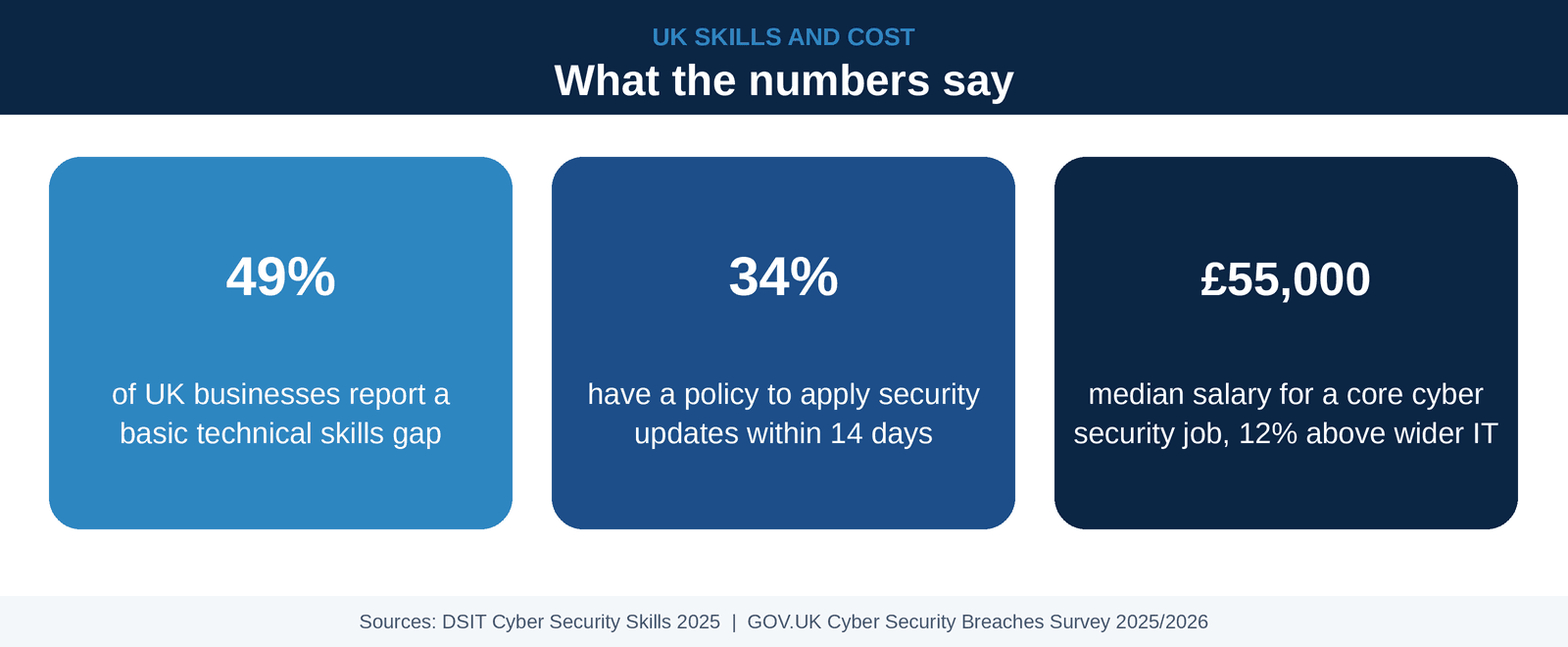
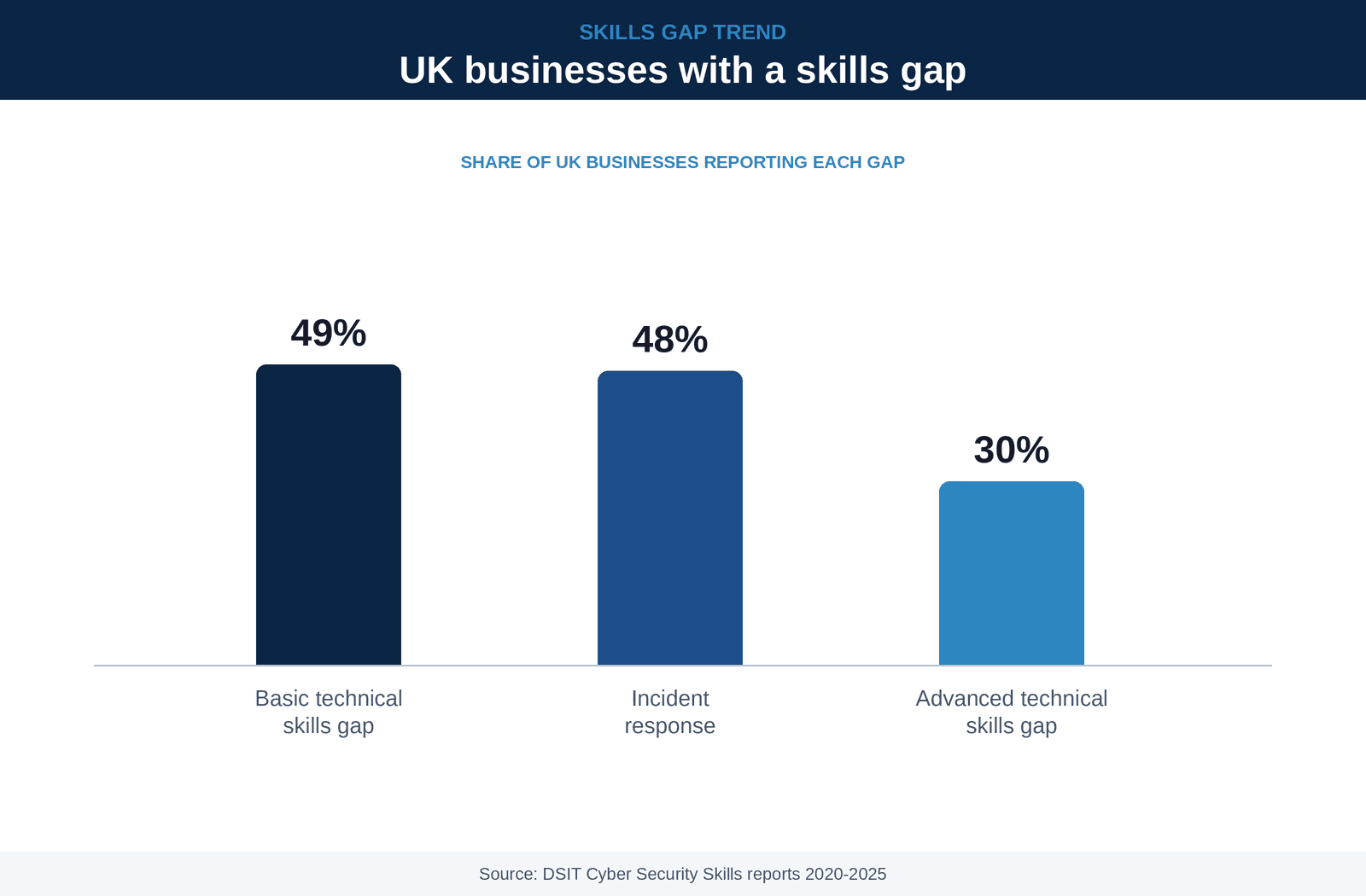
Skills gaps are common, not rare. Almost half of UK businesses, 49%, report a basic technical cyber security skills gap, according to the government's Cyber Security Skills in the UK Labour Market 2025 report. The gap in incident response skills has grown from 27% in 2020 to 48% in 2024, based on the 2024 edition of the same research.
Hiring does not always close the gap. The median advertised salary for a core cyber security role reached £55,000 in 2024, 12% above the wider IT labour market, and competition for experienced staff remains tight even as overall job postings have fallen.
Sign 2: Patching and updates keep slipping
Only 34% of UK businesses have a policy to apply security updates within 14 days, based on the government's Cyber Security Breaches Survey. Cyber Essentials sets that same 14 day window as its baseline for critical and high risk fixes. If updates routinely wait for a quiet week that never arrives, that is a resourcing problem, not a discipline problem.
Industry insight
The regulatory picture is tightening around IT providers too. The Cyber Security and Resilience Bill, expected to receive Royal Assent in late 2026, will bring managed service providers directly into UK cyber regulation for the first time, with a duty to report significant incidents within 24 hours. If you outsource, your provider's own compliance becomes part of your risk picture.
Sign 3: One person holds too much of the picture
When IT support relies on one person knowing where everything is, the business carries a single point of failure. Holiday, illness or a resignation can leave passwords, configurations and vendor relationships hard to trace. A managed provider spreads that knowledge across a team and documents it as a matter of course. Ask yourself a simple test: if your IT lead were unreachable for two weeks, would anyone else know how to reset a server, renew a certificate or contact your key suppliers. If the honest answer is no, that gap is worth closing before it becomes a crisis.
Sign 4: Downtime is starting to cost real money
Downtime rarely announces itself as one dramatic outage. It shows up as slow recovery from small failures. The government's Cyber Security Breaches Survey found that businesses reporting a loss of revenue or share value after a breach more than doubled in a year, from 2% to 5%, and reputational damage rose from 1% to 3%. Those are the outcomes that follow when detection and recovery are slow.
Sign 5: Your asset and licence records are incomplete
If nobody can say with confidence how many devices the business owns, which are still supported, or which software licences are active, that gap makes every other decision harder. It slows audits, complicates renewals and makes it difficult to plan a refresh. A managed provider typically brings a live asset register as a standard part of the service.
Firefighting IT versus planned IT
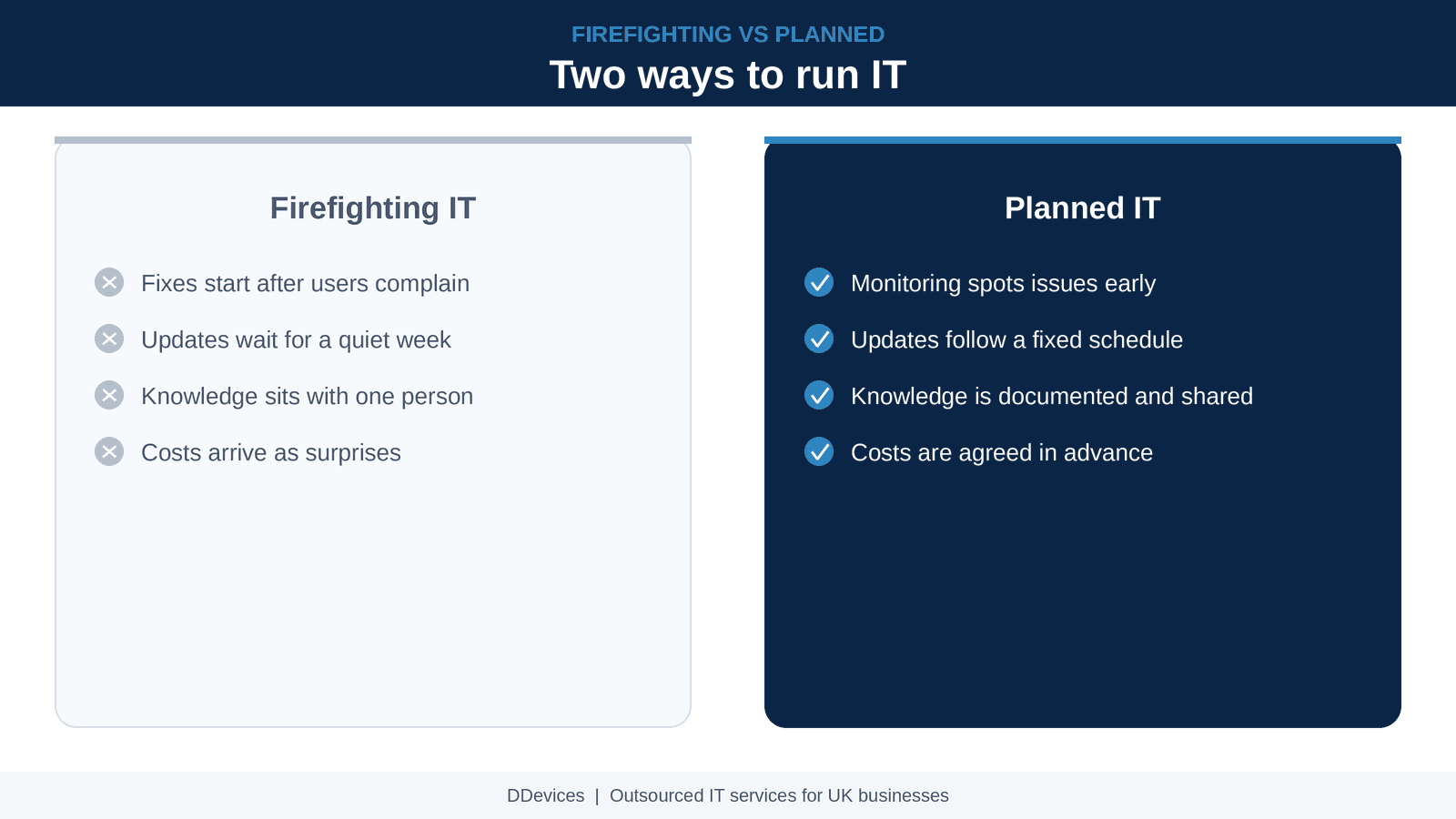
The signs above share a pattern. Reactive IT waits for something to break. Planned IT catches it first.
Score yourself against the signs
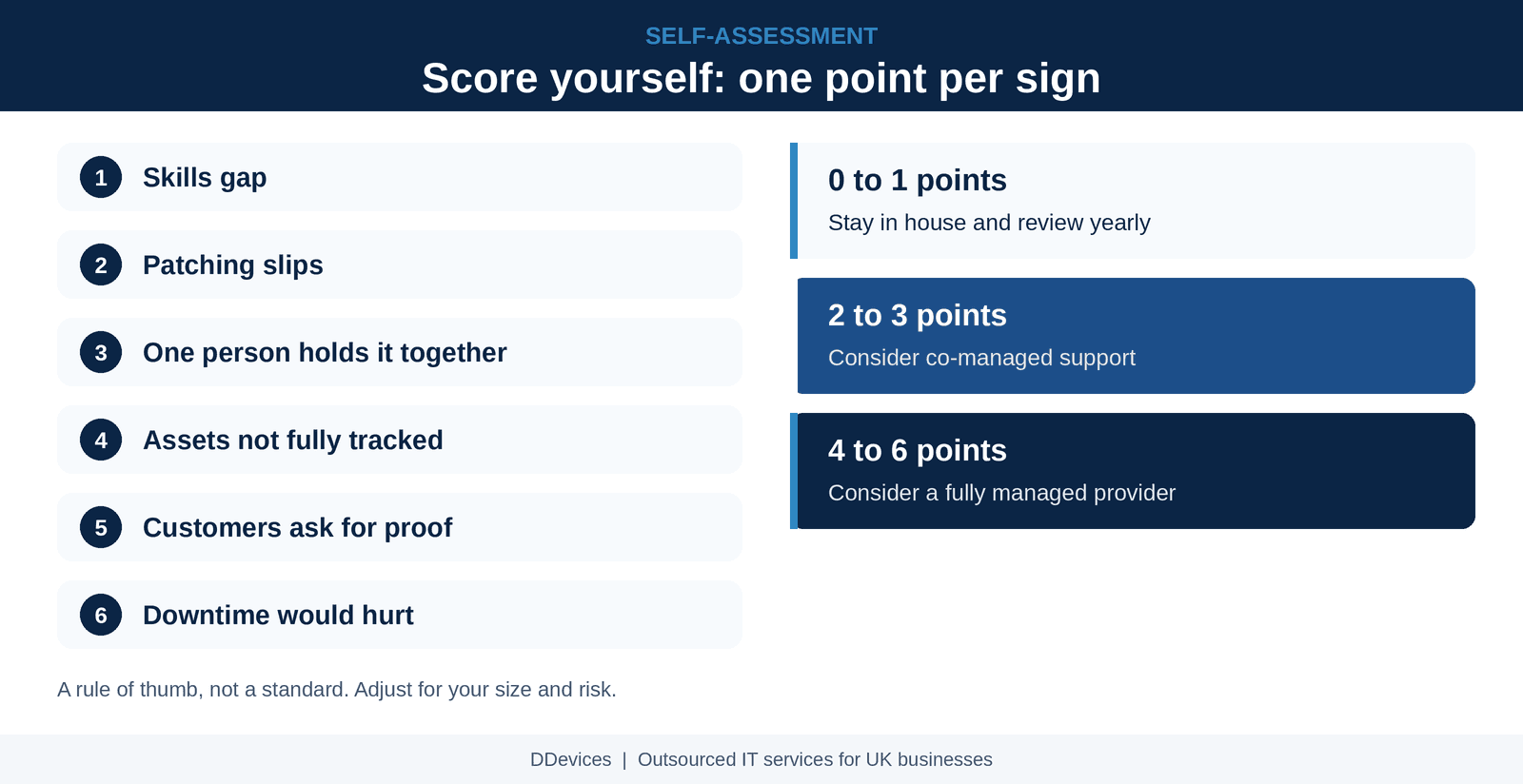
Give your business one point for each sign that genuinely fits, then use the bands as a starting point for the conversation.
A low score does not rule outsourcing out, and a high score does not make it mandatory. Company size, industry and growth plans all shift where the right line sits.
How to choose a provider once you decide to outsource
Choosing the wrong provider can recreate the same risks you were trying to fix. The NCSC's guidance on choosing a managed service provider sets out what to check before signing.
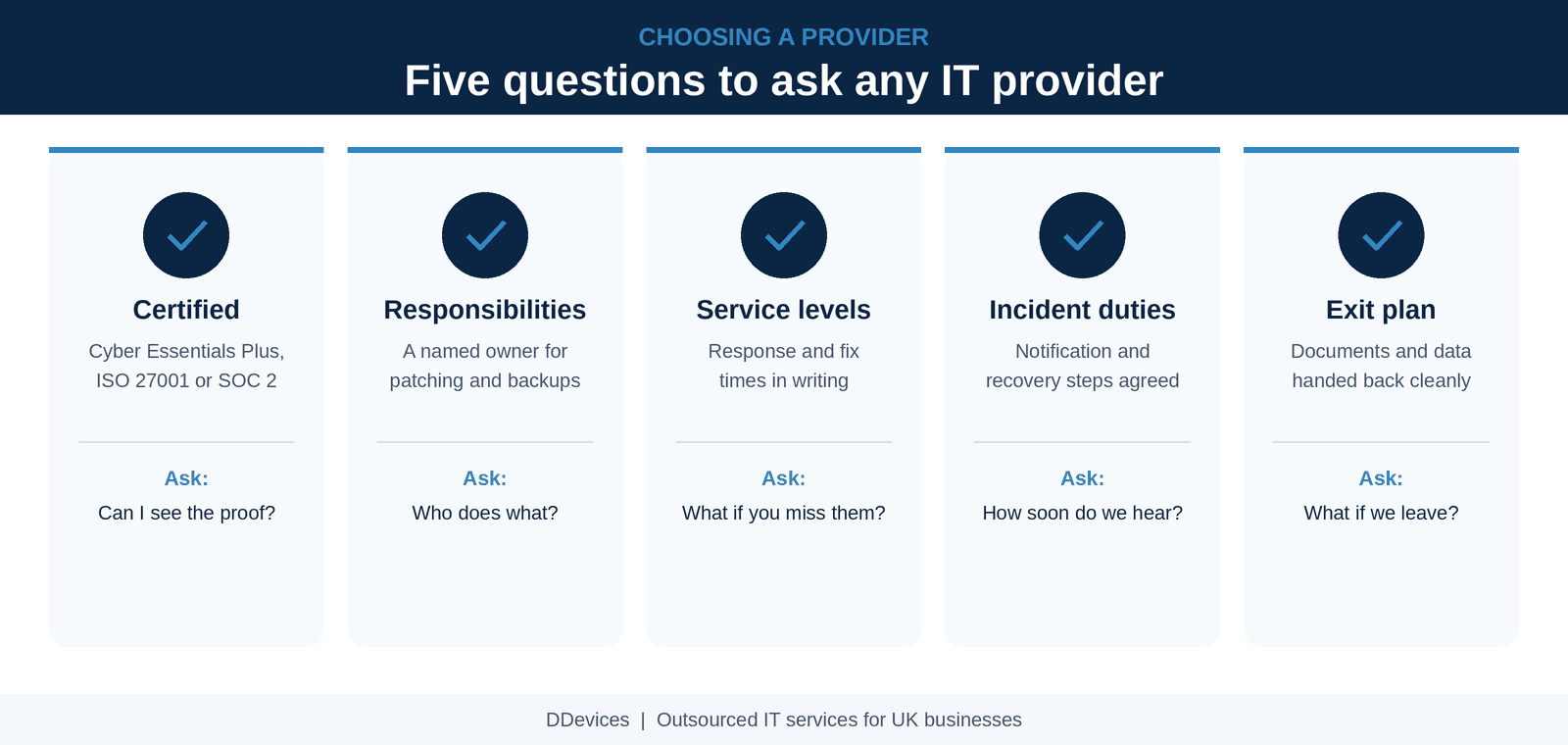
Key criteria for evaluating an outsourced IT provider
A good provider should answer the questions below plainly, without hiding behind jargon. If they cannot, that is itself a useful answer.
| Question area | What good looks like | Why it matters |
|---|---|---|
| Certification | Cyber Essentials Plus at minimum, ISO 27001 or SOC 2 ideally | A recognised baseline you can verify independently |
| Responsibilities | A named owner for patching, backups and access control | Prevents tasks falling between two teams |
| Service levels | Response and fix times set out in writing | Turns expectations into something you can hold them to |
| Incident duties | Clear notification timescales and recovery steps | Matters more once the Cyber Security and Resilience Bill is in force |
| Exit plan | Documentation and data handed back in a usable format | Keeps you in control if the relationship ends |
Why UK organisations choose Digital Devices for IT support
At DDevices, we help organisations across the UK keep technology working and risk under control. From our London base, we support the full IT lifecycle, from procurement and licensing advice to deployment and managed services. More than 2,500 customers trust us, and we hold ISO 9001 certification.
Is your IT support keeping up with your business?
Talk to a DDevices specialist about a managed IT plan built around your goals, from helpdesk to security.
Our approach helps organisations:
- See a clear picture of what to keep in house and what to hand over.
- Bring accurate asset and licence records into one place.
- Set service levels and responsibilities out clearly from the start.
- Keep cyber security and compliance needs in view at every stage.
Whether you are weighing up your first move to managed support or reviewing an existing setup, DDevices gives you the lifecycle expertise to decide with confidence.
Conclusion
None of these signs alone means you must outsource. Together, they point to a business spending more energy holding IT together than using it to move forward. The right choice depends on your size, your growth plans and how much risk you can comfortably carry, not on following what a competitor has done.
Three actions will move you forward this month:
- Score your business against the six signs and be honest about the total.
- List every device and licence your business holds, and note what is missing.
- If you already outsource, run your current provider through the five questions above.
Do that and the choice between in house and outsourced becomes a decision, not a guess.
Frequently asked questions
Outsourced IT services means an external provider manages some or all of your technology support, monitoring or security, either fully or alongside your own team in a co-managed setup.
Look for signs such as a skills gap, slipping patch schedules, one person holding all the knowledge, incomplete asset records, or downtime that is starting to cost money. The more signs that fit, the stronger the case.
It depends on your size and needs. A core cyber security role now costs £55,000 on average, before recruitment and training. A managed service spreads that cost and gives access to a wider team.
No. Cyber Essentials treats a provider with access to your systems as part of your infrastructure, so responsibility for outcomes stays with your business even when the work is outsourced.
Ask about certification such as Cyber Essentials Plus or ISO 27001, named responsibilities, written service levels, incident notification duties and a clear exit plan, as set out in NCSC guidance.
DDevices helps UK organisations build accurate asset records, plan what to keep in house and set clear service expectations, so a move to managed support is a considered decision. Contact us to discuss your needs.
Related reading
This guide is part of DDevices' IT lifecycle and procurement content hub. For related topics, see: