
Most business leaders have heard the term managed IT services provider. Far fewer could explain, in practical terms, what one actually does day to day.
That gap matters. UK businesses face rising cyber threats, growing software costs, and infrastructure that goes out of date faster than budgets can keep up. Many organisations respond by outsourcing IT to a managed service provider, or MSP, but treat the relationship as a black box. Tickets go in, problems mostly get fixed, and nobody looks much closer.
This guide breaks down exactly what a managed IT services provider does, the core services included in most contracts, and how to tell a strong provider from an average one.
What is a managed IT services provider?
A managed IT services provider, also called an MSP, is a third-party company that takes ongoing responsibility for a business's IT infrastructure, systems and support. Rather than waiting for something to break, a managed IT services provider monitors, maintains and optimises technology continuously, under a fixed contract.
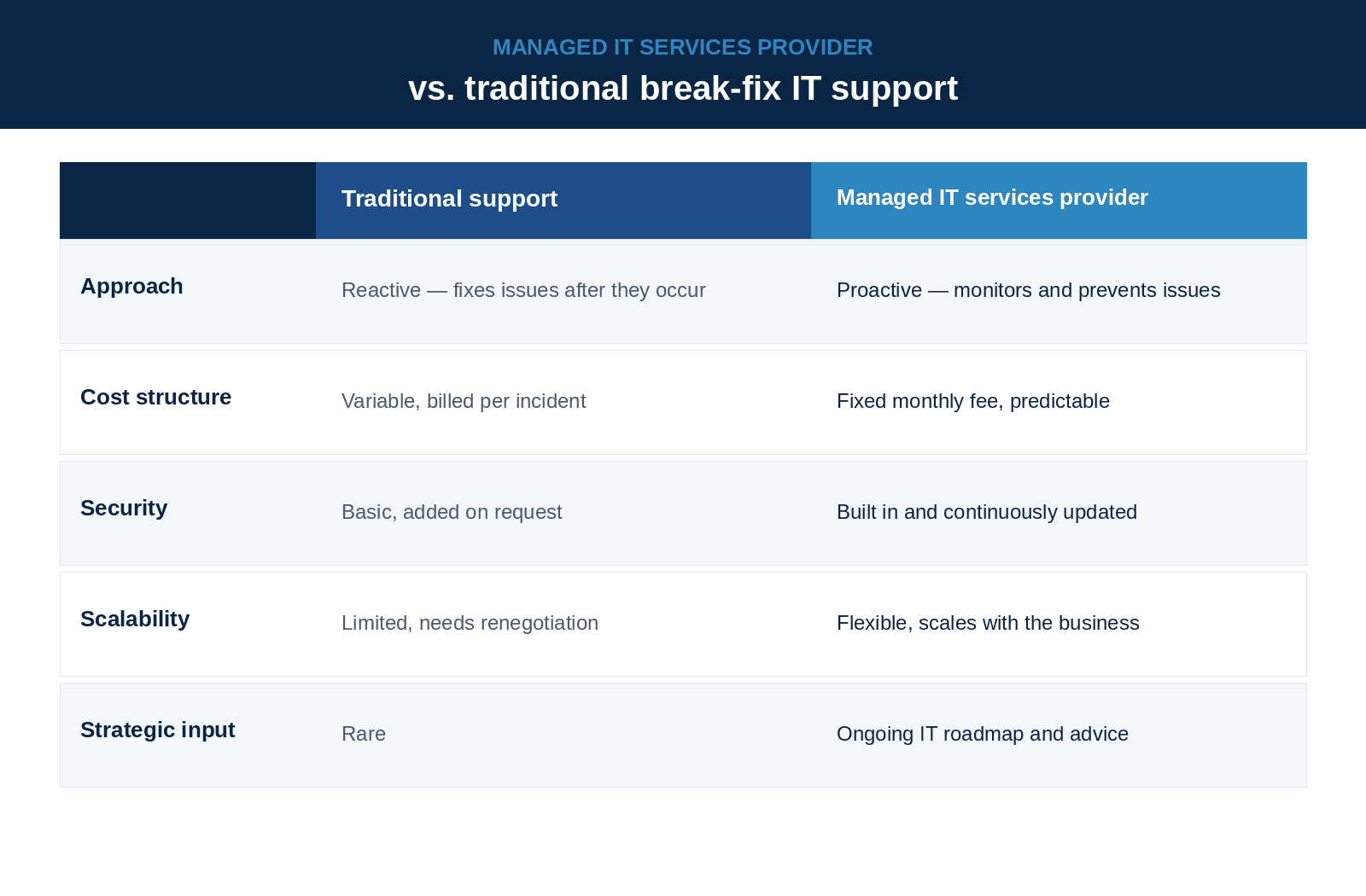
This differs from traditional break-fix IT support, where a technician is called only once something goes wrong. An MSP works proactively, aiming to prevent the issue in the first place. That shift, from reactive to proactive, is the core distinction between a managed IT services provider and a standard IT support company.
Most MSP contracts cover a defined scope of devices, users, or systems for a fixed monthly fee, giving finance teams a level of cost certainty that ad hoc IT spending rarely provides.
Why UK businesses are turning to managed IT services providers
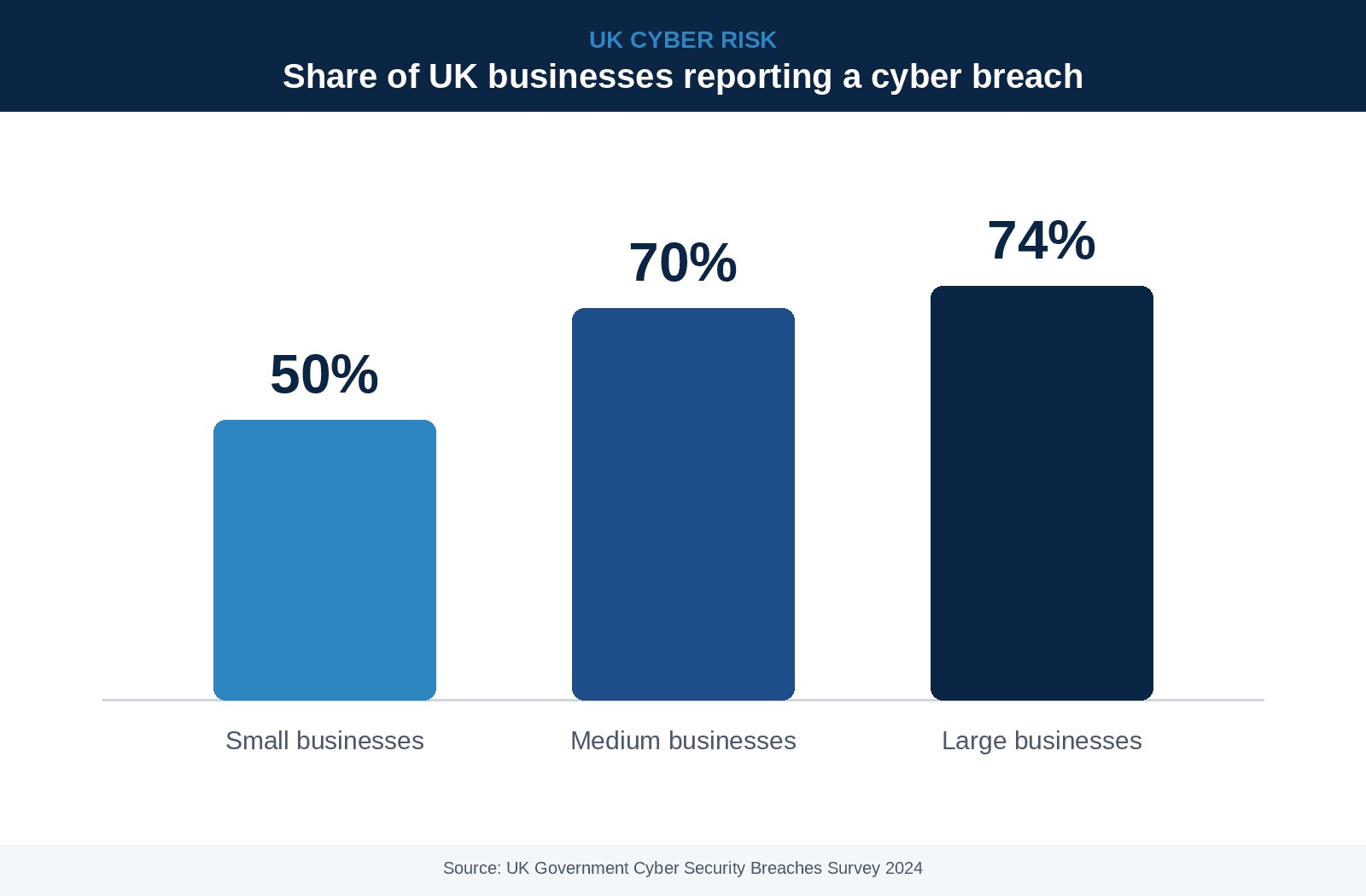
The case for outsourcing IT has strengthened considerably. According to the UK Government's Cyber Security Breaches Survey 2024, half of UK businesses (50%) reported a cyber security breach or attack in the last 12 months, rising to 70% among medium-sized businesses and 74% among large ones. Phishing was behind the large majority of these incidents.
Downtime carries a real cost too. Research from Orderwise, citing Gartner data, puts the average cost of IT downtime at approximately £4,000 per minute, a figure that climbs sharply for organisations that depend on always-on systems.
Against that backdrop, the UK's managed IT services sector has grown into a significant industry. Research from SES Computers puts UK sector employment at more than 343,762 people, generating over £51 billion a year. For most organisations, the question is no longer whether to bring in outside IT expertise, but how to choose the right partner.
What does a managed IT services provider actually do?
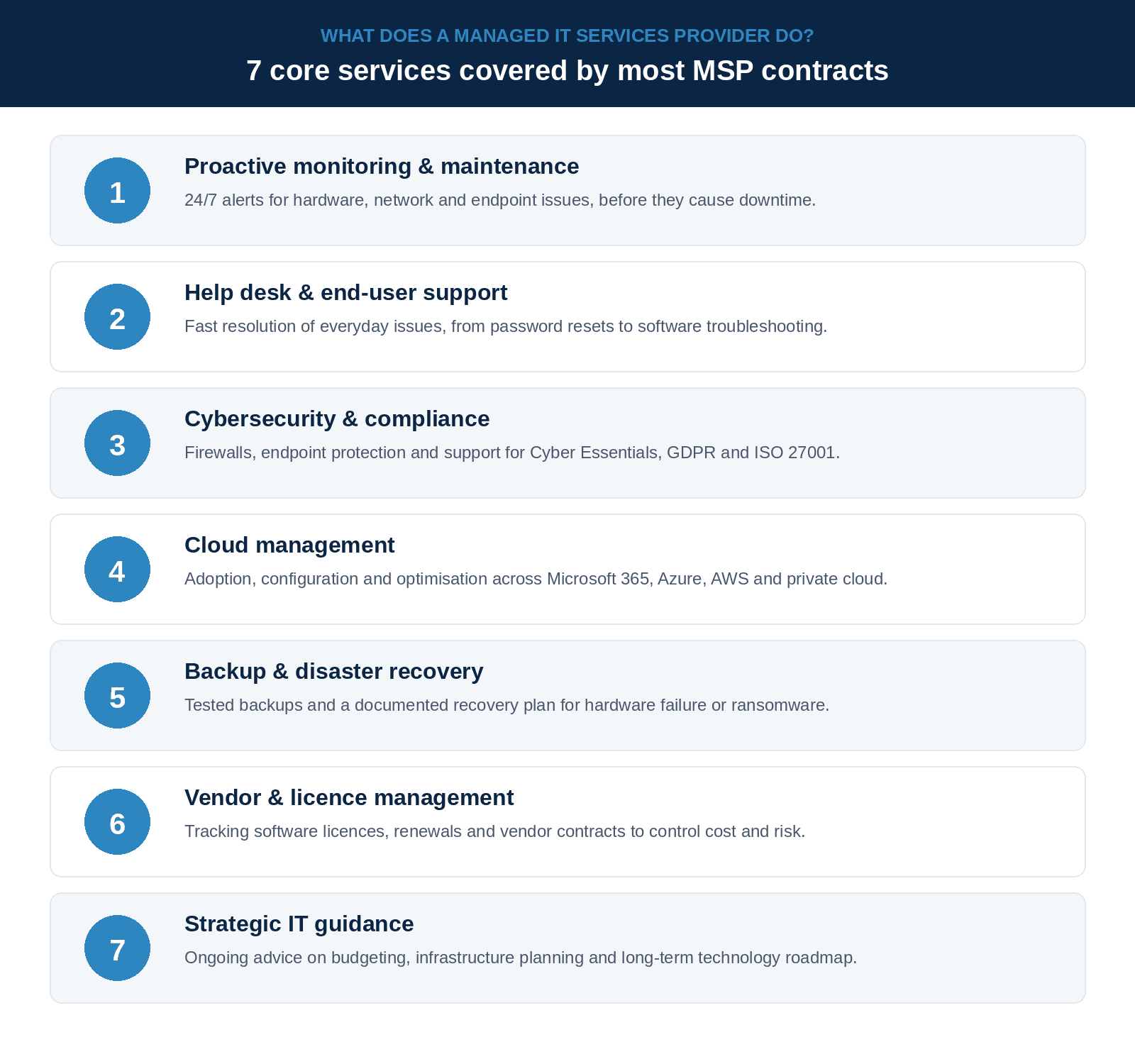
Coverage varies between providers, but most managed IT services providers deliver some combination of the following seven core services.
On vendor and licence management specifically: research from Vertice shows 90% of companies overpay for software, by an average of 26%, which makes licence oversight a genuine cost-control lever, not just an admin task.
Managed IT services provider vs. traditional IT support
The difference between a managed IT services provider and traditional break-fix support comes down to approach. One waits for problems. The other works to prevent them.
How to choose the right managed IT services provider
Not every MSP operates at the same standard. Before signing a contract, it is worth checking for:
Response times and service level agreements (SLAs) stated in writing, not just promised verbally
Relevant accreditations, such as Cyber Essentials Plus or ISO 27001
References from clients of a similar size and sector
Clear, jargon-free reporting on performance and security
A transparent pricing structure with no hidden add-on fees
The right provider should feel like an extension of the internal team, not simply a vendor sending invoices.
Managed IT services provider vs. managed security service provider
The two terms get used interchangeably, but they are not quite the same. A managed IT services provider manages IT operations holistically: infrastructure, help desk, cloud and general security. A managed security service provider, or MSSP, focuses exclusively on cyber security, running services such as 24/7 threat detection, vulnerability management and compliance reporting.
Many managed IT services providers include a solid security layer as standard. Organisations with higher-risk profiles, such as those in finance or healthcare, sometimes layer a specialist MSSP on top for deeper, always-on security coverage.
Why UK businesses choose DDevices
At DDevices, we help organisations across the UK manage every stage of the IT lifecycle, from procurement and deployment to ongoing managed support. Our team monitors, maintains and secures client environments proactively, backed by transparent reporting and a single point of contact for every request.
Rather than treating IT as a cost centre, we help clients use it as a genuine driver of efficiency and growth, with pricing and service levels agreed upfront and no surprises along the way.
Ready to simplify your IT?
Talk to a DDevices specialist about what a tailored managed IT services plan for your business.
Get a quote Contact us
Frequently asked questions
A managed IT services provider monitors, maintains and supports a business's IT systems under contract. Core services typically include proactive monitoring, help desk support, cyber security, cloud management, backup and disaster recovery, and strategic IT guidance.
An MSP delivers IT support and expertise on a contracted, outsourced basis, while an in-house team is employed directly. Many UK businesses use a co-managed model, combining internal staff with MSP support for specialist coverage.
Pricing usually depends on the number of users or devices covered, along with the scope of services included. Most providers charge a fixed monthly fee, which gives finance teams more predictable IT budgeting than ad hoc support.
For many small businesses, yes. A single serious IT incident can cost more than a year of managed support, and smaller organisations often lack the in-house resources to monitor systems around the clock.
Look for clear service level agreements, relevant security accreditations, transparent pricing, and references from similarly sized clients in your sector.
Yes. This co-managed approach is increasingly common, with the MSP covering specific functions such as security monitoring, backup management, or after-hours support.