Most businesses find out their security has a gap after something has already gone wrong. By then the question is not whether to invest in cyber security, but how much the delay just cost.
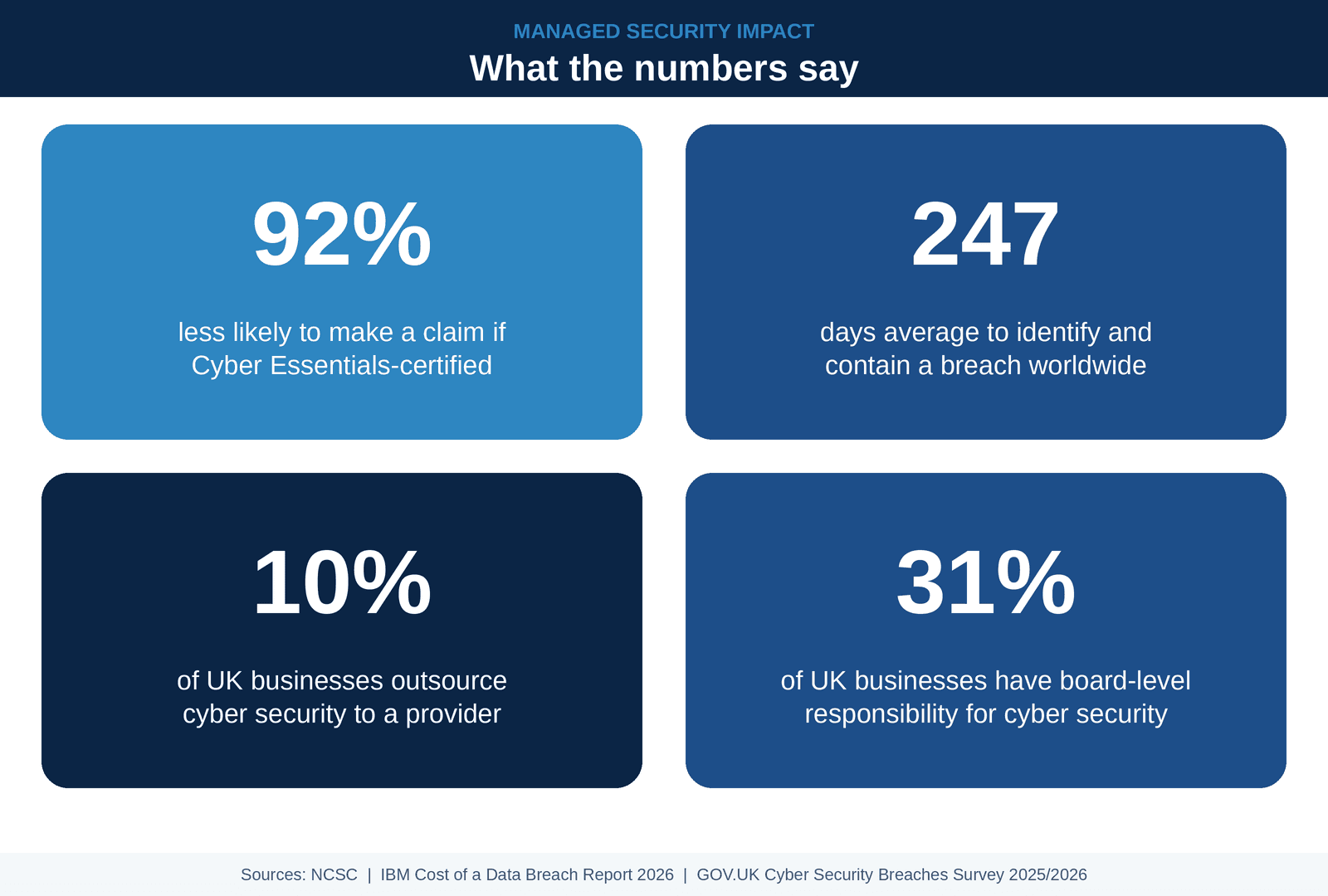
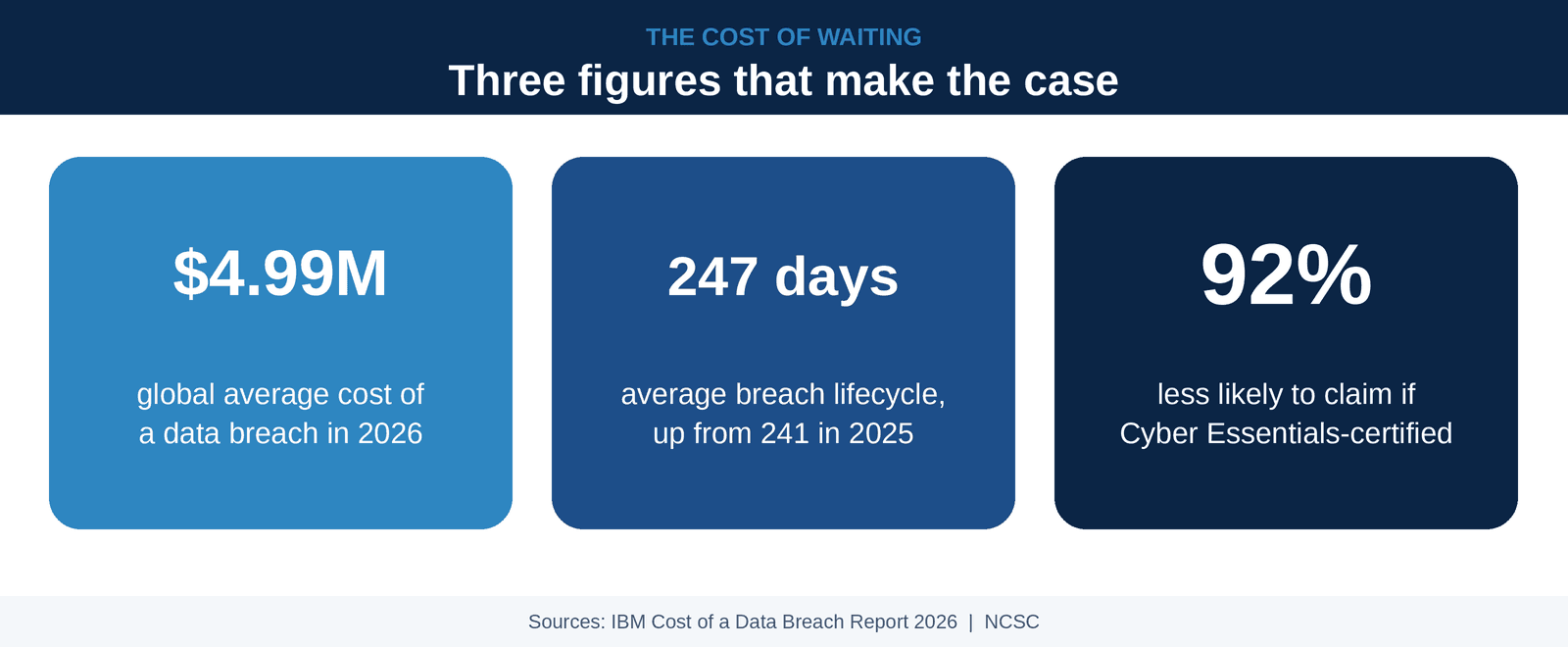
The numbers make the case on their own. Cyber Essentials-certified organisations are 92% less likely to make a cyber insurance claim, according to NCSC data. Despite that, only 10% of UK businesses currently outsource cyber security to an external provider.
This guide explains what managed IT security covers, how it improves cyber security and compliance, and what to check before you choose a provider.
What is managed IT security?
Managed IT security means a specialist provider monitors, maintains and improves your security controls on an ongoing basis, rather than checking in once a year or waiting for a call after something breaks. It usually covers monitoring, patch management, access control, malware protection, backup and a tested incident response plan.
Security and compliance are related but different. Security is the set of technical controls that reduce the chance and impact of an attack. Compliance is the evidence that those controls are in place and operating, whether that's UK GDPR, Cyber Essentials or a client's own security questionnaire. Managed security is built to produce both at once: the control and the record of it.
It helps to picture two different postures. Reactive security waits for an alert, a call or a breach before anyone looks. Managed security watches continuously, so most issues are caught and closed before they become an incident worth reporting.
Why managed security matters more in 2026
Detection is getting slower, not faster. IBM's 2026 Cost of a Data Breach Report found the average breach now takes 247 days to identify and contain, up from 241 the year before, reversing five years of improvement. The global average breach cost reached a record $4.99 million, and breaches running longer than 200 days cost over a million dollars more than those caught early.
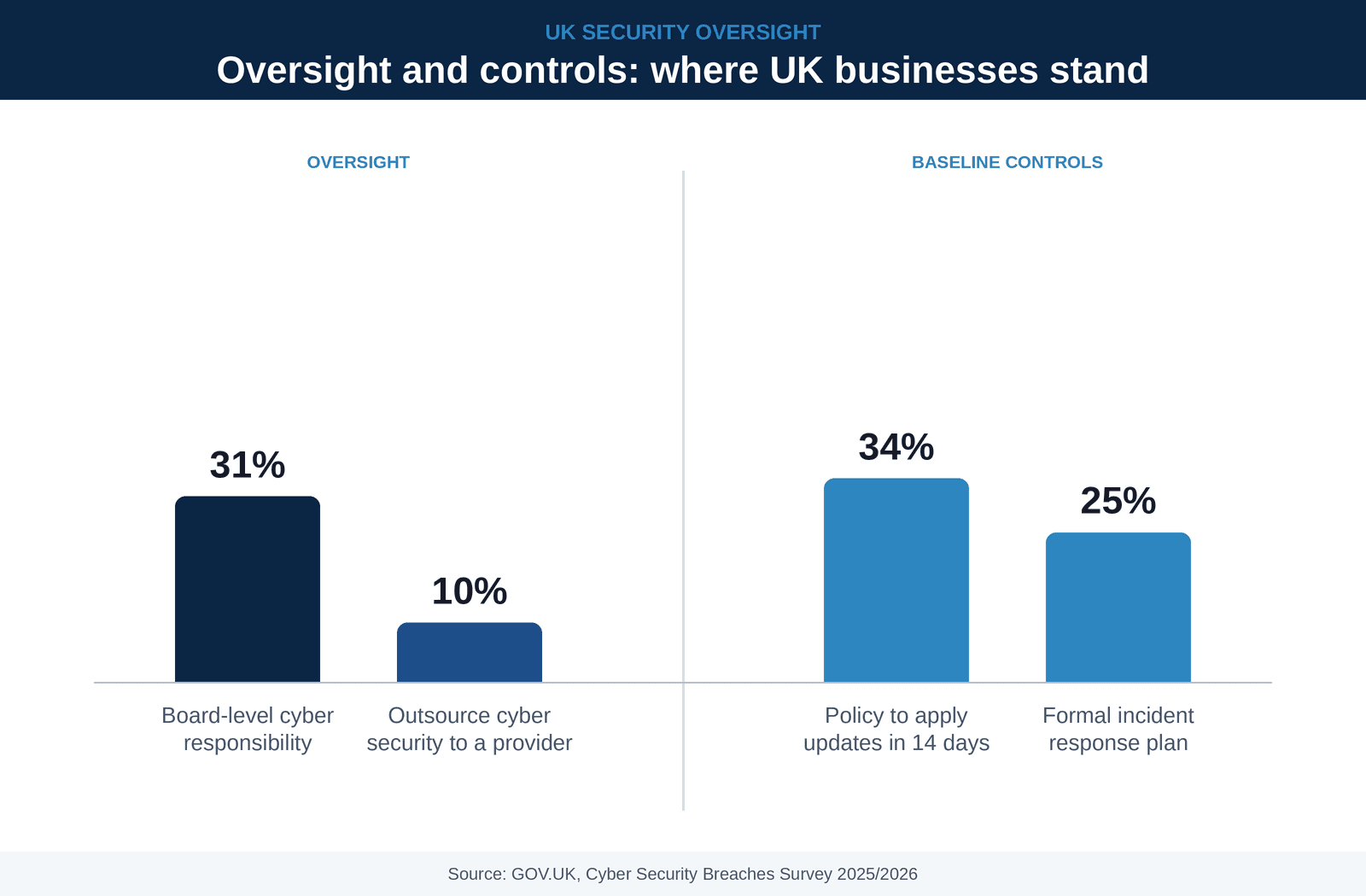
Oversight in the UK is thin. In the Cyber Security Breaches Survey 2025/2026, only 31% of businesses have board-level responsibility for cyber security, and just 10% outsource it to an external provider. Basic controls lag too: only 34% have a policy to apply security updates within 14 days, and only 25% have a formal incident response plan.
Certification pays for itself. Organisations with Cyber Essentials certification are 92% less likely to make a cyber insurance claim than uncertified peers, and some insurers now build the certificate into their underwriting criteria. The scheme is built around five basic technical controls: firewalls, secure configuration, security update management, access control and malware protection.
None of this is exotic. It is discipline, applied continuously, which is exactly what a managed provider is built to deliver.
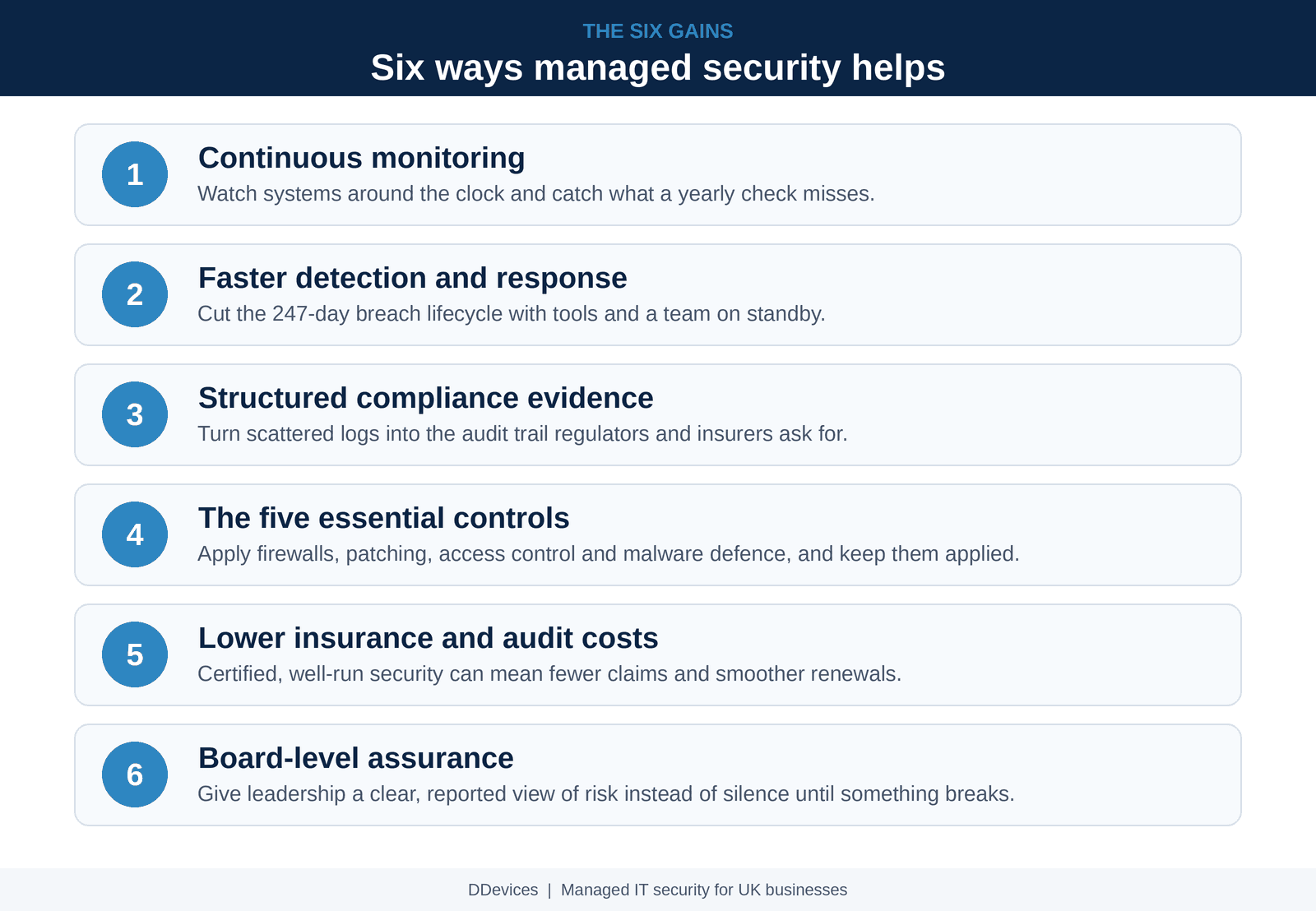
Six ways managed security improves cyber security and compliance
Every managed security service is built to deliver the same six gains. Ask a provider to show you evidence of each one, not just a description of it.
1. Continuous monitoring
An annual review checks a single point in time. Continuous monitoring watches for failed logins, unusual traffic and stalled patches every day, so a small anomaly gets looked at before it becomes an incident.
What to look for. 24/7 monitoring, clear alert thresholds and a monthly report showing what was flagged and how it was closed.
2. Faster detection and response
A breach caught in days costs far less than one caught in months. IBM's data shows organisations still average 247 days to identify and contain a breach, and the gap between fast and slow containment now runs into millions of dollars. A managed provider's tools and playbooks are built to shorten that window.
What to look for. Written detection and response time targets, and a tested incident response plan rather than one that only exists on paper.
3. Structured compliance evidence
Regulators, insurers and clients all want the same thing: proof, not a promise. IBM found that non-compliance with regulations added over $200,000 to the average breach cost as an isolated factor. A managed provider keeps logs, patch records and access reviews in one place, so an audit becomes a report you already have.
What to look for. Evidence mapped to a named standard, whether that's Cyber Essentials, ISO 27001 or your sector's own requirement, and access to it whenever you need it, not just at renewal.
4. The five essential controls, applied and kept applied
Cyber Essentials exists because most attacks exploit a handful of common gaps: missing firewalls, default configurations, unpatched software, weak access control and absent malware protection. A managed provider applies all five and, critically, keeps applying them as your business changes, which is the part most in-house teams struggle to sustain.
What to look for. A provider that holds Cyber Essentials Plus or ISO 27001 itself, not just for clients. Our cyber security team builds these controls in alongside managed support.
5. Lower insurance and audit costs
Certification changes how insurers price risk. Cyber Essentials-certified organisations are 92% less likely to make a cyber insurance claim, and some insurers now discount premiums or include cover for certified businesses. Cleaner records also mean audits take less time and turn up fewer surprises.
What to look for. A provider that helps you gain and maintain certification, not just one that mentions it in passing.
6. Board-level assurance
Only 31% of UK businesses have board-level responsibility for cyber security, which leaves leadership guessing until something goes wrong. Managed security turns risk into a number the board can track: incidents caught, patch coverage, time to respond, and where the business still stands exposed.
What to look for. A regular, plain-English report you could hand straight to your board or your biggest client.
What poor security oversight can cost
Breaches are common, and the costs at the sharp end are rising. The figures below show where the exposure sits when nobody owns it.
| Area | What the data shows | Source |
|---|---|---|
| Breach cost | Global average data breach cost reached a record $4.99 million in 2026, up 12% year on year | IBM, 2026 |
| Detection speed | Average breach lifecycle rose to 247 days, reversing five years of improvement | IBM, 2026 |
| Insurance | Cyber Essentials-certified firms are 92% less likely to make a cyber insurance claim | NCSC, 2024 |
| Oversight | Only 31% of UK businesses have board-level responsibility for cyber security | GOV.UK, 2026 |
| Outsourcing | Just 10% of UK businesses outsource cyber security to an external provider | GOV.UK, 2026 |
| Compliance cost | Non-compliance adds over $200,000 to the average breach cost as an isolated factor | IBM, 2026 |
In-house, managed or co-managed security?
No single model fits every business. This comparison shows where each one works best.
| Factor | In-house team | Managed security | Co-managed |
|---|---|---|---|
| Best for | Larger firms with a dedicated security function | Businesses without security specialists | Teams that want cover and specialist depth |
| Coverage | Working hours unless you fund shifts | 24/7 monitoring as set by contract | Partner covers gaps and out-of-hours |
| Compliance evidence | Built and kept by your own team | Collected and reported for you | Shared, agreed by area |
| Response speed | Depends on team size and on-call cover | Tied to contracted response targets | Best of both, if scoped clearly |
| Cost pattern | Salaries, tools and certification | Fixed fee tied to scope | Split between the two |
Co-managed security suits teams that want to keep ownership of decisions but need round-the-clock cover and specialist depth they cannot justify hiring for.
How to choose a managed security provider
Ask every provider these six questions before you sign:
- Do you hold Cyber Essentials Plus or ISO 27001 yourselves?
- What are your detection and response time targets, in writing?
- Can you show a sample compliance report before I sign?
- How do you support a Cyber Essentials or client security questionnaire renewal?
- What happens in the first hour of a suspected breach?
- Who owns the data, logs and documentation if we leave?
If a provider cannot answer clearly, keep looking.
Why UK businesses choose DDevices
At DDevices, we make security the part of your technology you never have to worry about. From monitoring and patching to compliance evidence and incident response, our cyber security and managed services work together to close the gap between what you think is protected and what actually is.
One partner. One record of risk. Our team listens first, then builds a plan around your goals, your budget and your compliance needs. Technology moves fast, and so do the threats against it. We make your next move clear.
Keep reading: “Top 8 IT Procurement Challenges 2026 and How to Overcome Them” and “Why Strategic IT Procurement Is Essential for Successful Digital Transformation.”
Do you know how long a breach would go unnoticed in your business?
Talk to a DDevices specialist about managed security built around your risk and your compliance needs.
Conclusion
Managed IT security closes the gap between the controls you think you have and the ones that are actually working. Continuous monitoring, faster response, structured compliance evidence and board-level reporting turn security from a once-a-year check into an ongoing discipline.
With breach costs at a record $4.99 million globally, detection still averaging 247 days, and only 10% of UK businesses outsourcing cyber security, the gap between reactive and managed security is where the risk sits. Businesses that close it stay in control of cost, compliance and reputation.
Frequently asked questions
Managed IT security is ongoing monitoring, maintenance and improvement of an organisation's security controls by a specialist provider, covering areas such as monitoring, patching, access control, malware protection, backup and incident response.
An audit checks controls at a single point in time. Managed security monitors and maintains them continuously, so gaps are more likely to be caught before they are exploited.
Yes. A managed provider typically keeps logs, patch records and access reviews in one place, which is the evidence most compliance frameworks and audits ask for.
Cyber Essentials is a UK government-backed certification covering five basic technical controls. It is mandatory for some government contracts and increasingly requested by clients and insurers, and certified organisations report far fewer insurance claims.
Cost depends on scope, headcount and the systems covered. Most providers price per user or device, or as a tiered package, so compare what is included rather than the headline figure alone.
No. Smaller businesses are less likely to have a dedicated security specialist in-house, which is exactly the gap managed security is built to fill. Across all UK businesses, only 10% currently outsource cyber security to an external provider, according to the government's survey, so most are still covering it internally, whatever their size.