
The IT asset life cycle covers everything that happens to a device between the moment it is purchased and the moment it is securely destroyed or recycled. Most businesses manage the first half reasonably well. It is the second half, particularly disposal, where things quietly go wrong.
A laptop that is bought without a plan, used without being tracked, and then thrown in a cupboard or handed to a recycler with no certificate is not an unusual story. It is the default outcome when there is no structured life cycle in place, and it carries real financial, security and legal risk at every stage.
This guide walks through the full IT asset life cycle, from procurement to secure disposal, with the current UK data behind each stage and the practical steps that separate a well-managed IT estate from an expensive, exposed one.
What is the IT asset life cycle?
The IT asset life cycle is the structured process a business follows to manage a piece of technology from acquisition through to retirement. It applies to laptops, desktops, servers, mobile devices, networking equipment and any other hardware the business owns or leases.
The purpose of managing it as a life cycle, rather than a series of disconnected purchases and disposals, is control. A business that treats each device individually tends to lose track of what it owns, overspends on ad hoc replacements, and has no consistent process for handling data when a device is finally retired.
A structured life cycle approach fixes that by defining what happens at each stage, who is responsible, and how the asset is documented throughout, right up to the point it leaves the business for good.
Why managing the IT asset life cycle matters
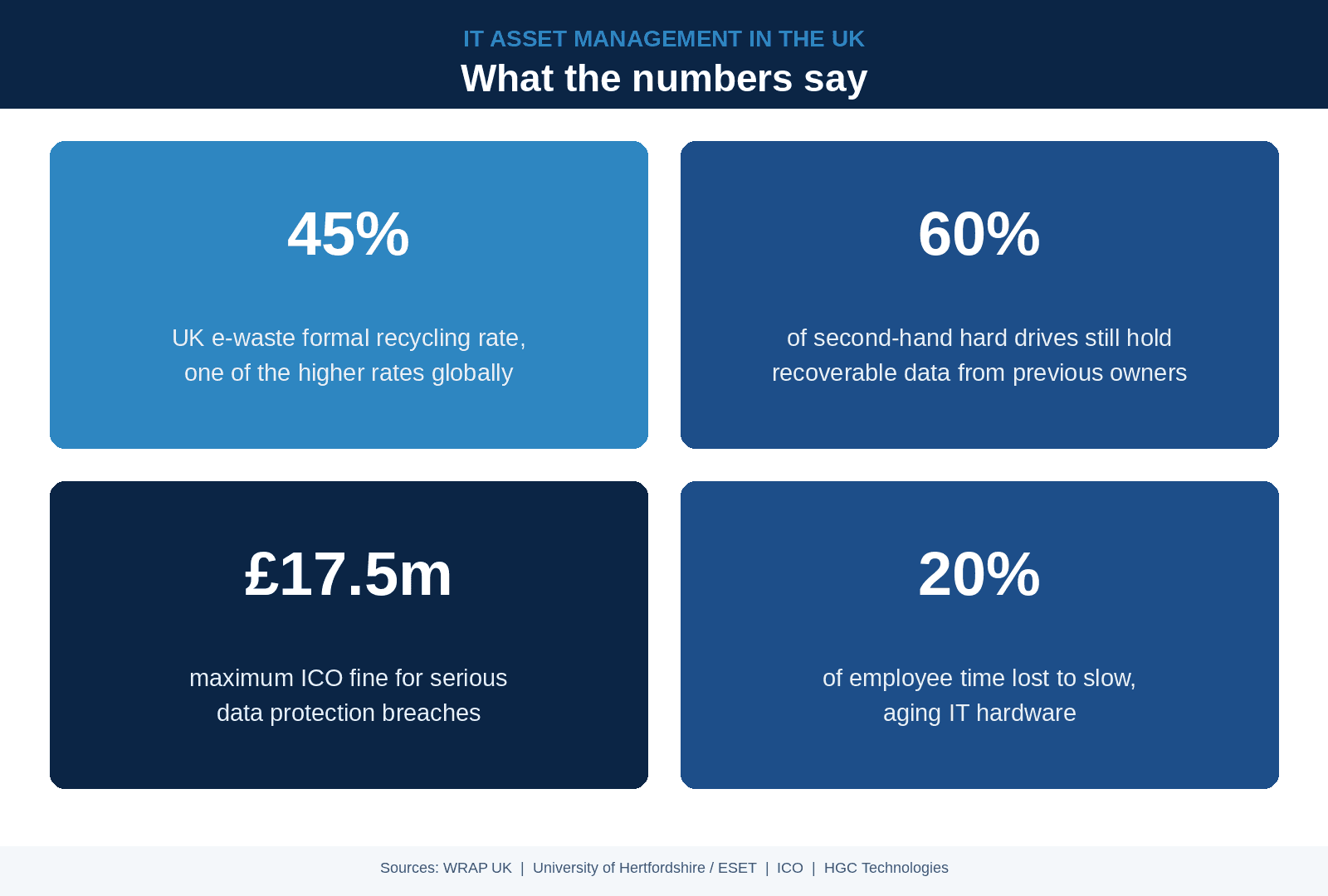
Disposal is where the biggest, least visible risk sits. A study by the University of Hertfordshire, commissioned by Comparitech, found that almost 60% of second-hand hard drives bought on the open market still contained recoverable data from their previous owners, despite many sellers believing they had wiped the device properly.
The regulatory exposure behind that is significant. Under UK GDPR, the Information Commissioner's Office can issue fines of up to £17.5 million, or 4% of global annual turnover, whichever is higher, for serious data protection breaches, and a device that leaves the business without proper data destruction is a direct route to exactly that kind of breach.
The other end of the life cycle carries its own cost. Research from HGC Technologies suggests that ageing, poorly managed hardware can cost UK businesses up to 20% in lost employee time, through slow boot speeds, application crashes and unplanned support calls, well before the device is anywhere near being retired.
Even the recycling stage has room to improve. The UK's formal e-waste recycling rate sits at around 45%, according to WRAP UK research, one of the higher rates globally, but still some way short of the 65 to 70% WRAP considers realistically achievable with better business compliance.
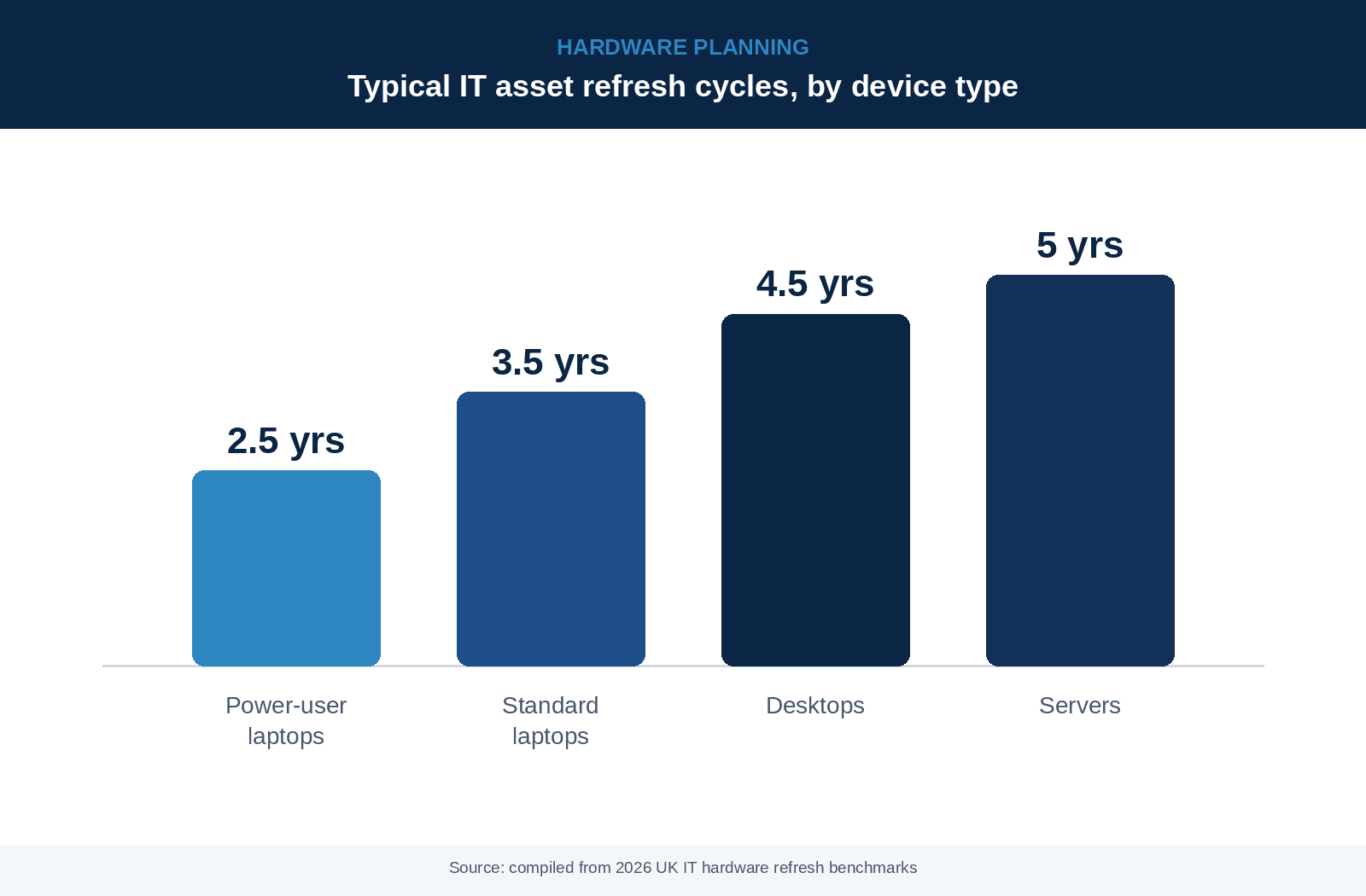
There is no single correct refresh cycle for every device. Power users and developers typically need hardware replaced faster than standard office staff, while servers are generally kept in service longer, provided they remain supported and within warranty.
The 7 stages of the IT asset life cycle
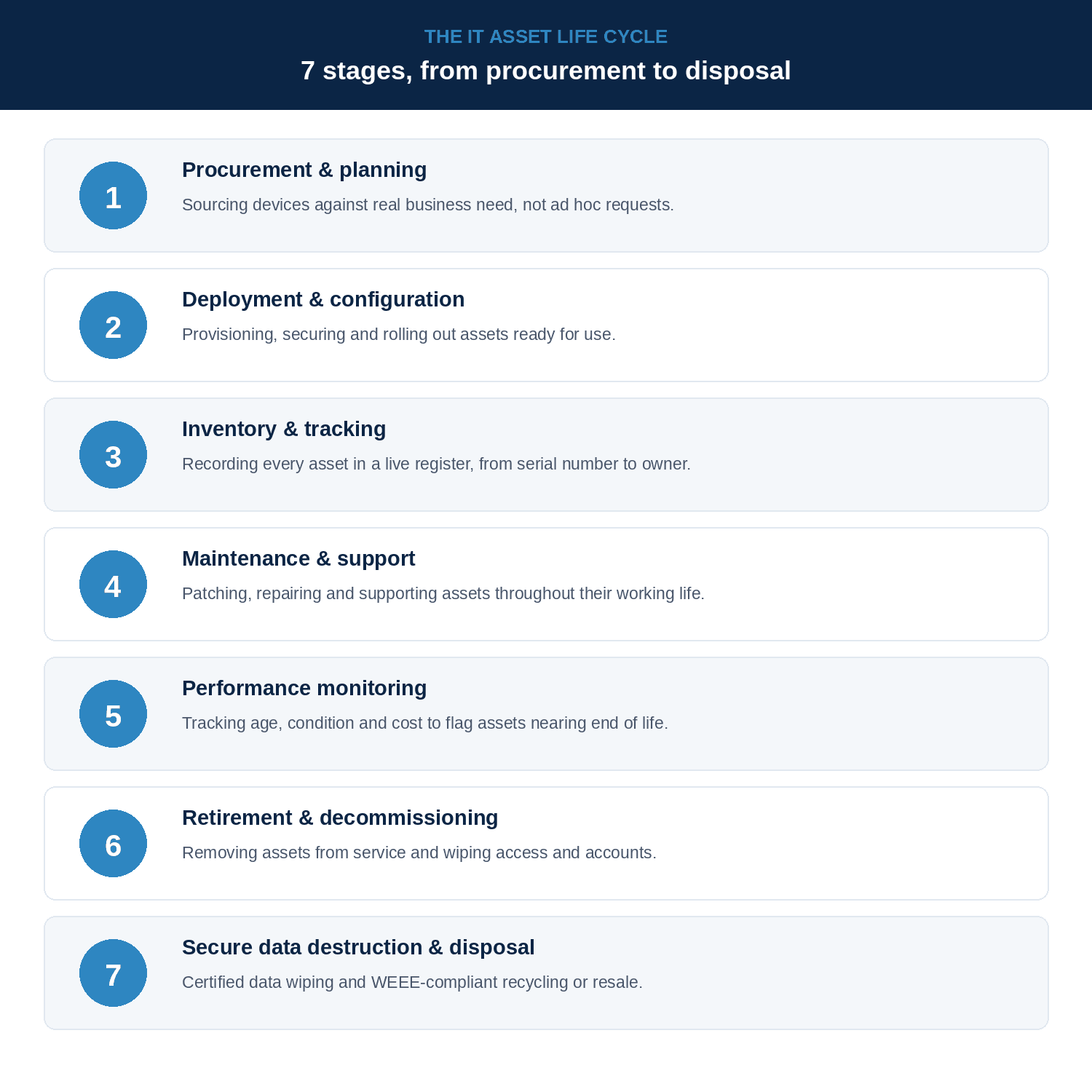
A complete IT asset life cycle runs through seven distinct stages, from the initial purchasing decision to the certificate confirming a device has been securely destroyed or recycled.
The final two stages are where most businesses lose control. Retirement is often informal, a device simply stops being used and ends up in a drawer, and disposal is frequently outsourced without any verification that data was actually destroyed or that the recycler is an approved treatment facility.
Under the Waste Electrical and Electronic Equipment Regulations 2013, businesses have a legal obligation to ensure IT equipment is only handled by an approved authorised treatment facility. Placing equipment in general waste, or handing it to an uncertified operator, is a criminal offence enforced by the Environment Agency, not simply a compliance formality.
Unmanaged vs. structured lifecycle management
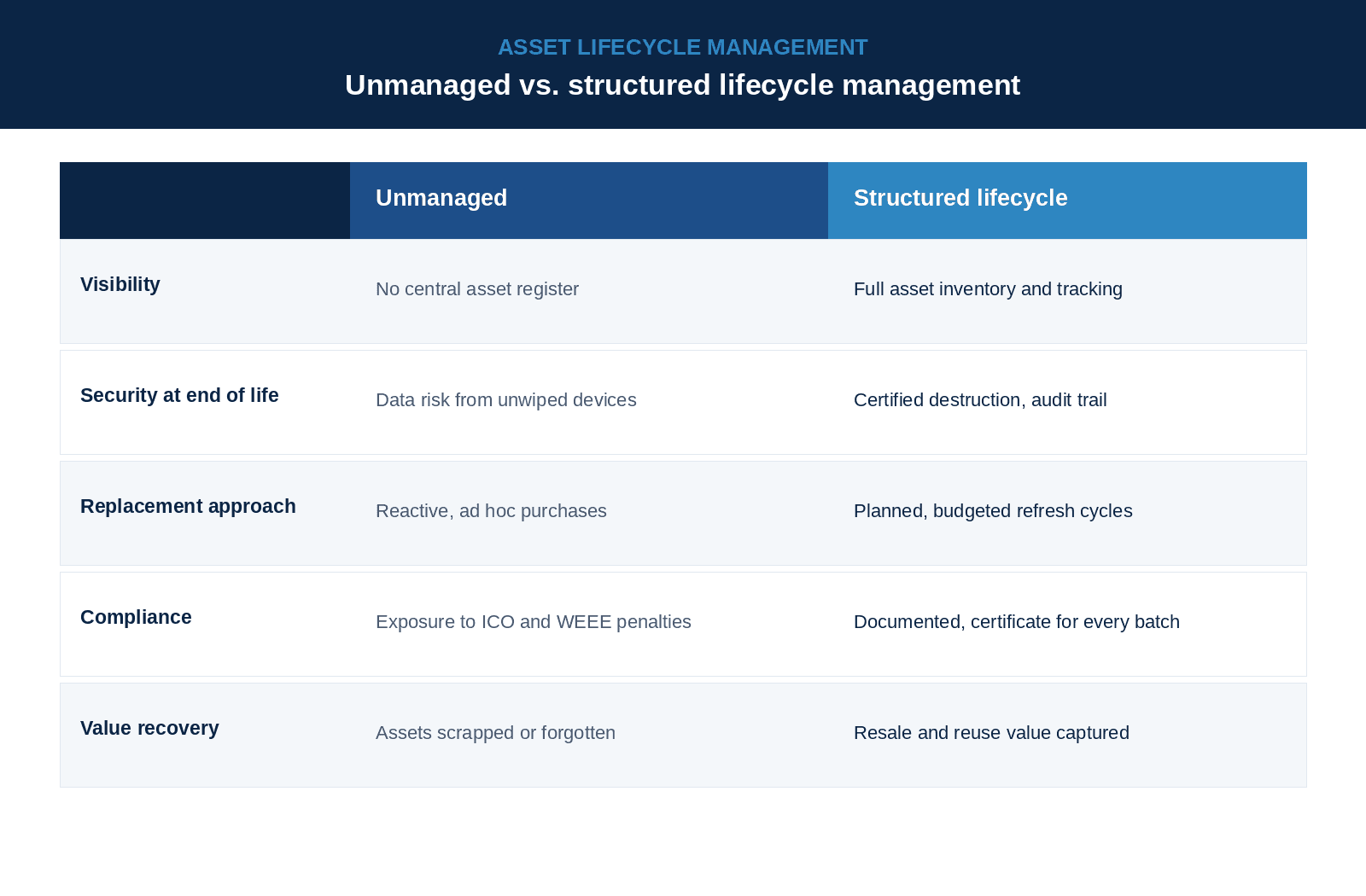
The practical gap between businesses that manage this well and those that do not usually shows up at exactly the two points already discussed: how well assets are tracked, and how securely they are retired.
Building a structured IT asset life cycle strategy
Moving from ad hoc device management to a structured life cycle does not require a complete overhaul overnight. Most organisations build it up through a consistent set of practices:
- Maintain a single, live asset register covering every device from purchase date to disposal, including serial numbers and current owner
- Standardise procurement around a small number of approved device models, to simplify support and reduce sprawl
- Set refresh triggers based on device age, performance and vendor support status, not just an arbitrary calendar date
- Wipe or destroy data to a recognised standard, such as NIST 800-88, before any device leaves the business, with no exceptions
- Use an approved WEEE treatment facility for every disposal, and keep the certificate of destruction and waste transfer note on file
- Review the life cycle policy annually, checking it still reflects current devices, threats and regulatory requirements
Conclusion
The IT asset life cycle does not end when a device is handed over to a user, and it does not end when that device stops being useful, either. It ends only once the data on it has been securely destroyed and the hardware has been responsibly recycled or resold, with a paper trail to prove it.
Businesses that manage this properly, from the procurement decision through to the disposal certificate, spend less on reactive replacements, recover more residual value from their hardware, and remove one of the most common, least visible routes to a serious data breach.
Why choose DDevices for IT asset life cycle strategy
At DDevices, we support the full IT asset life cycle, not just the purchasing decision at the start of it. From sourcing and deploying the right hardware, to tracking assets throughout their working life, to secure, certified data destruction and WEEE-compliant disposal when a device reaches the end of the road.
That means one point of accountability for your entire IT estate, a documented audit trail for every device, and no gaps between procurement and disposal where risk can quietly build up.
Not sure what's sitting in your IT estate right now?
Talk to a DDevices specialist about bringing your IT asset life cycle, from procurement to secure disposal, under one plan.
Get a quote Contact us
sales@ddevices.com | 0207 993 4783 | Toll free: 0800 195 0222
Frequently asked questions
The IT asset life cycle is the structured process businesses use to manage technology from procurement through deployment, maintenance and monitoring, to retirement and secure disposal.
The main stages are procurement and planning, deployment and configuration, inventory and tracking, maintenance and support, performance monitoring, retirement and decommissioning, and secure data destruction and disposal.
Most standard laptops are refreshed every 3 to 4 years, desktops every 4 to 5 years, and servers around every 5 years, though power users and mission-critical systems often need shorter cycles.
The two main risks are data protection breaches, since a significant proportion of second-hand drives still hold recoverable data, and WEEE non-compliance, which is a criminal offence enforced by the Environment Agency and can lead to fines of up to £17.5 million under UK GDPR in serious data breach cases.
WEEE compliance refers to the legal obligations under the Waste Electrical and Electronic Equipment Regulations 2013, which require businesses to dispose of IT equipment only through an approved authorised treatment facility rather than general waste. It applies to any UK business disposing of electrical or electronic equipment.
Yes. Devices that still function can often be resold, remarketed or reused internally once data has been securely wiped, offsetting some of the cost of replacing them rather than simply becoming a disposal expense.
Ultimately the business itself, as the data controller, remains responsible for what happens to its data, even when disposal is outsourced. That makes choosing a certified, auditable ITAD partner, and keeping the resulting certificates, an essential part of the process rather than an optional extra.