Connected workplaces and IoT: a guide for UK enterprises
A connected workplace uses Internet of Things (IoT) sensors, controls and analytics to make a building respond to the people in it. For UK enterprises, that means better working conditions, a clear view of how space and equipment are used, and energy data you can report with confidence. This guide explains how each outcome works and how they connect.
What is a connected workplace?
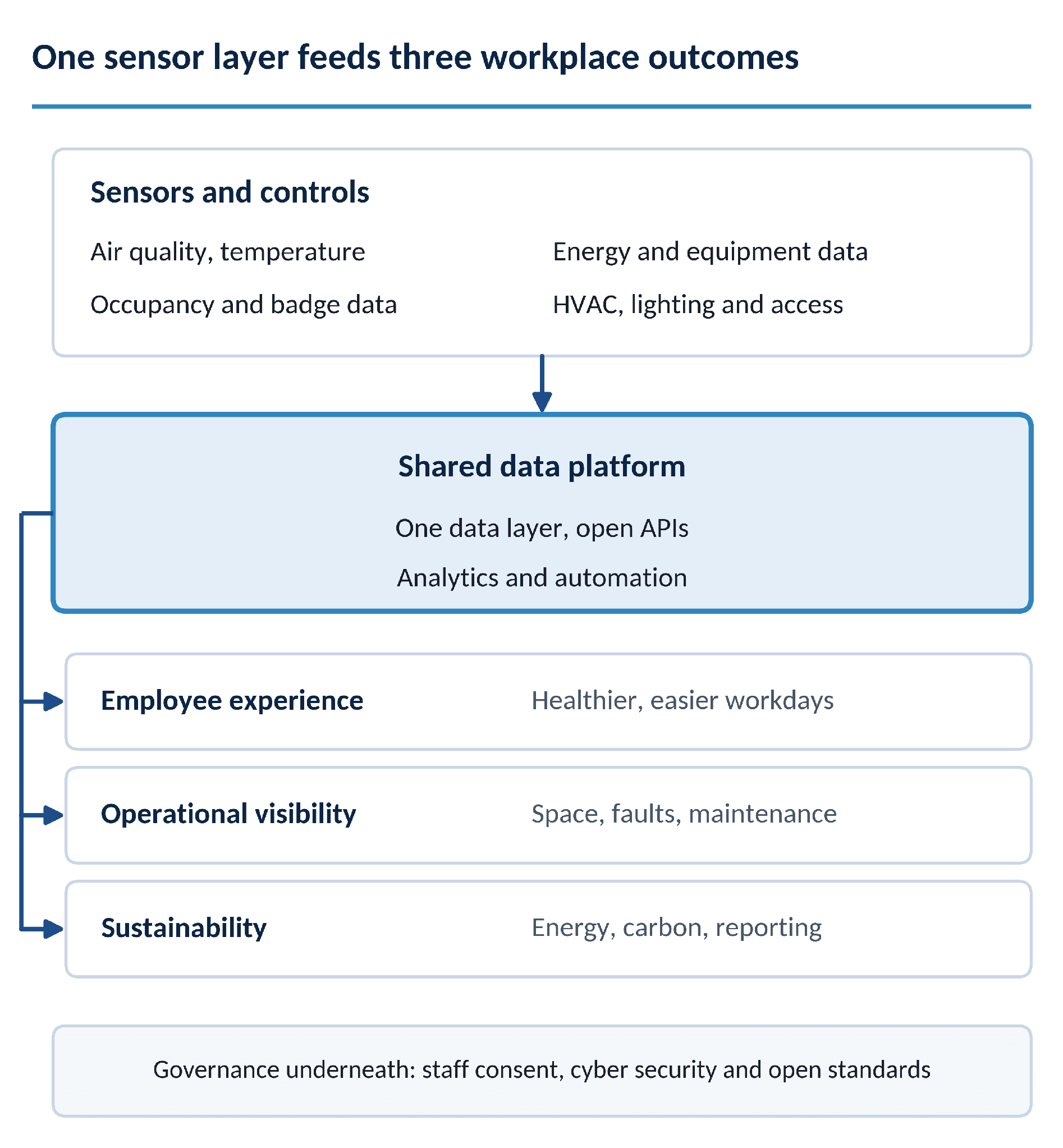
A connected workplace is an office or campus where sensors, controls and software share data in real time. Sensors measure occupancy, air quality, temperature, light and equipment condition. Controls such as smart heating, ventilation and air conditioning (HVAC) systems and lighting controls act on that data. An analytics platform helps facilities, IT, HR and sustainability teams interpret the data and decide what action to take.
What IoT sensors and controls do
Four layers make up most enterprise deployments:
- Environmental sensors track carbon dioxide (CO₂), fine particles, volatile organic compounds (VOCs), humidity and temperature.
- Occupancy sensing counts people and links to badge data and room booking systems.
- Asset and energy monitoring covers chillers, air handling units, boilers and meters.
- Smart controls adjust HVAC, lighting and access automatically.
Why one shared data layer matters
The same sensor can support several goals. Occupancy data can help staff identify available rooms, allow HVAC controls to respond to space use, and show leadership how much office space the organisation needs. Running separate programmes for employee experience, operational analytics and sustainability reporting can duplicate costs and limit the value of shared data.
Why enterprises are investing now
Hybrid working makes office attendance and space demand less predictable. Facilities and IT teams need a clearer view of which areas are used, how equipment performs and where energy is being wasted.
Connected workplace technologies can support these decisions by bringing occupancy, environmental and equipment data together. For existing estates, a focused pilot helps organisations assess compatibility and demonstrate value before committing to wider deployment.
How do IoT technologies improve employee experience?
Air quality is one area where research has examined the relationship between workplace conditions and cognitive performance.
Air quality and comfort
Harvard’s COGfx research examines links between indoor air quality and cognitive function. Monitoring CO₂ and fine particulates can help teams identify conditions that warrant investigation and review ventilation performance.
Poor air quality can be difficult to recognise without measurement. Linking environmental sensors to ventilation controls can help teams identify poor conditions and adjust airflow where appropriate.
Less friction in the working day
Connected systems help reduce everyday delays. Desk and room booking linked to live occupancy helps identify unused reservations and release spaces for others. Mobile access credentials can simplify entry, while digital wayfinding helps employees and visitors navigate larger offices and campuses.
Measure the impact through booking availability, comfort complaints and complaint-resolution times. Combine these indicators with employee feedback to understand whether the technology is making the working day easier.
Safety, health and trust
Since the pandemic, connected workplaces have also supported occupancy limits, ventilation management and touchless entry. A room is no longer ready just because the calendar says it is free. Visible air quality readings show staff that the organisation is watching conditions that affect them.
The same sensing can feel like surveillance if it is handled badly. The privacy section below explains how to avoid that.
How does IoT give you operational visibility?
IoT turns invisible inefficiency into numbers you can act on. Empty floors, idle equipment and silent faults all show up in the data.
Occupancy and space use
People-counting sensors, access records and booking data can help estimate occupancy, meeting room use and peak attendance times. Teams can use these insights to assess space requirements, schedule cleaning and catering based on actual use, and adjust ventilation to demand. The data can also help identify where collaboration spaces are most needed.
Fault detection and predictive maintenance
Continuous monitoring can help facilities teams identify unusual equipment behaviour between scheduled inspections. Changes in temperature, vibration or power consumption can signal a developing fault and prompt investigation.
For example, unexpected heating and cooling patterns may reveal conflicting controls or a faulty sensor. Connecting alerts to maintenance work orders helps teams investigate problems, record corrective action and check whether performance improves.
Predictive maintenance uses trends in equipment data to help anticipate servicing needs. Its effectiveness depends on sensor accuracy, suitable analysis and a clear response process. Track fault-resolution times, unplanned downtime and the balance of reactive versus planned maintenance to assess results.
Joined-up platforms and digital twins
Connecting occupancy, lighting, HVAC and energy data helps teams understand how building systems affect one another. A shared platform can make it easier to investigate faults, coordinate controls and assess performance across sites.
Check compatibility, data access and integration requirements before selecting a platform. Open APIs can support integration, but existing equipment may still need gateways or specialist configuration.
Digital twins provide a model of the building and its systems to explore proposed changes. Their usefulness depends on the quality of the model and its data, so assess whether they add value to your specific use case.
Review your digital infrastructure to assess the connectivity, storage and integration needed to support connected systems.
How do connected workplaces support long-term sustainability?
Building operations use energy for heating, cooling, lighting and equipment. Monitoring this consumption helps teams identify waste and assess opportunities for improvement. Metering can give organisations a clearer view of energy use in the buildings they occupy, although access to controls and data may depend on lease arrangements.
Energy and carbon savings
Occupancy-linked lighting and HVAC controls can help reduce unnecessary energy use by adjusting operation to demand. Equipment monitoring can also reveal inefficient schedules, conflicting controls and faults that need attention.
Measure results against a suitable baseline, accounting for weather, attendance and operating hours. Track energy consumption alongside indoor conditions so efficiency improvements continue to support employee comfort. To estimate associated carbon savings, apply the relevant emissions factors to verified changes in energy use.
Water meters and leak sensors can support similar monitoring by identifying unusual consumption and prompting investigation.
Reporting and compliance for UK organisations
Metered energy data can support emissions calculations and sustainability reporting. Combine it with appropriate emissions factors and reporting boundaries, and retain records of the methodology used. More frequent readings can help teams investigate consumption patterns that periodic meter readings may miss.
Privately rented non-domestic properties covered by minimum energy efficiency standards in England and Wales generally need an EPC rating of E or above, unless a valid exemption applies. The government’s June 2026 interim response proposes EPC B from 2031 for buildings over 1,000 square metres, where cost-effective. Energy monitoring can help teams investigate consumption and plan improvements, but it does not determine a building’s EPC rating.
Staff engagement
Efficiency improvements also depend on how people use the workplace. Clear dashboards, energy-saving reminders and departmental feedback can help employees understand consumption and take practical action.
Managing the lifecycle of IoT devices
Long-term sustainability also depends on how connected devices are maintained and replaced. Sensors need periodic calibration, batteries may need replacing, and software requires ongoing support. Include these needs in procurement and maintenance plans so the system continues to provide reliable data.
Where practical, reuse compatible equipment and choose devices with clear support periods and replaceable components. Plan for secure retirement and responsible recycling when devices reach the end of their useful life.
Include connected devices in your IT lifecycle management plan, from procurement and maintenance to secure retirement.
How do you protect privacy, security and trust?
Connected workplaces only deliver value if staff trust them and the systems are secure. Three risks need a plan before deployment.
Connected workplaces need clear safeguards for personal data, connected devices and system access. Address these requirements before deployment and explain to employees how workplace data will be used.
Review cyber security solutions alongside device access, network segmentation, software updates and monitoring requirements.
Privacy and lawful data use
Use anonymous, aggregated occupancy data where possible. If sensor data can identify employees, establish an appropriate lawful basis, explain what you collect and why, and limit access and retention. Consent is usually unsuitable for workplace monitoring because employees may not feel free to refuse.
Assess whether a data protection impact assessment (DPIA) is required before deployment, and involve your data protection officer or adviser. Follow the ICO’s guidance on monitoring workers, checking for updates before finalising your approach.
Keep an inventory of connected devices and assign responsibility for software updates, access permissions and incident response. Separate building systems from corporate networks where appropriate, replace default credentials and check supplier support periods before procurement. Review who can access building controls and sensor data, including external service providers.
How do you roll out a connected workplace?
Start with a defined business problem and a manageable pilot. Expand once you have evidence that the technology works with your existing systems and delivers useful results. Timelines will depend on building complexity, integration requirements and available resources.
Phase 1: instrument and prove
Choose a priority use case, such as unexplained HVAC energy consumption, recurring comfort complaints or unused meeting rooms. Establish a baseline, check sensor accuracy and assign responsibility for investigating findings.
Address privacy and security requirements before collecting data. Use the pilot to identify practical improvements, such as correcting equipment schedules or recalibrating faulty sensors.
Phase 2: integrate and optimise
Connect relevant sensor data with building controls, booking systems and maintenance workflows. Test compatibility and agree who can access the data and act on alerts.
Introduce automation where appropriate, checking its effect on both energy consumption and employee comfort before extending it across more spaces.
Phase 3: predict, report and sustain
Use accumulated data to identify recurring faults, refine maintenance planning and assess performance over time. Feed verified energy data into sustainability reporting where relevant.
Review sensor calibration, software support and supplier performance regularly. Expand the programme where results justify the investment, keeping responsibilities and success measures clear.
Build the business case
Assess the full cost of deployment, including sensors, connectivity, integration, software licences and ongoing maintenance. Compare these costs with measurable benefits, such as lower energy consumption, fewer equipment faults and better use of office space.
Use pilot results to test your assumptions before expanding. When comparing energy use, account for changes in weather, occupancy and operating hours. This helps distinguish improvements from changes in how the building is used.
Plan the foundations of a connected workplace
Clear priorities and the right technology foundation help connect workplace improvements with business goals. Explore Digital Devices’ modern workplace solutions, or speak with the team about your workplace technology requirements.
Frequently asked questions
A connected workplace uses IoT sensors, controls and software to share information about building conditions, space use and equipment. Teams use this data to improve comfort, identify operational problems and manage energy consumption.
IoT can help identify poor air quality, uncomfortable temperatures and unused booked spaces. Linking sensor data to ventilation controls and room booking systems supports timely adjustments, helps reduce ghost bookings and makes shared workspaces easier to use.
Savings depend on the building, existing controls, occupancy and how sensor data is used. Establish an energy baseline before installation, then compare performance after deployment, accounting for weather, attendance and operating hours.
Payback depends on installation, integration, software and maintenance costs, alongside verified energy and operational savings. Establish a baseline before deployment and use pilot results to assess whether the benefits justify a wider rollout.
Compliance depends on whether the data identifies people and how it is used. Where personal data is involved, establish an appropriate lawful basis, explain the monitoring clearly, limit collection and retention, and assess whether a data protection impact assessment is required.
Connected devices can introduce additional security risks. Assess device support, access controls, network segmentation and monitoring before deployment. Assign responsibility for updates and incident response across IT, facilities and suppliers.
Yes. IoT sensors and suitable integration platforms can be added to existing buildings. Feasibility depends on compatibility with current systems, network coverage and installation requirements. Start with a defined use case and test it before expanding.
Start with a specific problem, such as unused meeting rooms, comfort complaints or unexplained energy consumption. Establish a baseline, assign an owner and agree how success will be measured. Test the approach through a small pilot, addressing privacy and security requirements before deployment.