
Co-managed IT vs Fully Managed IT: Key Differences (2026 Guide)
Most IT leaders do not choose between co-managed and fully managed IT until they are forced to, usually after a security incident, a key resignation, or a budget review that will not wait.
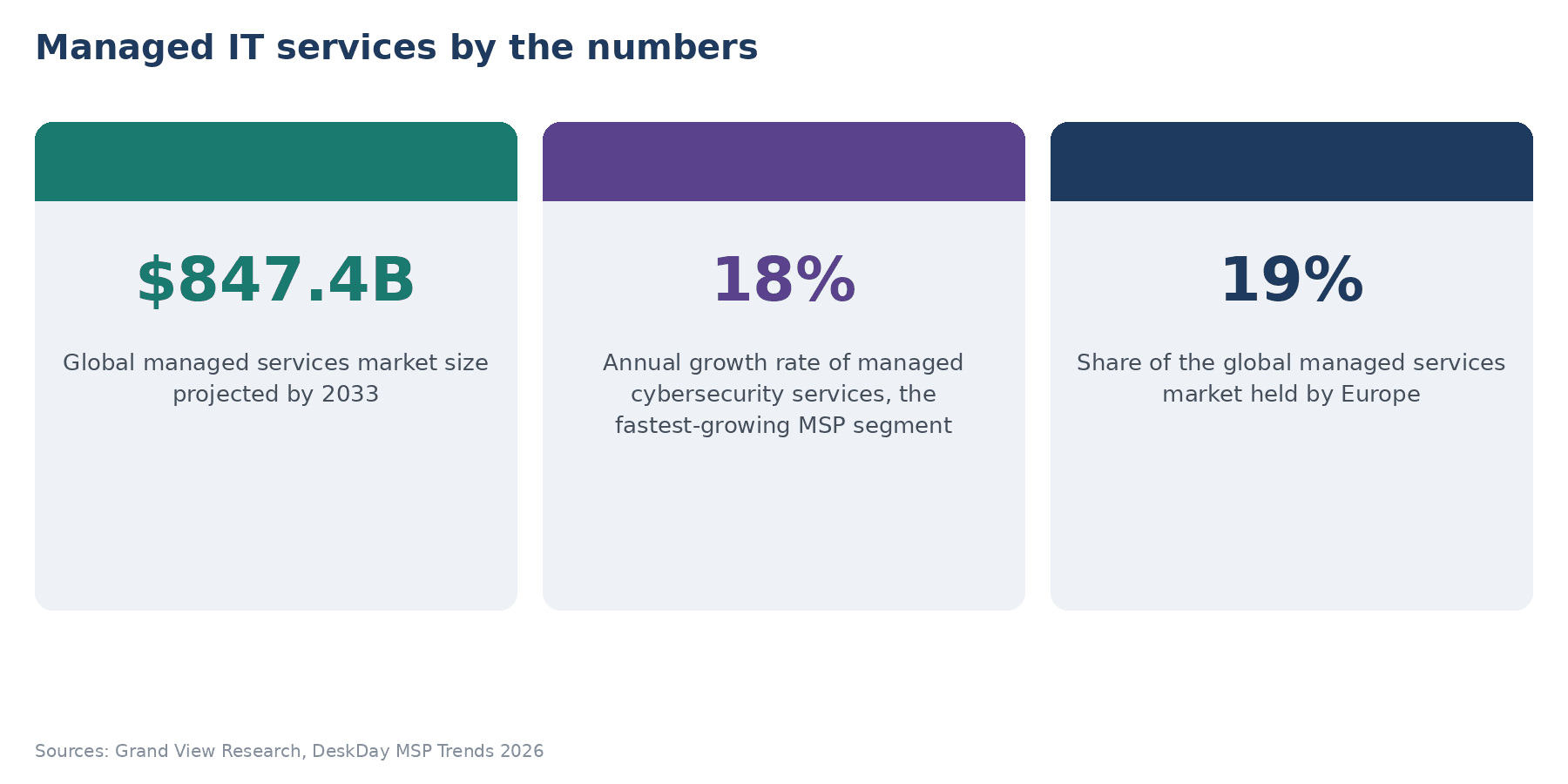
Here is the number worth knowing before that moment arrives: the global managed services market is on track to nearly double, from 401 billion US dollars in 2025 to 847 billion by 2033. More organisations are outsourcing part or all of their IT operations than ever before.
The question is not whether to get outside help. It is which managed IT support model fits how your team actually works. Let us break down the difference.
Key takeaway
Co-managed IT and fully managed IT solve different problems. Co-managed IT adds capacity and expertise to a team you already have. Fully managed IT replaces the need for an internal team altogether. Choosing the right managed IT support model starts with deciding what you want to keep control of, not just what you want to hand over.
What Co-Managed IT Means
Co-managed IT is a partnership model. Your internal IT team stays in place and keeps ownership of strategy, priorities and day-to-day decisions. Demand for this kind of blended support is climbing fast: the global managed services market is on track to nearly double by 2033 as more organisations look to outsource parts of their IT operation rather than all of it. A managed service provider steps in to cover specific gaps, whether that is extra hands for a busy period, specialist skills your team does not have or round-the-clock monitoring your staff cannot realistically provide alone.
This model works well when a team is capable but stretched. A small internal team might handle help desk support and vendor relationships well, but struggle to keep up with patching, backups and security monitoring at scale. A co-managed setup fills exactly that gap without removing anyone's job or authority.
The relationship is flexible by design. Some organisations bring in a partner for one function, such as cybersecurity monitoring, while keeping everything else in house. Others use a partner more broadly, but still make the final call on priorities and spend.
What Fully Managed IT Means
Fully managed IT hands the entire operation to a single provider. Instead of running an internal team, the organisation relies on a managed service provider for everything from help desk support and infrastructure to security and vendor management.
This model appeals to organisations that do not want to build or maintain an internal IT function at all. It is common among smaller organisations without the budget for a full team, and among larger ones that would rather focus internal headcount on core business priorities instead of IT operations.
Fully managed does not mean no oversight. A named account manager and defined service levels give the organisation visibility into performance, even without in-house technical staff. Day-to-day decisions, escalations and technical judgement calls sit with the provider, not the client.
This shift matters most in security: managed cybersecurity services are now growing at 18 percent a year, faster than any other part of the managed services market, which is exactly the kind of specialist coverage a fully managed contract is built to absorb.
The State of Managed IT in Numbers
The scale of this shift is worth pausing on. The global managed services market was valued at over 400 billion US dollars in 2025 and is projected to nearly double within a decade. Europe already accounts for close to a fifth of that market, driven in large part by GDPR and the compliance pressure it places on how organisations handle data.
For UK organisations, that context matters. Regulatory pressure is not a future risk to plan for. It is already shaping how quickly the market is moving toward specialist, outsourced support, whether that support is co-managed or fully managed.
Cost, Control and Accountability Trade-Offs
Cost comparisons are rarely straightforward. Co-managed IT often costs less upfront because it supplements rather than replaces existing headcount, but the organisation still carries salary, training and retention costs for its internal team. Fully managed IT consolidates cost into a single contract, which is easier to forecast but can feel more expensive if internal capability already exists.
Control follows a similar pattern. Co-managed IT keeps more decisions in house, which suits organisations with strict regulatory obligations or highly specific internal processes. Fully managed IT reduces day-to-day control but also reduces the burden of hiring, training and retaining technical staff in a competitive market.
Neither model removes accountability for outcomes. Under UK data protection law and most regulatory frameworks, the organisation remains responsible for its own compliance regardless of which model it chooses. The provider's role changes. The obligation does not.
Which model fits your organisation
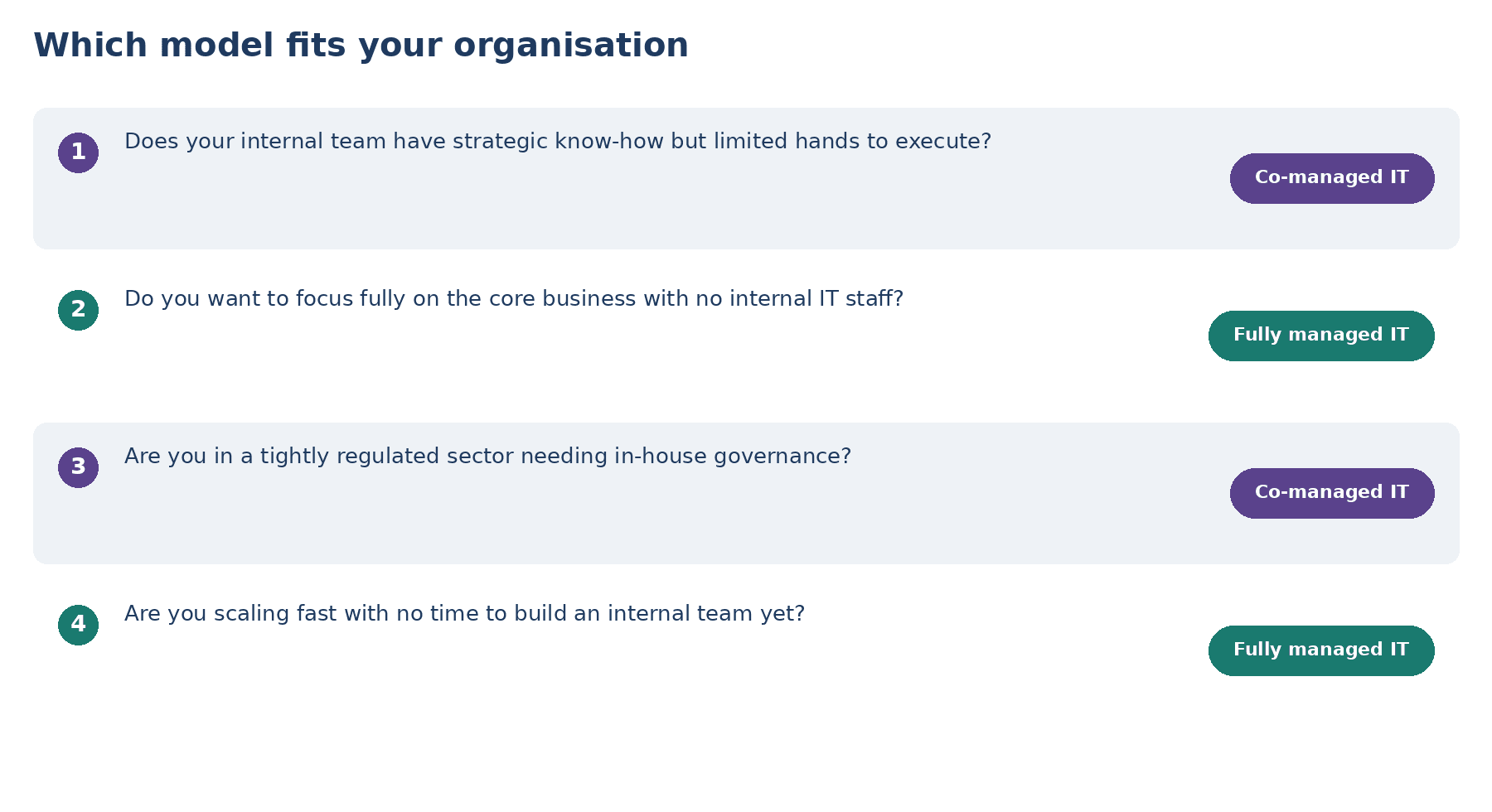
A few honest questions make this IT outsourcing decision easier. Does your internal team have the strategic knowledge to make good technology decisions, even if it lacks hands to execute them? If yes, co-managed IT is usually the better fit.
Does your organisation want to focus entirely on its core business, with no interest in building or maintaining technical staff? Fully managed IT tends to work better here.
Regulatory exposure matters too. Organisations in sectors with strict data or operational requirements, such as financial services or healthcare, often prefer to keep architecture and governance decisions in house, which points toward co-managed IT even when budgets are tight.
The growth stage plays a role as well. Fast-growing organisations sometimes choose fully managed IT early, then shift to a co-managed model once they have the scale and the case for building an internal team.
Getting the Transition Right
Whichever model you choose, the transition itself determines how well it works. Give any new provider time to learn your environment before handing over responsibility for anything business-critical. A rushed handover creates the same risks as no plan at all.
Set clear service levels from day one, with a number, a way to measure it and a real consequence attached. Vague expectations lead to vague results, no matter which model you pick.
Review the arrangement regularly. What works for a 50-person organisation rarely stays right at 200. The best outcomes come from organisations that treat this as an ongoing IT outsourcing decision, not something to decide once and forget.
Not Sure Which Model Fits Your Organisation?
We can help you assess your internal capability, map out the gaps and design a support model, co-managed or fully managed, that matches your risk profile and growth plans. Contact DDevices