
Hiring a managed service provider is meant to take risk off the table. Pick the wrong one, and it just moves the risk somewhere harder to see.
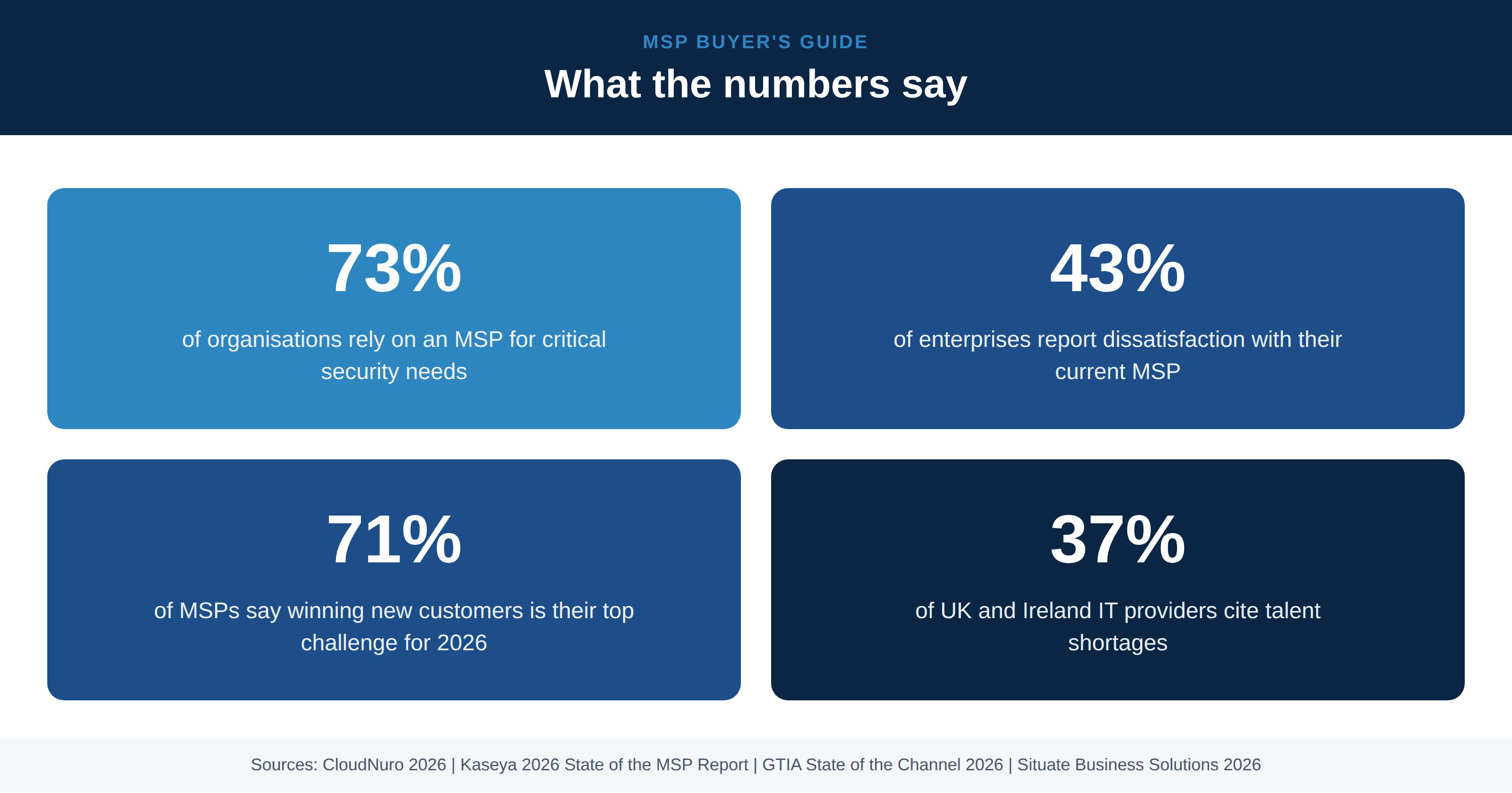
The scale of the decision is bigger than it looks. 73% of organisations now rely on an MSP to manage critical security needs, according to Situate Business Solutions, yet separate research puts MSP-relationship dissatisfaction among enterprises at 43% (CloudNuro). Most of that gap traces back to how the provider was chosen in the first place, not how they performed after signing.
This guide sets out what a managed service provider actually does, the criteria that separate a strong one from a weak one, and the questions to put to every name on your shortlist before you sign.
What does a managed service provider actually do?
A managed service provider (MSP) takes ongoing responsibility for some or all of a business's IT, for a fixed monthly fee under a service level agreement (SLA). That typically spans helpdesk support, network and server monitoring, cyber security, backup and disaster recovery, cloud management and, increasingly, strategic technology planning.
Not every MSP does all of this equally well. Some are strongest on day-to-day helpdesk volume, others on security depth, others on a specific platform such as Microsoft 365 or a particular industry's compliance rules. The buying process exists to find the fit for your business, not the biggest logo or the lowest quote.
Why choosing well MSP matters more in 2026
The market is growing fast enough that quality is harder to judge from the outside. Global managed services spend is projected to grow from $401 billion in 2025 to $847 billion by 2033 (Grand View Research), which has pulled in providers of very different quality under the same MSP label.
Providers themselves are stretched. In the Kaseya 2026 State of the MSP Report, a survey of 1,061 providers, 71% said winning new customers was their top challenge for 2026, ahead of cyber security (53%). GTIA's State of the Channel 2026 survey of 130 UK and Ireland providers found 37% cite talent shortages as a leading challenge. Growth pressure and thin staffing are exactly the conditions that produce an impressive sales pitch and a disappointing service desk.
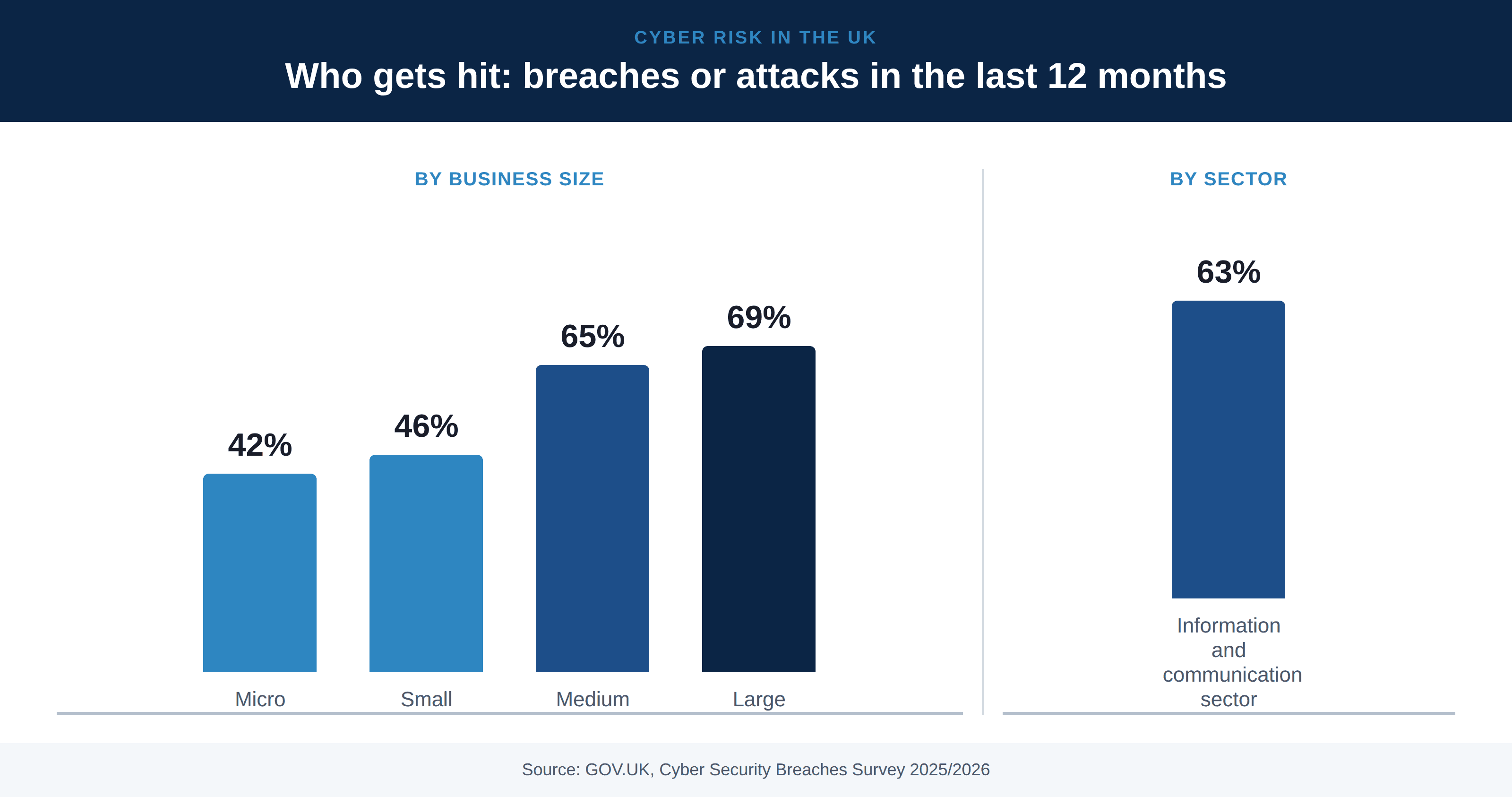
The security backdrop raises the stakes further. The Cyber Security Breaches Survey 2025/2026 found 43% of UK businesses identified a breach or attack in the last year. An MSP with weak security practices does not just fail to help. It becomes the entry point.
How to tell a strong MSP from a weak one
Most red flags show up before you ever sign a contract, if you know where to look.
Warning signs
- Vague answers about response times, “we're usually pretty quick”
- No named account manager, just a shared inbox
- Certifications mentioned but no certificate produced
- Reluctant to name any reference clients
- Onboarding plan is “we'll figure it out once you sign”
- Standard contract, no room to negotiate exit terms
What good looks like
- Response times by severity, written into the SLA
- A named account manager and a defined escalation path
- Cyber Essentials, Cyber Essentials Plus or ISO 27001, certificate on request
- Two or three reference clients of a similar size
- A documented onboarding and transition plan with dates
- Clear data ownership and a defined notice period to leave
Six criteria to check before you sign
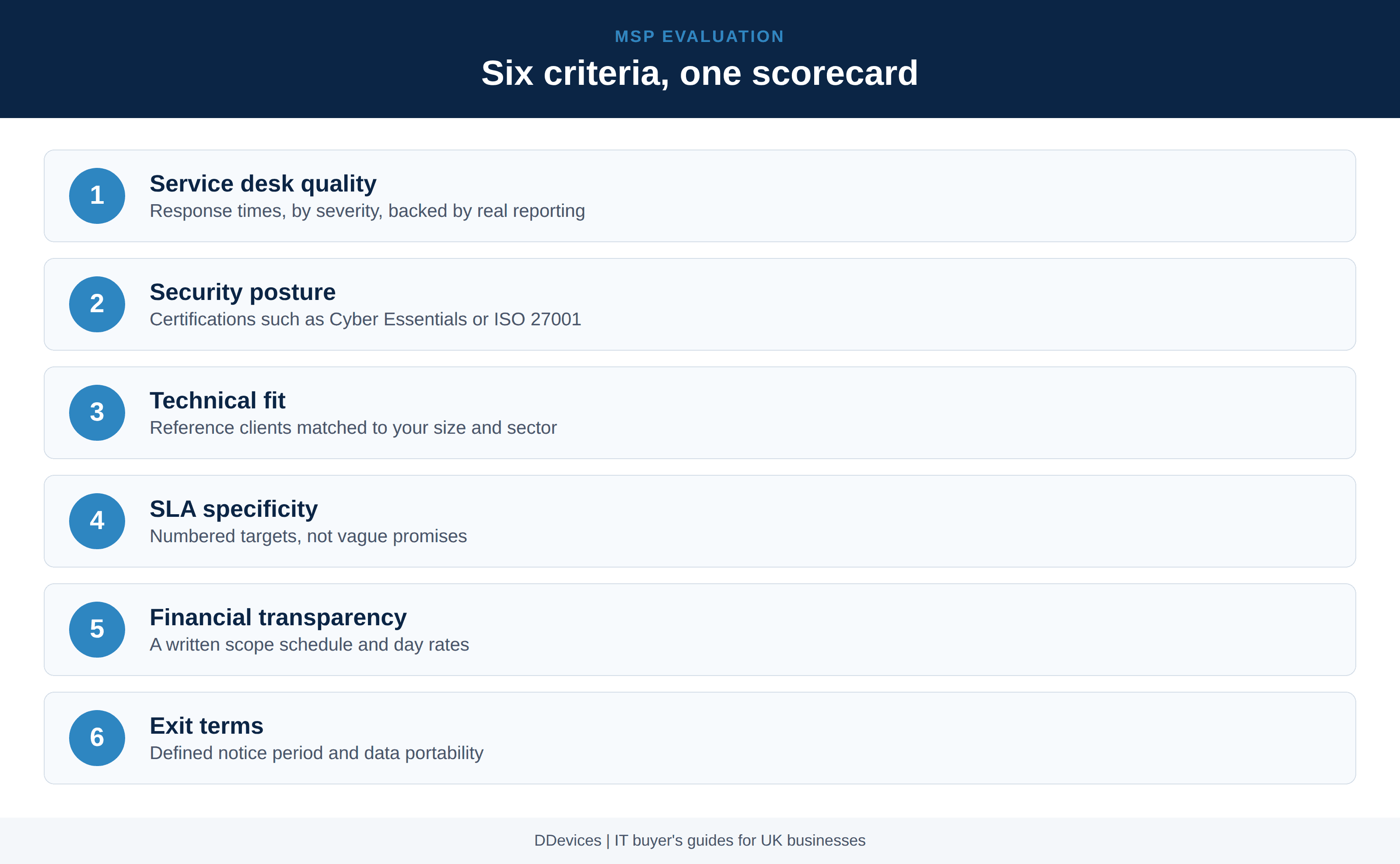
Score every provider on your shortlist against the same six criteria. It keeps the comparison objective and stops a strong sales pitch from carrying more weight than it should.
1. Service desk quality and response time
This is the part of the relationship you will feel every week. Ask for real response and resolution time data from existing clients, not a headline promise. Ask what counts as an emergency, and whether out-of-hours cover is a genuine team or an answerphone.
What good looks like. Tiered response times by severity, written into the SLA, backed by reporting the provider is willing to share before you sign.
2. Cyber security posture and certifications
A provider managing your systems should meet a higher security bar than they ask of you. Look for Cyber Essentials or Cyber Essentials Plus as a baseline, and ISO 27001 for a mature information security management system.
What good looks like. Certificates produced without being chased, a clear patch management policy, and a straight answer about how they handle your data if there is ever an incident.
3. Technical fit for your stack
A generalist provider can be a poor fit for a business built around one specific platform, a legacy application, or a regulated industry. Ask for evidence of similar clients, not just a list of vendor logos on a slide.
What good looks like. Two or three reference clients close to your size and sector, and specific, not generic, answers about how they would support your actual environment.
4. SLA specificity and accountability
A vague SLA protects the provider, not you. “We aim to respond promptly” is not a target. Look for response and resolution times by severity, and what happens if they are missed.
What good looks like. Numbered response targets by severity level, service credits or another consequence for a missed SLA, and a commitment to report performance against it.
5. Financial transparency and contract terms
Fixed-fee contracts sound simple until “out of scope” work starts appearing on invoices. Ask exactly what is included, what is billed separately, and at what rate.
What good looks like. A written scope schedule, day rates stated up front for anything outside it, and no penalty for asking to see one before you sign.
6. Exit terms and data portability
The easiest time to negotiate how you leave is before you arrive. Ask who owns your data, licences and documentation, and how a handover would work if you ever switch provider.
What good looks like. A defined notice period, written confirmation that your data and documentation are yours, and a described offboarding process, not a shrug.
What a weak choice costs
The figures below show why the selection process is worth the time it takes.
| Area | What the data shows | Source |
|---|---|---|
| Dissatisfaction | 43% of enterprises report dissatisfaction with their current MSP relationship | CloudNuro, 2026 |
| Provider capacity | 71% of MSPs say winning new customers, not service delivery, is their top challenge for 2026 | Kaseya, 2026 |
| Talent | 37% of UK and Ireland IT service providers cite talent shortages as a leading challenge | GTIA, 2026 |
| Breach rate | 43% of UK businesses identified a breach or attack in the last 12 months, rising to 69% of large businesses | GOV.UK, 2026 |
| Reliance | 73% of organisations now rely on an MSP to manage critical security needs | Situate Business Solutions, 2026 |
| Market growth | Global managed services spend is projected to grow from $401 billion in 2025 to $847 billion by 2033 | Grand View Research |
Referral, public RFP or a structured shortlist?
How you run the search shapes who ends up on it. This comparison shows where each approach tends to work best.
| Factor | Referral | Public RFP | Shortlist + scorecard |
|---|---|---|---|
| Best for | A quick decision, small estates | Complex or regulated environments | Most growing UK businesses |
| Objectivity | Depends entirely on who you ask | High, if criteria are well written | High, and faster than a full RFP |
| Time to decide | Fast, days | Slow, often 6 to 12 weeks | Moderate, 2 to 4 weeks |
| Risk | Easy to miss a better-fit provider | Process can outlast the urgency that started it | Needs discipline to score consistently |
Most growing UK businesses do best with a short list of three or four providers scored against the same criteria, rather than a single referral or a lengthy formal RFP.
Ten questions to ask every MSP on your shortlist
What is your guaranteed response time for a critical issue, by severity, and is it written into the SLA?
Can we see real reports of your response and resolution times for an existing client?
Do you hold Cyber Essentials, Cyber Essentials Plus or ISO 27001, and can we see the certificate?
Who is our named account manager, and who covers when they are unavailable?
What exactly is included in the fixed fee, and what is billed separately?
Can we speak to two or three reference clients close to our size and sector?
What does onboarding look like, and what is the timeline?
How do you keep our asset and licence records, and can we see them at any time?
What is the notice period to leave, and how is data and documentation handed over?
What happens if you miss an SLA target?
A confident, specific answer to most of these is a good sign. A vague one to more than two or three is worth a follow-up before you sign anything.
Why UK businesses choose Digital Devices
At DDevices, we make the evaluation easy to get right the first time. Our managed services team publishes clear SLAs, named account managers and real reporting from day one, backed by cyber security credentials we're happy to show you before you sign, not just after.
One partner. One record for every ticket, patch and asset. Our team listens first, then builds a plan around your goals, your budget and your compliance needs. Our procurement services and lifecycle services mean the rest of your IT estate starts on the same solid ground.
Keep reading: “Top 8 IT Procurement Challenges 2026 and How to Overcome Them” and “Why Strategic IT Procurement Is Essential for Successful Digital Transformation.”
Not sure your shortlist stacks up?
Talk to a Digital Devices specialist about what a strong MSP evaluation should look like for your business.
Conclusion
Choosing a managed service provider is a filtering exercise, not a leap of faith. Score every candidate against the same six criteria, check the warning signs before you check the price, and put the exit terms in writing before you need them.
With the managed services market projected to nearly double by 2033, there is no shortage of providers competing for your business. The businesses that choose well are the ones that make the provider prove it, before they sign, not after.
Frequently asked questions
A company that takes ongoing responsibility for some or all of a business's IT, typically covering help desk support, monitoring, cyber security, backup and strategic planning, for a fixed fee under an SLA.
Service desk quality and response times, cyber security posture and certifications, technical fit for your systems, a specific and accountable SLA, financial transparency, and clear exit terms.
At minimum, Cyber Essentials. Cyber Essentials Plus or ISO 27001 signal a more mature security practice, and a credible provider will produce the certificate without being chased.
Three or four, scored against the same written criteria. Fewer risks missing a better-fit provider, and more tends to slow the decision without improving it.
A vague answer to a direct question, especially on response times, certifications or exit terms. A confident, specific answer is easy to give when the capability is actually there.
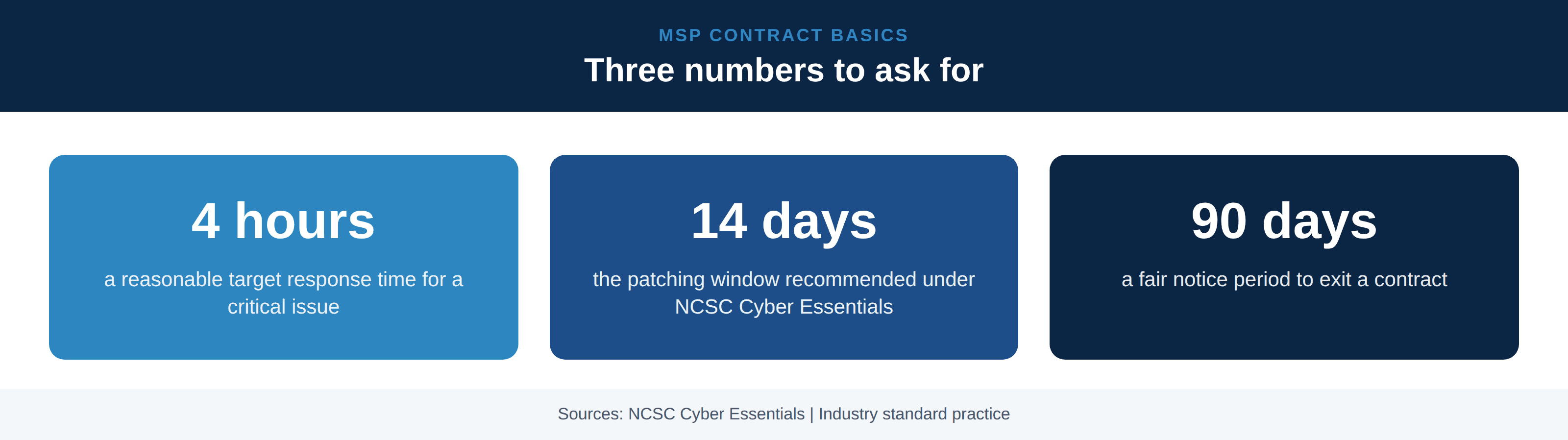
Many UK businesses use an initial 12 to 36 month term with a 90-day notice period to leave. Whatever the length, confirm in writing that your data, licences and documentation remain yours if you go.