
What Are the Benefits of Managed IT Services? A Complete Guide for UK Businesses
Technology should be the part of your business that just works. For many teams it is the part that breaks at the worst moment, and the fix waits for whoever is free.
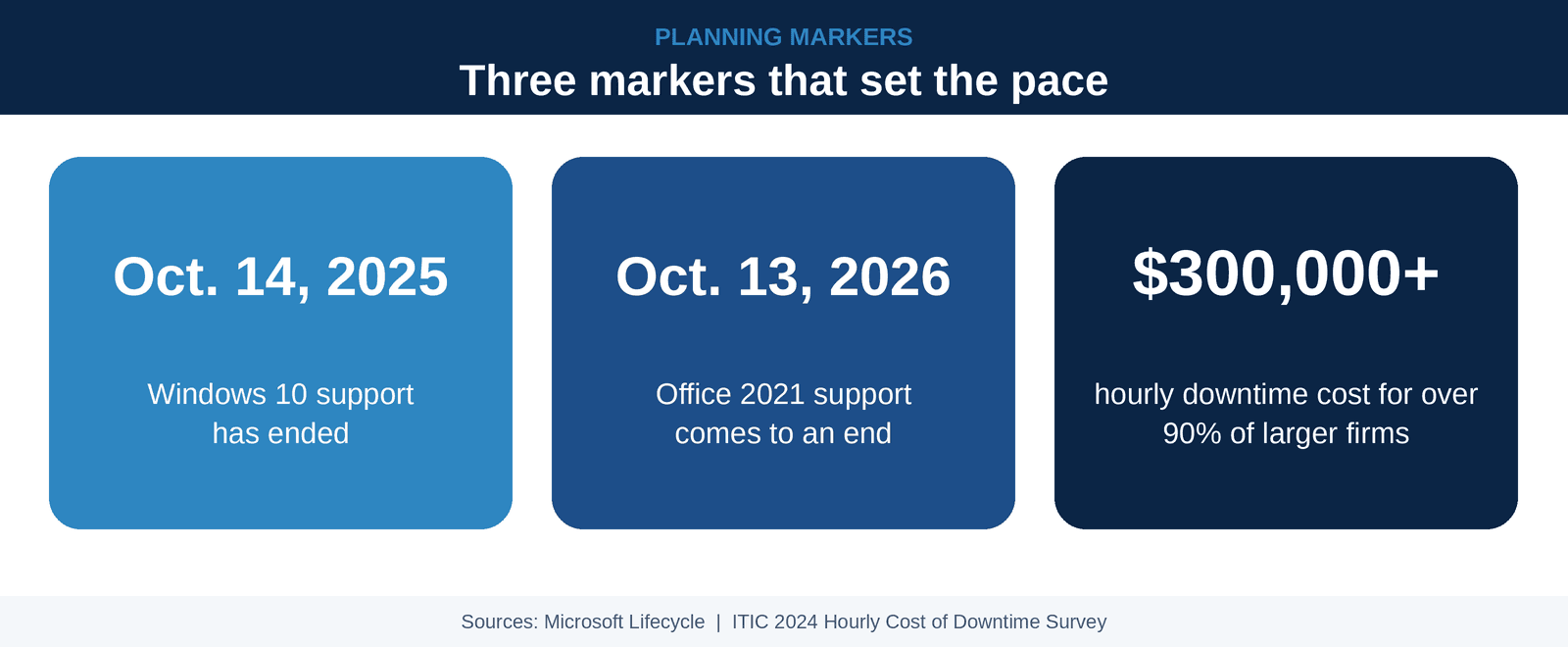
The pressure is rising. Support for Windows 10 ended on Oct. 14, 2025, and Office 2021 loses support on Oct. 13, 2026, according to Microsoft. Meanwhile the UK government's latest survey found that 43% of businesses identified a breach or attack in the past year.
This guide explains what managed IT services are, the six business benefits they deliver and how to choose the right partner.
What are managed IT services?
Managed IT services mean a specialist provider runs, monitors and supports your technology for a fixed monthly fee. That usually covers help desk support, device and network management, patching, security, backup and cloud, with a named team behind it.
Three terms often get mixed up. Break-fix support is paid for when something goes wrong. Managed IT services are ongoing and proactive, with issues found and fixed before they cause an outage. Co-managed IT means a provider supports your in-house team rather than replacing it.
It helps to picture a car. Break-fix is the garage you call when the engine cuts out. Managed IT is the service plan that stops it cutting out. Both get you moving again, but only one keeps you from stopping in the first place.
Why managed IT matters more in 2026
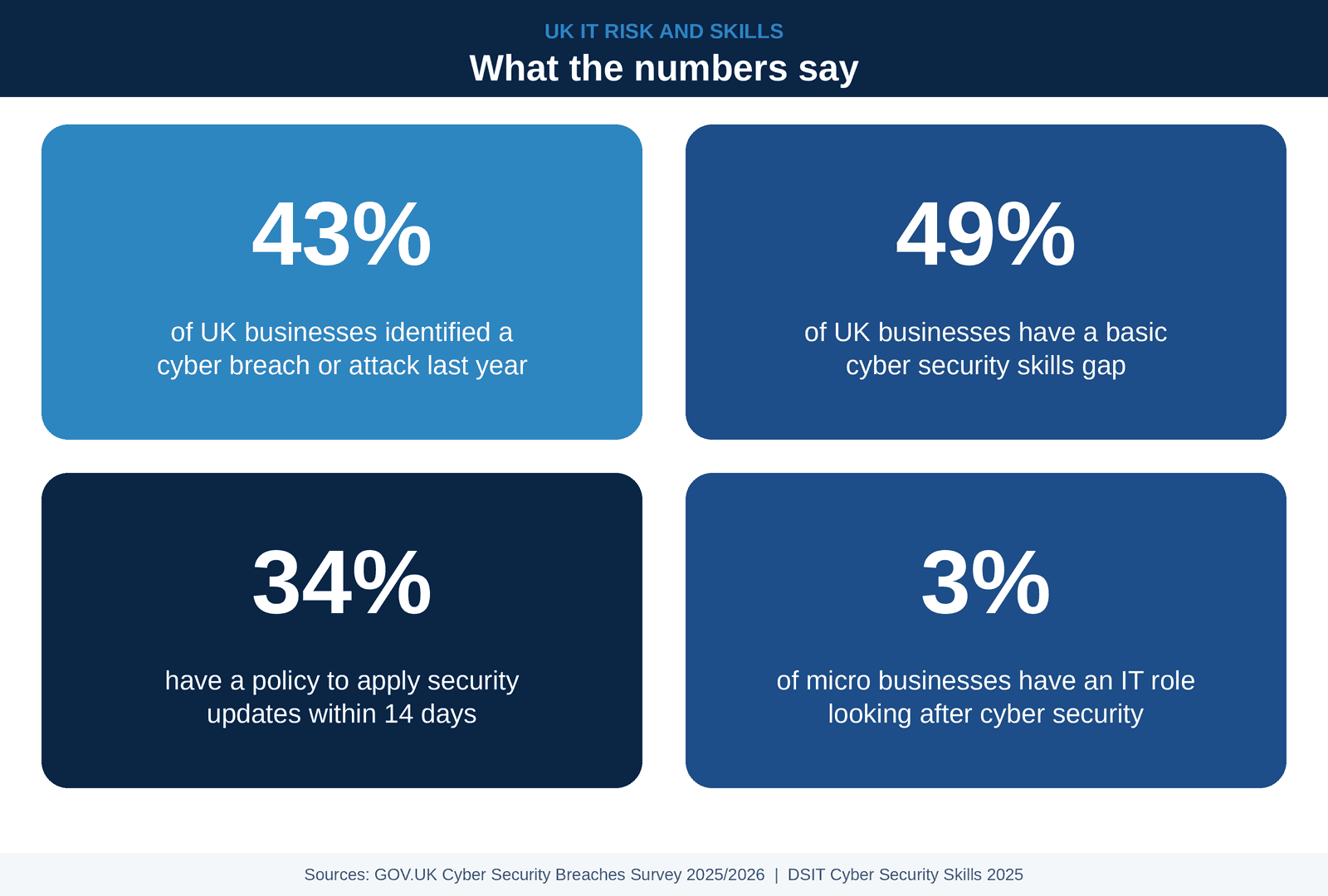
The threat is common and the skills to handle it are scarce. In the Cyber Security Breaches Survey 2025/2026, 43% of businesses identified a breach or attack, rising to 65% of medium and 69% of large businesses. Yet just 3% of micro businesses had someone in an IT role looking after cyber security.
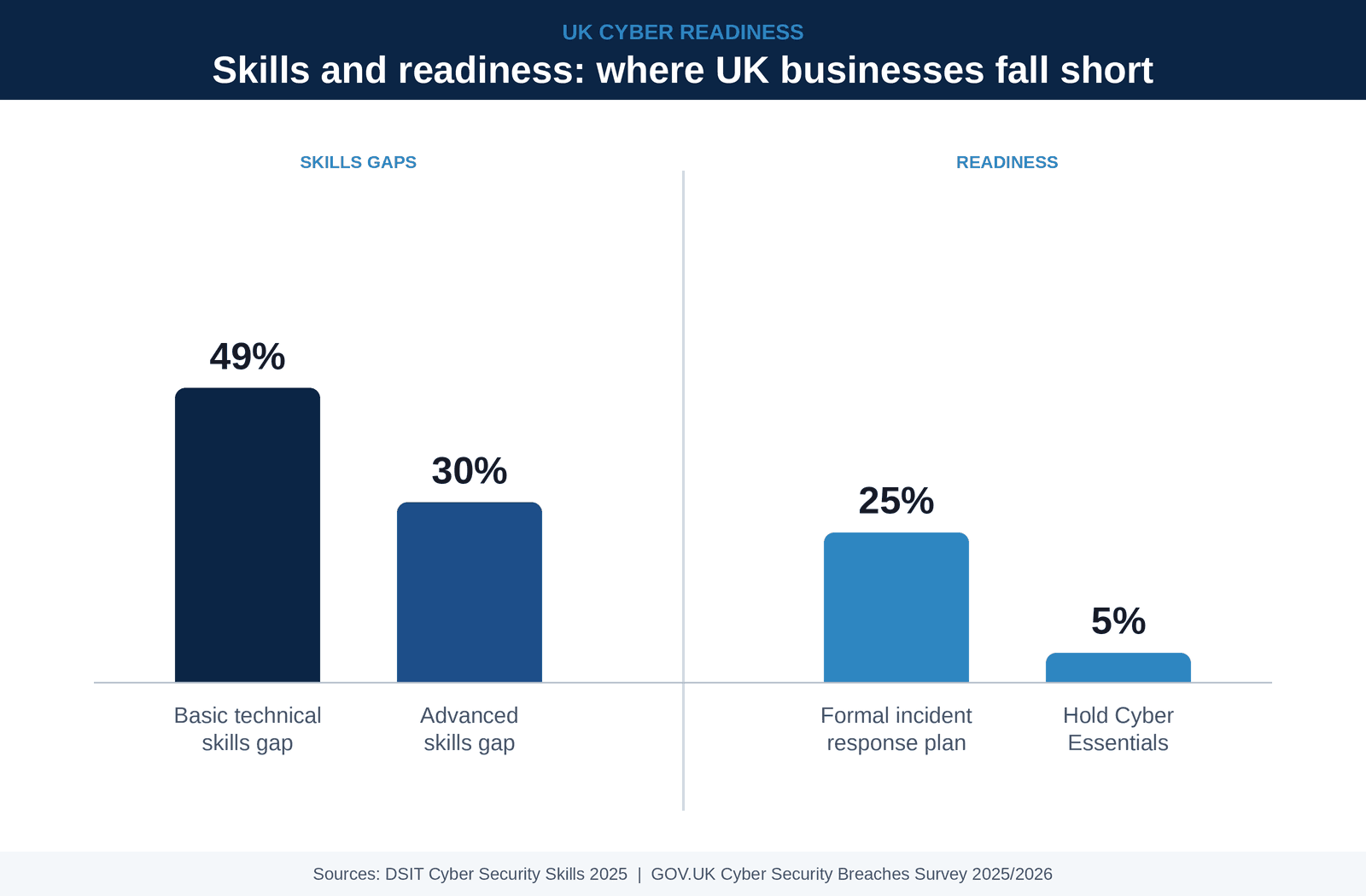
Government labour market research found that 49% of UK businesses have a basic cyber security skills gap and 30% have a gap in advanced skills, according to DSIT's 2025 report. Basics slip as a result: only 34% of businesses have a policy to apply security updates within 14 days, and only 25% have a formal incident response plan.
Downtime is the other cost. ITIC's 2024 survey of over 1,000 firms found that one hour of downtime costs more than $300,000 for over 90% of mid-size and large enterprises. Those are self-reported estimates from larger firms, so treat them as a guide, but the principle applies at any size: the less you can afford to be offline, the more it pays to have someone watching.
Deadlines add pressure. Windows 10 support has ended, and Office 2021 follows on Oct. 13, 2026 with no extended security updates. A managed provider keeps the calendar, so each date is a planned project instead of an emergency.
The six business benefits of managed IT services
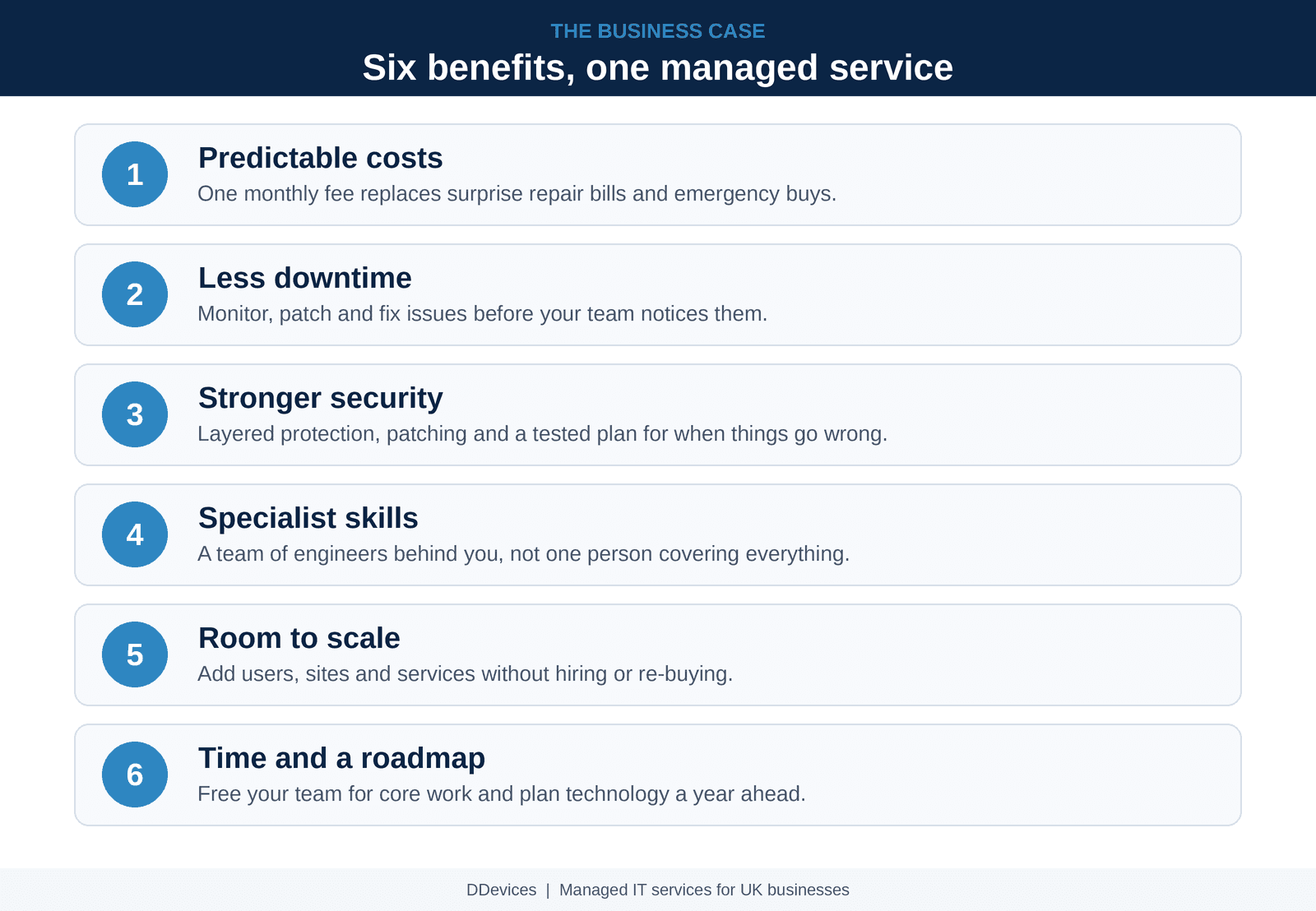
Every managed IT service is built to deliver the same six benefits. Good providers make each one visible, measured and reported.
1. Predictable costs
A fixed monthly fee replaces surprise repair bills and emergency purchases, so IT becomes a line you can budget for. Managed services can cost less than a full in-house team, but the real gain is predictability, and the saving depends on what you have today.
What to look for. A clear scope, a price per user or device and a written list of what falls outside the fee.
2. Less downtime
Monitoring tools spot failing disks, full servers and stalled updates before staff notice. A support desk then fixes many issues remotely, often within minutes. Less time offline protects revenue and morale, and ITIC's figures show what an hour is worth to larger firms.
What to look for. Written response and resolution targets, out-of-hours monitoring and a monthly report showing what was found and fixed.
3. Stronger security and compliance
Security is where the gap is widest. Only 34% of businesses have a 14-day update policy, and only 5% hold Cyber Essentials, the government-backed scheme built around five basic technical controls. A managed provider applies patches on a schedule, manages malware protection and access controls, and keeps the evidence customers, insurers and auditors ask for.
What to look for. Cyber Essentials Plus or ISO 27001 for the provider itself, tested backups and a written incident response plan. Our cyber security team works alongside managed services for exactly this reason.
4. Specialist skills on tap
One in-house generalist cannot cover networks, cloud, security and helpdesk. With 49% of UK businesses reporting a basic skills gap, buying a team is often easier than hiring one. You get engineers with different specialities, cover for holidays and sickness, and expertise on hand when something unusual breaks.
What to look for. A named contact, engineers who know your setup and support based in the UK.
5. Room to scale
New starters, a second site or a merger should not mean a new IT project. Managed services scale up and down with your headcount, and co-managed options let your own team keep control of what matters most to them.
What to look for. Simple onboarding and offboarding, flexible contract terms and pricing that moves with your user numbers.
6. Time back and a technology roadmap
When IT runs itself, your people stop being the helpdesk. A good provider also plans ahead: refresh cycles, licence renewals and end-of-support dates such as Office 2021 all go on one roadmap. Many businesses link this to IT lifecycle services and consulting for a single plan.
Ask for a quarterly review. A provider that only reacts is break-fix with a monthly invoice.
What going without managed IT can cost
Most breaches are cheap. The median cost of the most disruptive breach was £0, according to the government's survey. The risk sits in the tail: the share of businesses reporting that a breach led to lost revenue or share value rose from 2% to 5%, and reputational damage from 1% to 3%. The figures below show where the exposure sits when nobody is watching.
| Area | What the data shows | Source |
|---|---|---|
| Breach exposure | 43% of UK businesses identified a breach or attack, including 69% of large and 65% of medium businesses | GOV.UK, 2026 |
| Business impact | Businesses reporting lost revenue or share value after a breach rose from 2% to 5% | GOV.UK, 2026 |
| Patching | Only 34% have a policy to apply security updates within 14 days | GOV.UK, 2026 |
| Skills | 49% have a basic cyber security skills gap | DSIT, 2025 |
| Preparedness | Only 25% have a formal incident response plan | GOV.UK, 2026 |
| Downtime | Over 90% of mid-size and large firms put one hour of downtime above $300,000 | ITIC, 2024 |
In-house, managed or co-managed?
No single model fits every business. This comparison shows where each one works best.
| Factor | In-house team | Managed IT | Co-managed |
|---|---|---|---|
| Best for | Larger estates with steady demand | Small and mid-size firms without an IT team | Growing firms with a small IT team |
| Coverage | Working hours unless you fund shifts | Helpdesk and monitoring as set by contract | Partner covers gaps and out-of-hours |
| Skills | Deep knowledge of your business, narrow range | Wide range of specialists | Your knowledge plus partner specialists |
| Control | Full control, full responsibility | Provider runs day to day, you set direction | Shared, agreed by area |
| Cost pattern | Salaries, tools and training | Fixed fee tied to scope | Split between the two |
Co-managed suits teams that want to keep control but need cover and specialist skills. Keep strategy and decisions in-house and hand the repeatable work to a partner.
How to choose a managed IT services provider
Ask every provider these six questions before you sign:
- Do you cover support, security, cloud and hardware, or only one of them?
- What are your response and resolution targets, and what happens if you miss them?
- Can you show independent proof of security, such as Cyber Essentials Plus or ISO 27001?
- Who is my named contact, and where is support based?
- What is included in the fixed fee, and what costs extra?
- What happens at the end of the contract, and who holds our data, documents and passwords?
If a provider cannot answer clearly, keep looking.
Why UK businesses choose DDevices
At DDevices, we make technology the easiest part of your day, and we stay with you long after the first ticket is closed. From helpdesk and monitoring to security, cloud and hardware, our managed services simplify every layer of IT for UK businesses.
One partner. Complete IT support. Our team listens first, then builds a plan around your goals, your budget and your compliance needs. Our procurement services keep the buying side simple, so your managed service starts on solid ground. Technology moves fast. We make your next move clear.
Is your IT support keeping up with your business?
Talk to a DDevices specialist about a managed IT plan built around your goals, from helpdesk to security.
Conclusion
Managed IT services turn technology from a source of interruptions into a planned, measured part of the business. The six benefits are predictable costs, less downtime, stronger security, specialist skills, room to scale and a clear roadmap.
With Windows 10 support gone, Office 2021 following on Oct. 13, 2026 and 43% of UK businesses reporting a breach or attack, waiting is the expensive option. Businesses that choose a proactive partner stay in control of cost, security and growth.
Frequently asked questions
Managed IT services are ongoing, proactive IT support and management from a specialist provider for a fixed monthly fee. They typically cover helpdesk, monitoring, patching, security, backup and cloud.
Scope varies by provider. Most include helpdesk support, device and server management, patching, antivirus and backup. Security monitoring, cloud management and hardware supply are common add-ons, so ask for the list in writing.
Most providers charge per user or per device each month, or a tiered fee for a defined scope. Price depends on headcount, systems and service levels, so compare what is included, not just the headline number.
Break-fix means you pay when something fails. Managed IT means you pay a regular fee for monitoring and maintenance that aims to stop failures happening.
Often, yes. Smaller teams rarely have a dedicated IT role: in the government's survey, just 3% of micro businesses had someone in an IT role looking after cyber security. A managed provider fills that gap at a predictable cost.
Not necessarily. Co-managed IT keeps your team in place and adds cover, tools and specialist skills where you need them.